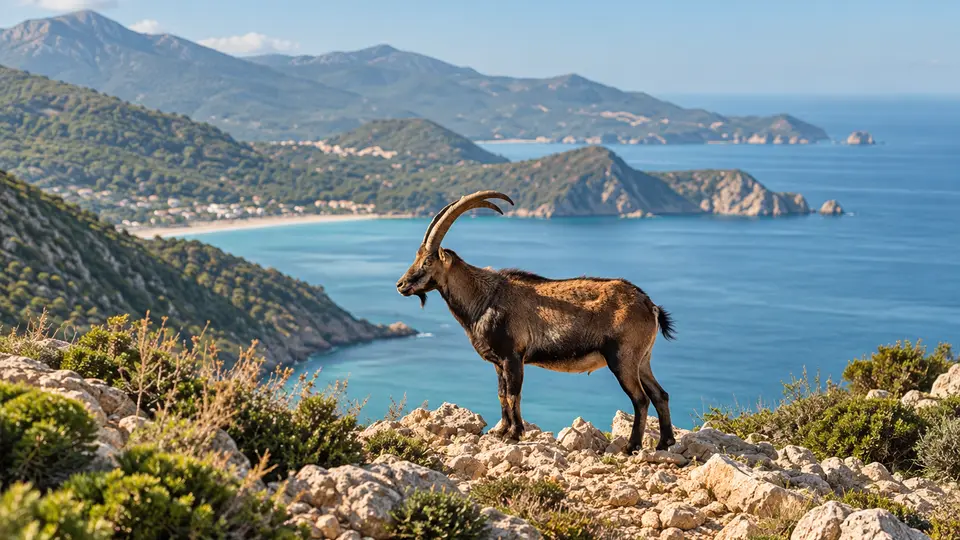
Wild Goat in its natural habitat, AI illustration

Wild GoatCapra aegagrusWhere and when to see them

Wild Goat at a glance

The wild goat, often called the bezoar goat, is a sure-footed mountain ungulate and the principal wild ancestor of domestic goats. Males carry impressive backward-curving horns and develop a dark beard and contrasting body markings. Turkey holds important populations in rugged mountain systems, including ranges near the Mediterranean coast. These are genuinely wild animals, distinct from free-ranging domestic herds, and coastal travelers usually need a dedicated mountain excursion to seek them.

Behaviour & reproduction

Size
100-150 cm head-body length
Weight
25-90 kg
Lifespan
10-15 years
Status
Check current assessment

Females and their young generally form groups, while adult males often associate separately until the rut. Goats move between feeding areas and steep escape terrain, using ledges that exclude many predators. During the mating season, males display, assess rivals and sometimes clash horns. Feeding is often concentrated in cooler hours, with resting periods on sheltered slopes. Animals disturbed by people may retreat rapidly across dangerously exposed ground. Wild goats are known for their exceptional agility and balance, capable of traversing extremely narrow ledges and steep rock faces with ease. They communicate through a variety of vocalizations, including bleats and snorts, especially when alarmed or interacting socially.

Top wildlife locations

Turkey wildlife habitat

Turkey

Rocky Taurus Mountain slopes above Mediterranean coastal districts provide suitable habitat. A guided inland mountain excursion is generally required; occupied cliffs may be inaccessible, and ordinary shore visits should not imply likely sightings.
Destinations describe the species' habitat, not guaranteed cruise stops. Some animals require an optional inland excursion or are found in restricted reserves.

Fun facts about the Wild Goat

  • Domestic goats descend primarily from populations of this species.
  • Males are substantially heavier and more strongly marked than females.
  • Both sexes have horns, although females' horns are much shorter.
  • The name bezoar refers to digestive concretions once prized in traditional medicine.

Best time to see the Wild Goat

Spring and autumn usually offer the most comfortable conditions for mountain observation in southern Turkey. The rut generally occurs in late autumn and early winter, with regional variation. Snow, heat, protected-area rules and road conditions can be more important than calendar dates. Early morning and late afternoon are generally the most productive times for viewing as goats are more active during these cooler periods. Be aware that the timing of the rut can vary based on local conditions and food availability, sometimes extending into early winter.

Wild Goat: season matrix by destination

Travel and observation windows vary by region. Highlighted months are an orientation for planning, not confirmed sightings or a guarantee of access.

Turkey

These are practical mountain-travel months at many lower and middle elevations; local snow, heat and access rules vary, and rut timing is separate.

JanFebMarAprMayJunJulAugSepOctNovDec
Cruise ships in Turkey

Where the Wild Goat lives

Wild goats favor steep rocky mountains, cliffs, ravines and broken slopes with adjacent scrub or open woodland. They occur across a broad elevation range. In southern Turkey, suitable terrain may rise near the coast, but occupied cliffs are frequently inaccessible. Wild goats often utilize caves or overhangs for shelter during harsh weather or as resting sites. Their preference for rugged terrain provides a natural defense against predators and human disturbance, making specific areas ecological refugia.

What the Wild Goat eats

They browse shrubs and tree shoots and graze grasses and other herbaceous plants. Seasonal availability determines the balance between browse and grazing. Their ability to use sparse vegetation on rocky slopes helps them occupy terrain less accessible to many larger herbivores. In addition to plant matter, goats may gnaw on bones, antlers, or mineral licks to supplement their diet with essential minerals like calcium and phosphorus. This osteophagia is particularly common in mineral-deficient areas.

Species at a glance

Common name
Wild Goat
Scientific name
Capra aegagrus
Animal group
Mammals
Size
100-150 cm head-body length
Weight
25-90 kg
Lifespan
10-15 years
Status
Check current assessment
Identification
Males have long, scimitar-shaped horns with a sharp front edge, unlike the more heavily knotted horns of many ibex species. Females (nannies) have significantly shorter, more slender horns that are less curved than those of males. Kids are identifiable by their smaller size and often lighter, unpatterned coats compared to adults.

Wild Goat: frequently asked questions

Where can I see the Wild Goat?
Turkey. Scan distant cliffs with a telescope from authorized trails or safe viewpoints. Do not pursue goats onto ledges, stand beneath unstable slopes, or approach females with kids; allow animals an unobstructed retreat. During shore excursions, look for signs such as droppings, hair snagged on bushes, or well-worn trails indicating goat presence. Use binoculars to scan ledges and slopes for movement before focusing a telescope for detailed observation.
When is the best time to see the Wild Goat?
Spring and autumn usually offer the most comfortable conditions for mountain observation in southern Turkey. The rut generally occurs in late autumn and early winter, with regional variation. Snow, heat, protected-area rules and road conditions can be more important than calendar dates. Early morning and late afternoon are generally the most productive times for viewing as goats are more active during these cooler periods. Be aware that the timing of the rut can vary based on local conditions and food availability, sometimes extending into early winter.
How big does the Wild Goat get?
100-150 cm head-body length. Adult weight: 25-90 kg. Size varies with age, sex and population.
How should I behave around the Wild Goat?
Scan distant cliffs with a telescope from authorized trails or safe viewpoints. Do not pursue goats onto ledges, stand beneath unstable slopes, or approach females with kids; allow animals an unobstructed retreat. During shore excursions, look for signs such as droppings, hair snagged on bushes, or well-worn trails indicating goat presence. Use binoculars to scan ledges and slopes for movement before focusing a telescope for detailed observation.
What does the Wild Goat eat?
They browse shrubs and tree shoots and graze grasses and other herbaceous plants. Seasonal availability determines the balance between browse and grazing. Their ability to use sparse vegetation on rocky slopes helps them occupy terrain less accessible to many larger herbivores. In addition to plant matter, goats may gnaw on bones, antlers, or mineral licks to supplement their diet with essential minerals like calcium and phosphorus. This osteophagia is particularly common in mineral-deficient areas.
Are wildlife sightings guaranteed on an adventure cruise?
No. Animals move freely and routes, weather, access restrictions and local conditions influence every outing. Confirm the actual itinerary and shore program before booking.

Compare wildlife in the same destinations

Explore other mammals recorded in these destinations. Similar surroundings do not mean the animals share the same habits or viewing season.

Species comparison by animal group and destination
Wild GoatWild GoatBrown BearBrown BearCaracalCaracal
Animal groupMammalsAnimal groupMammalsAnimal groupMammals
DestinationsTurkeyDestinationsTurkeyDestinationsTurkey
All wildlife destinations
Plan your trip

Find your next wildlife adventure

Compare destinations, shore programs and dates with the animals and habitats you would love to see.

  • Naturalist-led shore excursions
  • Responsible wildlife watching
  • Small expedition ships

Newsletter

Take Blue Rides with you

Adventure cruise offers, last-minute deals and trip inspiration.

Free, unsubscribe anytime. Details: Privacy Policy

Partner with Blue Rides

Affiliate Program

Recommend adventure cruises and earn commission on every confirmed booking.

Share. Track. Earn.

Your footage, our stage

Send us your videos or pictures.

Captured remarkable nature or wildlife on your journey? Share it with us, we may feature it on Blue Rides.