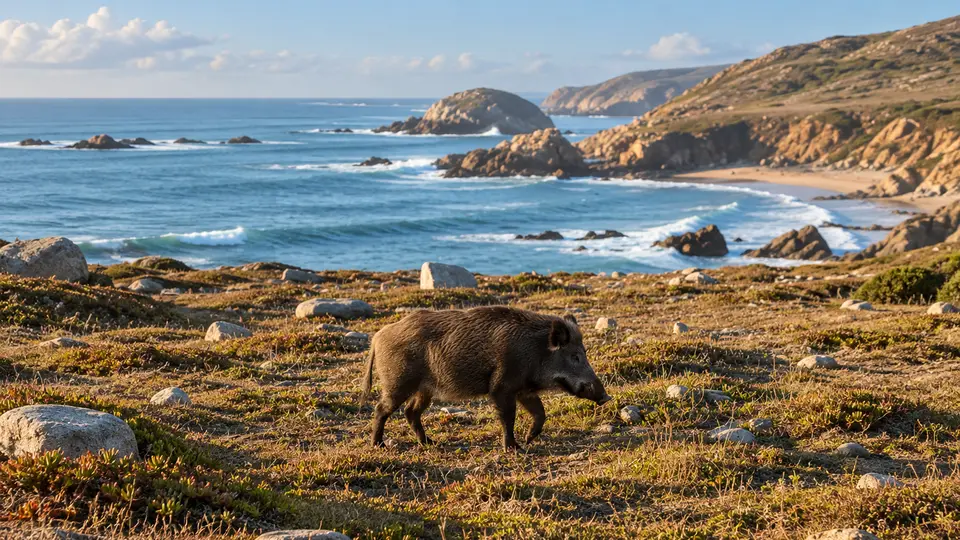
Wild Boar in its natural habitat, AI illustration

Wild BoarSus scrofaWhere and when to see them

Wild Boar at a glance

The wild boar is the wild ancestor of domestic pigs and a highly adaptable native mammal across much of Europe and Asia. Its muscular shoulders, elongated snout and coarse coat suit a life of rooting through soil and dense vegetation. Both Croatia and Portugal support populations, although visitors more often notice churned ground, tracks or wallows than the animals themselves. Coastal woodland can be occupied, but sightings are usually incidental.

Behaviour & reproduction

Size
90-180 cm head-body length
Weight
40-150 kg
Lifespan
8-15 years
Status
Least Concern

Females and young commonly live in social groups called sounders, while mature males tend to be more solitary outside the mating period. Boar use a strong sense of smell to find buried food and communicate through grunts, scent and body posture. Where people are active, they often become predominantly nocturnal. Mothers defend small piglets, and any animal surprised at close range may react forcefully if its escape route is blocked. Wild boar communicate complex social information through a variety of calls, including grunts, squeals, and alarm snorts. They are excellent swimmers and may cross rivers or even short stretches of open water. During the rut (mating season), mature males can be particularly aggressive and territorial.

Top wildlife locations

Croatia wildlife habitat

Croatia

Coastal scrub and woodland behind the Adriatic shore can hold boar, but daylight sightings are uncommon. An inland woodland excursion may improve habitat access; check local hunting notices before using forest trails.

Portugal wildlife habitat

Portugal

Woodland, cork-oak landscapes and dense scrub behind coastal districts provide potential habitat. Boar are elusive and often nocturnal, so an inland excursion is usually more realistic than expecting sightings from beaches.

Destinations describe the species' habitat, not guaranteed cruise stops. Some animals require an optional inland excursion or are found in restricted reserves.

Fun facts about the Wild Boar

  • Young piglets have pale longitudinal stripes that fade as they grow.
  • The snout contains a specialized bone that helps support powerful rooting.
  • Both sexes have canine tusks, but males usually develop the largest.
  • Mud wallows help with cooling and skin care because pigs have limited effective sweating.

Best time to see the Wild Boar

There is no dependable coastal viewing season. Spring and autumn generally provide comfortable walking conditions in Croatia and Portugal, while activity is often concentrated around dusk or night. Hunting schedules, drought and local disturbance can strongly alter movements and public access. Early morning and late evening are often the most productive viewing times as boar emerge from cover to feed. During dry periods, water sources become key focal points for observation. Local park rangers or guides can offer updated information on recent sightings and predictable areas of activity.

Wild Boar: season matrix by destination

Travel and observation windows vary by region. Highlighted months are an orientation for planning, not confirmed sightings or a guarantee of access.

Croatia

These months suit walking in suitable habitat, not a predictable boar appearance or breeding period; local hunting and weather affect access.

JanFebMarAprMayJunJulAugSepOctNovDec
Cruise ships in Croatia

Portugal

Spring and autumn generally avoid peak summer heat; this is a habitat-visiting window, with no reliable seasonal guarantee of visible animals.

JanFebMarAprMayJunJulAugSepOctNovDec
Cruise ships in Portugal

Where the Wild Boar lives

Wild boar occupy deciduous and mixed woodland, Mediterranean scrub, wetlands and agricultural mosaics. Dense daytime cover and access to water are important. Coastal forests may support them, but many reliable signs occur farther inland along muddy tracks and woodland edges. In Croatia, they are widespread, inhabiting the Dinaric Alps, coastal regions, and lowlands. In Portugal, they thrive in oak forests and areas with Mediterranean scrub, especially in the central and southern parts. Their adaptable nature allows them to persist close to human settlements if sufficient cover and resources are available.

What the Wild Boar eats

An opportunistic omnivore, the wild boar eats roots, bulbs, acorns, fruits, crops and fungi, along with worms, insects, carrion and occasional small vertebrates. Its rooting redistributes soil and leaf litter, creating feeding opportunities for some organisms while disturbing vegetation and ground nests. A significant part of their diet includes acorns and chestnuts, particularly in autumn, influencing their distribution in oak and chestnut woodlands. Their rooting behavior can also spread seeds of native and invasive plant species. While highly adaptable, prolonged periods of snow cover can restrict access to buried food, impacting survival.

Species at a glance

Common name
Wild Boar
Scientific name
Sus scrofa
Animal group
Mammals
Size
90-180 cm head-body length
Weight
40-150 kg
Lifespan
8-15 years
Status
Least Concern
Identification
A long straight snout, high shoulders and coarse bristles distinguish typical wild boar from most domestic pigs, although hybrids can blur these differences. Adult males (boars) can be significantly larger than females (sows), often weighing over 100 kg with visible tusks. Piglets typically have characteristic longitudinal stripes that fade as they mature, usually by 4-6 months of age. The overall body shape is robust and compact, with relatively short legs.

Wild Boar: frequently asked questions

Where can I see the Wild Boar?
Croatia, Portugal. Use broad woodland paths in daylight and watch for fresh rooting without following animals into cover. Keep dogs leashed, never feed boar, and retreat calmly if piglets appear or an adult blocks the path. Look for distinctive muddy wallows and rub marks on trees, indicating their presence and activity. Binoculars are useful for observing from a safe distance, especially when animals are partially obscured by vegetation. If encountered, avoid making sudden movements or loud noises to prevent startling them.
When is the best time to see the Wild Boar?
There is no dependable coastal viewing season. Spring and autumn generally provide comfortable walking conditions in Croatia and Portugal, while activity is often concentrated around dusk or night. Hunting schedules, drought and local disturbance can strongly alter movements and public access. Early morning and late evening are often the most productive viewing times as boar emerge from cover to feed. During dry periods, water sources become key focal points for observation. Local park rangers or guides can offer updated information on recent sightings and predictable areas of activity.
How big does the Wild Boar get?
90-180 cm head-body length. Adult weight: 40-150 kg. Size varies with age, sex and population.
How should I behave around the Wild Boar?
Use broad woodland paths in daylight and watch for fresh rooting without following animals into cover. Keep dogs leashed, never feed boar, and retreat calmly if piglets appear or an adult blocks the path. Look for distinctive muddy wallows and rub marks on trees, indicating their presence and activity. Binoculars are useful for observing from a safe distance, especially when animals are partially obscured by vegetation. If encountered, avoid making sudden movements or loud noises to prevent startling them.
What does the Wild Boar eat?
An opportunistic omnivore, the wild boar eats roots, bulbs, acorns, fruits, crops and fungi, along with worms, insects, carrion and occasional small vertebrates. Its rooting redistributes soil and leaf litter, creating feeding opportunities for some organisms while disturbing vegetation and ground nests. A significant part of their diet includes acorns and chestnuts, particularly in autumn, influencing their distribution in oak and chestnut woodlands. Their rooting behavior can also spread seeds of native and invasive plant species. While highly adaptable, prolonged periods of snow cover can restrict access to buried food, impacting survival.
Are wildlife sightings guaranteed on an adventure cruise?
No. Animals move freely and routes, weather, access restrictions and local conditions influence every outing. Confirm the actual itinerary and shore program before booking.

Compare wildlife in the same destinations

Explore other mammals recorded in these destinations. Similar surroundings do not mean the animals share the same habits or viewing season.

Species comparison by animal group and destination
Wild BoarWild BoarBlue WhaleBlue WhaleCommon Bottlenose DolphinCommon Bottlenose Dolphin
Animal groupMammalsAnimal groupMammalsAnimal groupMammals
DestinationsCroatia, PortugalDestinationsMexico, Norway, Portugal, Antarctica, Arctic, Maldives, New ZealandDestinationsCosta Rica, Florida, Galapagos, Mexico, Cape Verde, Croatia, Greece, Portugal, Scotland, Seychelles, Turkey, Maldives, Australia, New Zealand
All wildlife destinations
Plan your trip

Find your next wildlife adventure

Compare destinations, shore programs and dates with the animals and habitats you would love to see.

  • Naturalist-led shore excursions
  • Responsible wildlife watching
  • Small expedition ships

Newsletter

Take Blue Rides with you

Adventure cruise offers, last-minute deals and trip inspiration.

Free, unsubscribe anytime. Details: Privacy Policy

Partner with Blue Rides

Affiliate Program

Recommend adventure cruises and earn commission on every confirmed booking.

Share. Track. Earn.

Your footage, our stage

Send us your videos or pictures.

Captured remarkable nature or wildlife on your journey? Share it with us, we may feature it on Blue Rides.