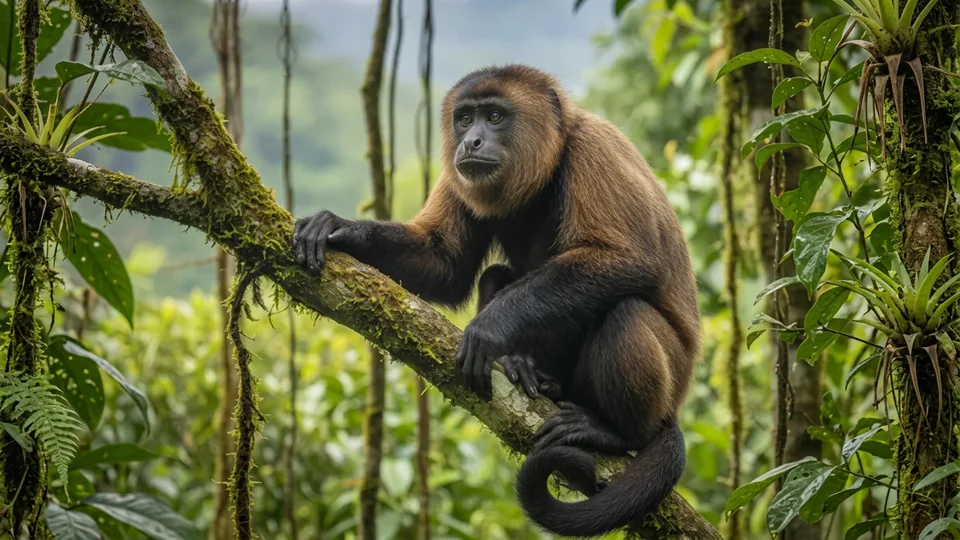
Mantled Howler in its natural habitat, AI illustration

Mantled HowlerAlouatta palliataWhere and when to see them

Mantled Howler at a glance

The mantled howler is one of Central America’s most recognizable forest mammals, known for calls that can carry far beyond the animal producing them. Mostly black fur contrasts with a fringe of longer golden-brown hair along the flanks. In Costa Rica, groups occupy both extensive forests and some wooded fragments. Their tolerance of disturbed habitat does not remove their dependence on connected trees and reliable food supplies.

Behaviour & reproduction

Size
45–65 cm head-body length
Weight
3–9 kg
Lifespan
15–25 years
Status
Vulnerable

Mantled howlers spend much of the day resting, an energy-saving strategy suited to a leaf-rich diet. Groups travel through the canopy in relatively short feeding movements, using a prehensile tail for support. Loud bouts of calling, particularly around dawn, advertise presence to neighboring groups. Social groups may contain several adults of both sexes, while grooming, play and close resting help maintain relationships within the group. The guttural roars are primarily used by males to defend territory and communicate group location, reducing the need for direct confrontation. Group size can vary widely, typically ranging from 10 to 20 individuals, including multiple adult males and females.

Top wildlife locations

Costa Rica wildlife habitat

Costa Rica

Protected coastal dry forest and humid forest trails provide plausible canopy viewing. Fragmented resort woodland is less dependable, and some populations require an inland excursion; listen from paths rather than approaching occupied trees.
Destinations describe the species' habitat, not guaranteed cruise stops. Some animals require an optional inland excursion or are found in restricted reserves.

Fun facts about the Mantled Howler

  • An enlarged hyoid bone helps amplify its resonant calls.
  • A bare gripping pad beneath the tail tip improves its hold on branches.
  • Leaf fermentation helps it extract energy from fibrous plant food.
  • Both males and females can leave their birth group.

Best time to see the Mantled Howler

Howlers are resident and can be observed year-round in Costa Rica. December through April often makes Pacific forest visits easier, and reduced foliage may improve visibility in dry forest. Early morning is usually more useful than choosing a particular month. While generally active at dawn, howlers can also be heard calling throughout the day, especially if groups are interacting or disturbed. Binoculars are essential for observing their often-still forms high in the canopy.

Mantled Howler: season matrix by destination

Travel and observation windows vary by region. Highlighted months are an orientation for planning, not confirmed sightings or a guarantee of access.

Costa Rica

These months favor Pacific-side travel and trail access; howlers are resident, and this is not a breeding-season or sighting guarantee.

JanFebMarAprMayJunJulAugSepOctNovDec
Cruise ships in Costa Rica

Where the Mantled Howler lives

They inhabit tropical dry forest, humid lowland forest, riverine woodland and some secondary growth. Coastal forests can support groups where canopy connections remain intact. Roads, power lines and cleared gaps create hazards, even where monkeys persist near settlements and farms. They are often found in fragmented forests and can adapt to human-modified landscapes if sufficient tree cover and connectivity remain. Their preference for tall trees with strong branches allows them to navigate the canopy safely.

What the Mantled Howler eats

Young leaves are important, supplemented by fruit, flowers and other plant material. Food choices change with seasonal availability and tree species. Microbial fermentation helps process fibrous leaves, but digestion is slow, contributing to long resting periods between bouts of feeding. In addition to leaves, they consume petioles, bark, and even soil, likely to obtain minerals or detoxify plant compounds. Their specialized digestive system allows them to subsist on a relatively low-quality diet, which is a key to their wide distribution.

Species at a glance

Common name
Mantled Howler
Scientific name
Alouatta palliata
Animal group
Mammals
Size
45–65 cm head-body length
Weight
3–9 kg
Lifespan
15–25 years
Status
Vulnerable
Identification
The black coat with golden-brown flank fringes and heavy throat distinguishes it from Costa Rica’s slimmer spider monkeys and pale-faced capuchins. Infants and juveniles share the adult's dark coat but may have less developed golden fringing on their flanks. Adult males are generally larger and have a more prominent throat sac compared to females.

Mantled Howler: frequently asked questions

Where can I see the Mantled Howler?
Costa Rica. Listen from established forest paths and scan the canopy without standing directly beneath a group. Never feed or imitate calls to provoke a response. Give monkeys space, secure food, and avoid touching vegetation near hazardous power lines. When observing, look for a dark, bulky silhouette and listen for their characteristic deep, guttural roars which can carry for several kilometers. Avoid shining bright lights on them at night, as this can disrupt their natural behaviors.
When is the best time to see the Mantled Howler?
Howlers are resident and can be observed year-round in Costa Rica. December through April often makes Pacific forest visits easier, and reduced foliage may improve visibility in dry forest. Early morning is usually more useful than choosing a particular month. While generally active at dawn, howlers can also be heard calling throughout the day, especially if groups are interacting or disturbed. Binoculars are essential for observing their often-still forms high in the canopy.
How big does the Mantled Howler get?
45–65 cm head-body length. Adult weight: 3–9 kg. Size varies with age, sex and population.
How should I behave around the Mantled Howler?
Listen from established forest paths and scan the canopy without standing directly beneath a group. Never feed or imitate calls to provoke a response. Give monkeys space, secure food, and avoid touching vegetation near hazardous power lines. When observing, look for a dark, bulky silhouette and listen for their characteristic deep, guttural roars which can carry for several kilometers. Avoid shining bright lights on them at night, as this can disrupt their natural behaviors.
What does the Mantled Howler eat?
Young leaves are important, supplemented by fruit, flowers and other plant material. Food choices change with seasonal availability and tree species. Microbial fermentation helps process fibrous leaves, but digestion is slow, contributing to long resting periods between bouts of feeding. In addition to leaves, they consume petioles, bark, and even soil, likely to obtain minerals or detoxify plant compounds. Their specialized digestive system allows them to subsist on a relatively low-quality diet, which is a key to their wide distribution.
Are wildlife sightings guaranteed on an adventure cruise?
No. Animals move freely and routes, weather, access restrictions and local conditions influence every outing. Confirm the actual itinerary and shore program before booking.

Compare wildlife in the same destinations

Explore other mammals recorded in these destinations. Similar surroundings do not mean the animals share the same habits or viewing season.

Species comparison by animal group and destination
Mantled HowlerMantled HowlerBrown-throated SlothBrown-throated SlothCentral American Squirrel MonkeyCentral American Squirrel Monkey
Animal groupMammalsAnimal groupMammalsAnimal groupMammals
DestinationsCosta RicaDestinationsCosta RicaDestinationsCosta Rica
All wildlife destinations
Plan your trip

Find your next wildlife adventure

Compare destinations, shore programs and dates with the animals and habitats you would love to see.

  • Naturalist-led shore excursions
  • Responsible wildlife watching
  • Small expedition ships

Newsletter

Take Blue Rides with you

Adventure cruise offers, last-minute deals and trip inspiration.

Free, unsubscribe anytime. Details: Privacy Policy

Partner with Blue Rides

Affiliate Program

Recommend adventure cruises and earn commission on every confirmed booking.

Share. Track. Earn.

Your footage, our stage

Send us your videos or pictures.

Captured remarkable nature or wildlife on your journey? Share it with us, we may feature it on Blue Rides.