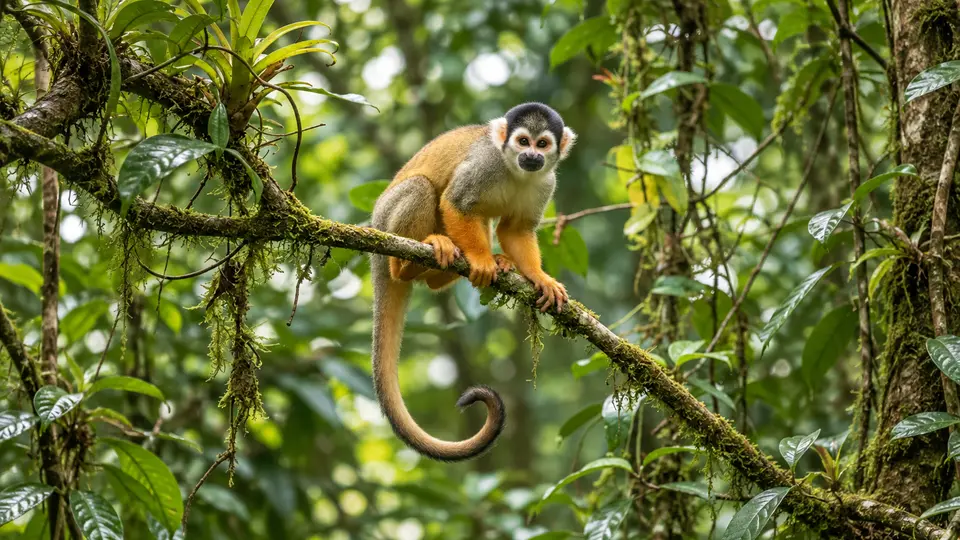
Central American Squirrel Monkey in its natural habitat

Central American Squirrel MonkeySaimiri oerstediiWhere and when to see them

Central American Squirrel Monkey at a glance

The Central American squirrel monkey is a small, agile primate restricted to parts of Costa Rica and Panama. Its pale face, dark muzzle and orange-toned limbs make it distinctive among the region's monkeys. Populations depend on connected forest and are vulnerable to habitat fragmentation, roads and electrical infrastructure. In Costa Rica it is associated with the Pacific lowlands, not the entire country, so itinerary location matters greatly when considering a responsible forest excursion.

Behaviour & reproduction

Size
25-32 cm head-body length; 33-41 cm tail
Weight
0.55-1.1 kg
Lifespan
Not reliably established
Status
Check current assessment

These monkeys travel in active social groups, searching foliage and branches for insects and fruit. Their movements can be quick and coordinated, with frequent calls helping maintain contact through vegetation. Unlike capuchins, they do not use the tail as a grasping fifth limb. Reproduction is seasonal, and births within a group are often closely synchronised. Young initially cling to their mothers while adults continue moving through a complex network of branches. Squirrel monkeys exhibit a fission-fusion social structure, where larger groups may temporarily split into smaller foraging parties throughout the day. These agile arborealists spend most of their time in the mid to upper canopy, moving quadrupedally and leaping between branches.

Top wildlife locations

Costa Rica wildlife habitat

Costa Rica

Authorised trails in suitable central and southern Pacific coastal forests offer plausible viewing habitat. A guided land excursion is required rather than deck observation, and fragmented distribution means many otherwise suitable forests lack this monkey.
Destinations describe the species' habitat, not guaranteed cruise stops. Some animals require an optional inland excursion or are found in restricted reserves.

Fun facts about the Central American Squirrel Monkey

  • Its natural range is confined to Costa Rica and Panama.
  • Its long tail aids balance but is not prehensile.
  • Births within a troop can cluster into a short seasonal period.
  • Its historical scientific placement with South American squirrel monkeys obscured its distinct regional identity.

Best time to see the Central American Squirrel Monkey

December through April usually offers easier walking conditions in Pacific Costa Rica, although monkeys remain active year-round. Rainy-season visits are also possible where trails operate safely. This travel window is not a promise of group encounters or a universal birth-season calendar. While active year-round, the dry season (December-April) in Pacific Costa Rica offers clearer forest understory visibility and reduced rainfall, potentially enhancing viewing opportunities. Their daily activity patterns typically peak in the morning and late afternoon.

Central American Squirrel Monkey: season matrix by destination

Travel and observation windows vary by region. Highlighted months are an orientation for planning, not confirmed sightings or a guarantee of access.

Costa Rica

These months mainly reflect generally drier Pacific-side trail conditions; monkeys are active year-round and sightings depend on local troop movements.

JanFebMarAprMayJunJulAugSepOctNovDec
Cruise ships in Costa Rica

Where the Central American Squirrel Monkey lives

Lowland tropical forest, secondary woodland, forest edges and connected riparian corridors provide habitat. Structurally varied vegetation can support abundant insect prey, but isolated fragments create risks. In Costa Rica, suitable Pacific coastal forests may be reached on authorised terrestrial trails. This species has a restricted range in the Pacific lowlands of Costa Rica and a small portion of Panama, often preferring areas near water sources. They are particularly vulnerable to habitat fragmentation due to their reliance on continuous canopy cover for foraging and travel.

What the Central American Squirrel Monkey eats

Insects and other small arthropods are central foods, supplemented by ripe fruit and occasional small vertebrates or other plant resources. Individuals inspect leaves, twigs and crevices while travelling. Seasonal fruit crops and insect abundance influence where a group feeds. Larval insects, spiders, and other small invertebrates form a significant portion of their diet, which they meticulously glean from leaves and bark. They also consume nectar and flowers from various plant species, contributing to pollination.

Species at a glance

Common name
Central American Squirrel Monkey
Scientific name
Saimiri oerstedii
Animal group
Mammals
Size
25-32 cm head-body length; 33-41 cm tail
Weight
0.55-1.1 kg
Lifespan
Not reliably established
Status
Check current assessment
Identification
Its small body, white facial mask, dark muzzle and orange limbs distinguish it from the larger capuchins, howlers and spider monkeys of Costa Rica. Their bright yellow-orange legs and forearms are a key distinguishing feature, contrasting with their olive-gray body fur and white chest. Look for their relatively long, non-prehensile tail, which is often held in an arch over their back.

Central American Squirrel Monkey: frequently asked questions

Where can I see the Central American Squirrel Monkey?
Costa Rica. Stay on authorised trails and let groups pass without crowding them. Never feed or touch monkeys, secure food, and maintain the guide's recommended distance to reduce bites, stress and transmission of human infections. Listen for their characteristic high-pitched chirps and chattering calls, which often betray their presence in the canopy before they are seen. Observe quietly from a distance, refraining from sudden movements to avoid disturbing their natural foraging and social behaviors.
When is the best time to see the Central American Squirrel Monkey?
December through April usually offers easier walking conditions in Pacific Costa Rica, although monkeys remain active year-round. Rainy-season visits are also possible where trails operate safely. This travel window is not a promise of group encounters or a universal birth-season calendar. While active year-round, the dry season (December-April) in Pacific Costa Rica offers clearer forest understory visibility and reduced rainfall, potentially enhancing viewing opportunities. Their daily activity patterns typically peak in the morning and late afternoon.
How big does the Central American Squirrel Monkey get?
25-32 cm head-body length; 33-41 cm tail. Adult weight: 0.55-1.1 kg. Size varies with age, sex and population.
How should I behave around the Central American Squirrel Monkey?
Stay on authorised trails and let groups pass without crowding them. Never feed or touch monkeys, secure food, and maintain the guide's recommended distance to reduce bites, stress and transmission of human infections. Listen for their characteristic high-pitched chirps and chattering calls, which often betray their presence in the canopy before they are seen. Observe quietly from a distance, refraining from sudden movements to avoid disturbing their natural foraging and social behaviors.
What does the Central American Squirrel Monkey eat?
Insects and other small arthropods are central foods, supplemented by ripe fruit and occasional small vertebrates or other plant resources. Individuals inspect leaves, twigs and crevices while travelling. Seasonal fruit crops and insect abundance influence where a group feeds. Larval insects, spiders, and other small invertebrates form a significant portion of their diet, which they meticulously glean from leaves and bark. They also consume nectar and flowers from various plant species, contributing to pollination.
Are wildlife sightings guaranteed on an adventure cruise?
No. Animals move freely and routes, weather, access restrictions and local conditions influence every outing. Confirm the actual itinerary and shore program before booking.

Compare wildlife in the same destinations

Explore other mammals recorded in these destinations. Similar surroundings do not mean the animals share the same habits or viewing season.

Species comparison by animal group and destination
Central American Squirrel MonkeyCentral American Squirrel MonkeyBrown-throated SlothBrown-throated SlothCollared PeccaryCollared Peccary
Animal groupMammalsAnimal groupMammalsAnimal groupMammals
DestinationsCosta RicaDestinationsCosta RicaDestinationsCosta Rica, Mexico
All wildlife destinations
Plan your trip

Find your next wildlife adventure

Compare destinations, shore programs and dates with the animals and habitats you would love to see.

  • Naturalist-led shore excursions
  • Responsible wildlife watching
  • Small expedition ships