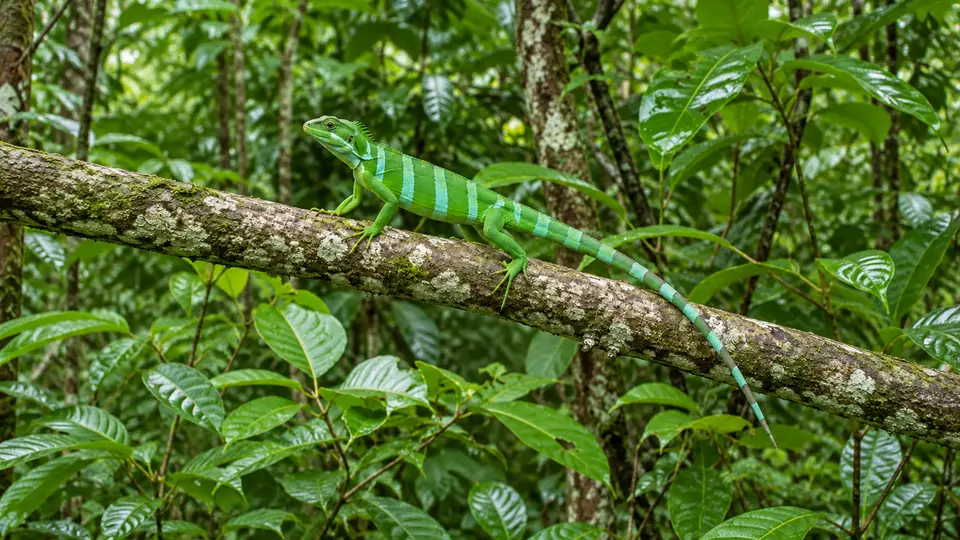
Central Fijian banded iguana in its natural habitatAI-modified

Central Fijian banded iguanaBrachylophus bulabulaWhere and when to see them

Central Fijian banded iguana at a glance

The supplied common name identifies the central Fijian banded iguana, rather than the more easterly Fiji banded iguana, Brachylophus fasciatus. This green, tree-dwelling lizard belongs to a remarkable Pacific radiation of iguanas far from the family’s main American distribution. Males often show conspicuous pale blue bands, while females are generally more uniformly green. Forest clearance, introduced predators and illegal collection threaten populations whose island distribution is more complicated than older field guides suggest.

Behaviour & reproduction

Size
18–20 cm (7.1–7.9 in) snout-to-vent length
Weight
Not reliably established
Lifespan
10–15 years in the wild, up to 25 years in captivity
Status
Endangered

Central Fijian banded iguanas are primarily active by day, moving through branches to feed, bask and find shelter. Their camouflage makes even stationary adults difficult to locate among leaves. Males use head movements and visual displays during territorial or reproductive interactions. Females descend to suitable ground to lay eggs in excavated nests. Much of their daily activity remains above human eye level, so responsible observation depends on patience rather than handling or disturbing vegetation. Males display head bobs and dewlap extensions to assert dominance or attract mates. Females lay clutches of 2-4 eggs in subterranean nests, often returning to the same nesting sites annually.

Top wildlife locations

Fiji wildlife habitatAI-modified

Fiji

Permitted paths through coastal or lowland forest within the species’ central Fijian range offer plausible viewing habitat. Wild sightings are uncommon, and some populations require an inland excursion or locally authorised access.
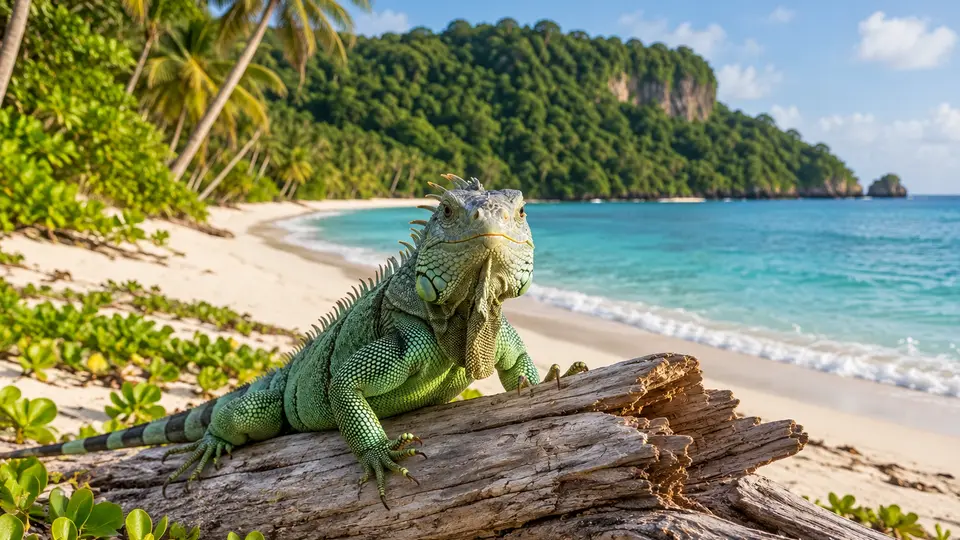
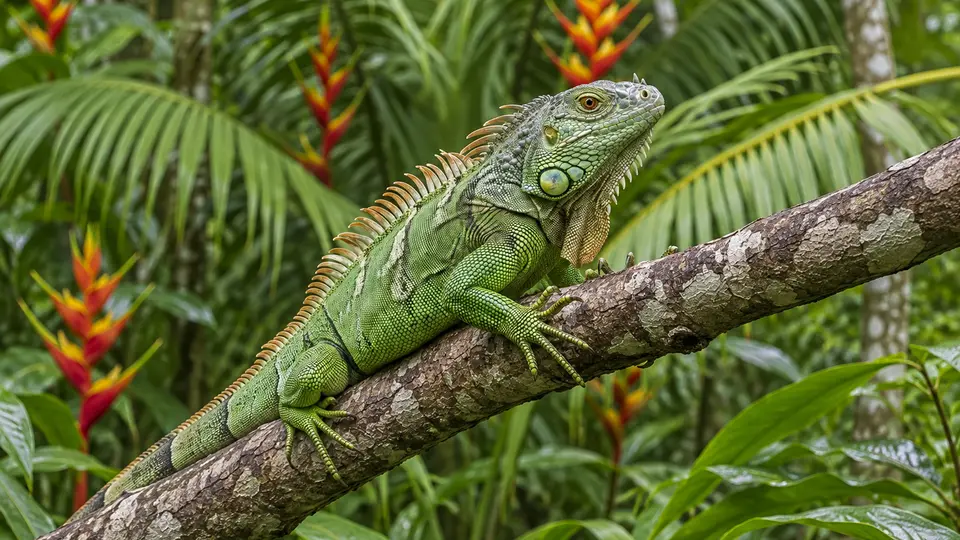
Destinations describe the species' habitat, not guaranteed cruise stops. Some animals require an optional inland excursion or are found in restricted reserves.

Fun facts about the Central Fijian banded iguana

  • Brachylophus bulabula was formally described as a species in 2008.
  • Its name derives from the Fijian greeting bula.
  • The long tail provides balance while moving among branches.
  • Male and female colour patterns can differ markedly.

Best time to see the Central Fijian banded iguana

May to October generally provides more comfortable conditions for walking and guided forest observation in Fiji. Iguanas can be active year-round, and this travel window is not a documented peak in sightings. Local access, canopy cover and weather strongly influence visibility. While iguanas are active year-round, the dry season offers clearer skies and less rain, which can improve visibility in dense forest environments. Breeding activity often increases during the warmer, wetter months, leading to more courtship displays.

Central Fijian banded iguana: season matrix by destination

Travel and observation windows vary by region. Highlighted months are an orientation for planning, not confirmed sightings or a guarantee of access.

Fiji

A generally drier travel window, not evidence of seasonal abundance; confirm species identity, local access and guiding arrangements.

JanFebMarAprMayJunJulAugSepOctNovDec
Cruise ships in Fiji

Where the Central Fijian banded iguana lives

This species inhabits forest on central Fijian islands, including Viti Levu and nearby island groups. It depends on trees and shrubs for feeding, concealment and movement. Suitable habitat includes coastal forest and inland woodland, but occurrence is patchy and locally depleted. They are often found in coastal dry forest and mangrove habitats, demonstrating adaptability to various arboreal environments. Their arboreal lifestyle means they rarely descend to the forest floor except for nesting.

What the Central Fijian banded iguana eats

Adults are predominantly herbivorous, taking leaves, flowers, buds and fruit from forest plants. Food selection changes with local vegetation and seasonal availability. Occasional animal material has been reported in Fijian iguanas, but insects should not be presented as this species’ main diet. Young iguanas may consume more insects than adults, but this shifts to an overwhelmingly plant-based diet as they mature. They play a role in seed dispersal through their fruit consumption.

Species at a glance

Common name
Central Fijian banded iguana
Scientific name
Brachylophus bulabula
Animal group
Reptiles
Size
18–20 cm (7.1–7.9 in) snout-to-vent length
Weight
Not reliably established
Lifespan
10–15 years in the wild, up to 25 years in captivity
Status
Endangered
Identification
Central Fijian banded iguanas lack the tall dorsal crest of Brachylophus vitiensis, while separating them from Brachylophus fasciatus often requires locality and expert examination. Adult males are typically brighter green with prominent white or pale blue bands, while females and juveniles are duller green with less distinct banding. The species is known for its bright orange irises, a distinctive field mark.

Central Fijian banded iguana: frequently asked questions

Where can I see the Central Fijian banded iguana?
Fiji. Use binoculars from permitted forest paths and let a qualified local guide identify suitable canopy habitat. Do not handle iguanas, shake branches or disclose sensitive locations; threatened populations are vulnerable to disturbance and collection. Look for their bright green bodies and distinct banding patterns against the foliage, which can be challenging due to their excellent camouflage. Listen for rustling in the canopy, which might indicate iguana movement.
When is the best time to see the Central Fijian banded iguana?
May to October generally provides more comfortable conditions for walking and guided forest observation in Fiji. Iguanas can be active year-round, and this travel window is not a documented peak in sightings. Local access, canopy cover and weather strongly influence visibility. While iguanas are active year-round, the dry season offers clearer skies and less rain, which can improve visibility in dense forest environments. Breeding activity often increases during the warmer, wetter months, leading to more courtship displays.
How big does the Central Fijian banded iguana get?
18–20 cm (7.1–7.9 in) snout-to-vent length. Adult weight: Not reliably established. Size varies with age, sex and population.
How should I behave around the Central Fijian banded iguana?
Use binoculars from permitted forest paths and let a qualified local guide identify suitable canopy habitat. Do not handle iguanas, shake branches or disclose sensitive locations; threatened populations are vulnerable to disturbance and collection. Look for their bright green bodies and distinct banding patterns against the foliage, which can be challenging due to their excellent camouflage. Listen for rustling in the canopy, which might indicate iguana movement.
What does the Central Fijian banded iguana eat?
Adults are predominantly herbivorous, taking leaves, flowers, buds and fruit from forest plants. Food selection changes with local vegetation and seasonal availability. Occasional animal material has been reported in Fijian iguanas, but insects should not be presented as this species’ main diet. Young iguanas may consume more insects than adults, but this shifts to an overwhelmingly plant-based diet as they mature. They play a role in seed dispersal through their fruit consumption.
Are wildlife sightings guaranteed on an adventure cruise?
No. Animals move freely and routes, weather, access restrictions and local conditions influence every outing. Confirm the actual itinerary and shore program before booking.

Compare wildlife in the same destinations

Explore other reptiles recorded in these destinations. Similar surroundings do not mean the animals share the same habits or viewing season.

Species comparison by animal group and destination
Central Fijian banded iguanaAI-modifiedCentral Fijian banded iguanaBrachylophus bulabulaAI-modifiedBrachylophus bulabulaFiji crested iguanaAI-modifiedFiji crested iguana
Animal groupReptilesAnimal groupReptilesAnimal groupReptiles
DestinationsFijiDestinationsFijiDestinationsFiji
Scientific nameBrachylophus bulabulaScientific nameScientific name
All wildlife destinations
AI-modified
Plan your trip

Find your next wildlife adventure

Compare destinations, shore programs and dates with the animals and habitats you would love to see.

  • Naturalist-led shore excursions
  • Responsible wildlife watching
  • Small expedition ships