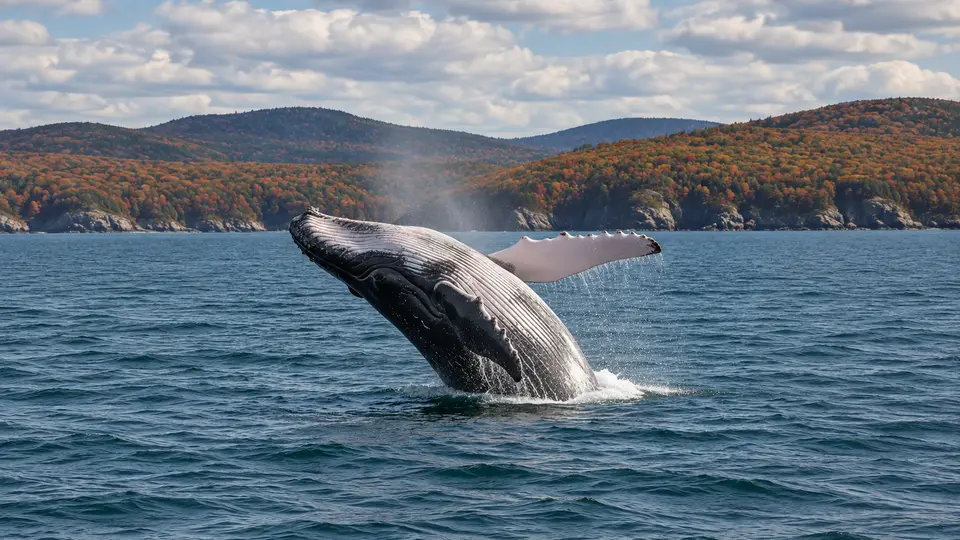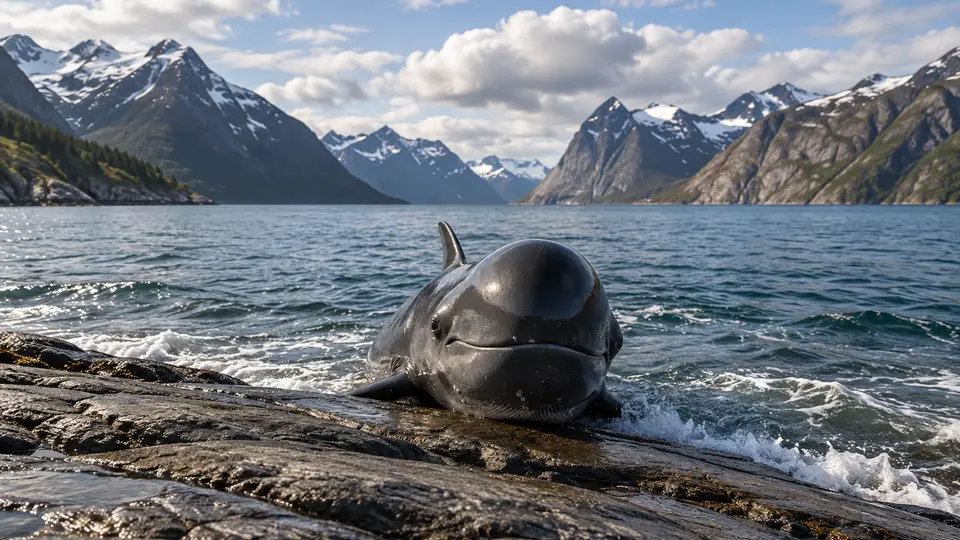
Long-finned Pilot Whale in its natural habitat, AI illustration

Long-finned Pilot WhaleGlobicephala melasWhere and when to see them

Long-finned Pilot Whale at a glance

The long-finned pilot whale is a large oceanic dolphin with a rounded forehead, dark body and strong social bonds. It inhabits cool-temperate and subpolar waters, including the North Atlantic around Norway. Despite its name, it belongs to the dolphin family rather than the baleen whales. Groups may travel along continental margins or enter coastal waters, but appearances near accessible shores are irregular and should never be treated as predictable attractions.

Behaviour & reproduction

Size
3.8–6.5 m long
Weight
1,000–3,000 kg
Lifespan
35–60 years
Status
Least Concern

Pilot whales live in enduring social groups, often containing closely related females and their offspring. Groups coordinate travel and may rest close together at the surface between feeding bouts. Their vocal repertoire includes whistles and pulsed calls used in social communication. They sometimes associate with other cetaceans. Strong group cohesion is one proposed contributor to mass strandings, although individual events can involve several interacting environmental, navigational and health factors. Vocalizations, including whistles, are crucial for maintaining group cohesion and for echolocation during hunting. They often engage in 'logging' behavior, where several individuals rest motionless at the surface, sometimes in close physical contact. While generally social, their behavior can vary from boisterous surface activity to quiet, submerged travel, making each encounter unique.

Top wildlife locations

Norway wildlife habitat

Norway

Exposed headlands and decks along deep coastal waters provide plausible distant viewpoints. Shore sightings are rare and unpredictable, and reaching a scenic fjord does not imply access to a regular pilot-whale gathering.
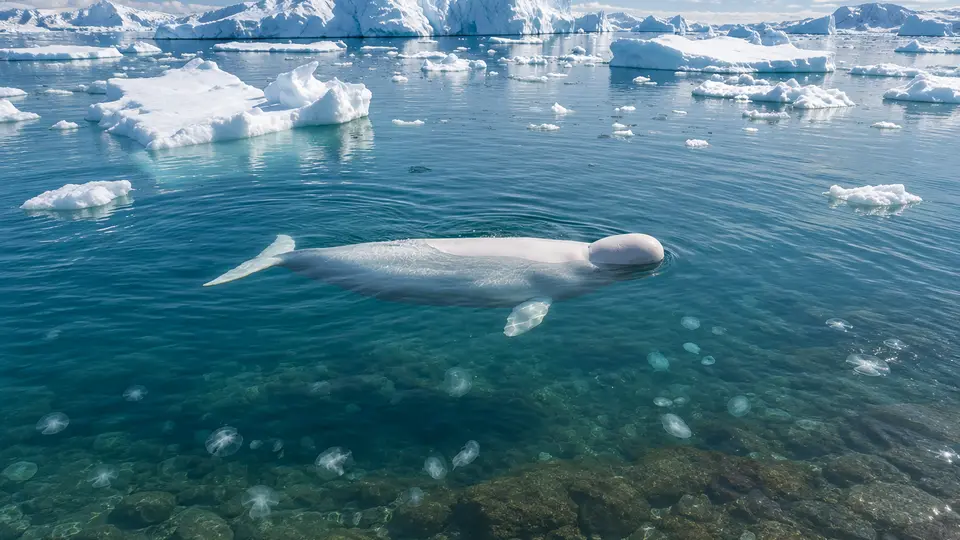
Destinations describe the species' habitat, not guaranteed cruise stops. Some animals require an optional inland excursion or are found in restricted reserves.

Fun facts about the Long-finned Pilot Whale

  • Pilot whales are members of the dolphin family.
  • Their long pectoral fins can approach one fifth of body length.
  • Females generally live longer than males.
  • Closely related females can remain together in stable social units.

Best time to see the Long-finned Pilot Whale

Norway's longer daylight and generally more workable coastal conditions make late spring and summer practical for distant observation. Pilot whales remain unpredictable, however, and this is not a defined local gathering season. Weather, visibility and chance strongly influence any shore or deck view. Summer months bring peak opportunities for whale watching tours operating from various coastal towns, increasing the chance of encountering these mobile pods. Their presence is often linked to the migrations of schooling fish or squid, which can be more predictable during certain times of year. Keep an eye on local marine wildlife reports for updates on recent sightings, which can fluctuate annually.

Long-finned Pilot Whale: season matrix by destination

Travel and observation windows vary by region. Highlighted months are an orientation for planning, not confirmed sightings or a guarantee of access.

Norway

Selected for daylight and practical coastal travel, not a confirmed seasonal concentration of pilot whales.

JanFebMarAprMayJunJulAugSepOctNovDec
Cruise ships in Norway

Where the Long-finned Pilot Whale lives

This species occupies cool oceanic waters and continental-slope habitats, sometimes moving onto shelves or into deep coastal channels. In Norway, its distribution depends on prey and wider ocean conditions rather than a fixed association with particular harbours or tourist routes. They are found in two distinct populations: one in the North Atlantic and another in the Southern Hemisphere. In Norway, they are more commonly found along the shelf edge and in deeper fjords, particularly in the northern and western parts of the coastline. These whales prefer waters between 0 and 25 degrees Celsius, aligning with their preferred prey distribution.

What the Long-finned Pilot Whale eats

Squid are major prey, supplemented by fish and other cephalopods according to region. Feeding commonly occurs well below the surface, with echolocation helping locate prey in darkness. Distant observers generally see travelling, breathing or resting animals rather than feeding itself. In the North Atlantic, their diet also includes schooling fish like mackerel and herring, especially when squid populations are less abundant. Their deep diving capabilities allow them to exploit prey resources across a significant portion of the water column. Studies have shown they can dive to depths of 600 meters or more for extended periods during foraging.

Species at a glance

Common name
Long-finned Pilot Whale
Scientific name
Globicephala melas
Animal group
Marine life
Size
3.8–6.5 m long
Weight
1,000–3,000 kg
Lifespan
35–60 years
Status
Least Concern
Identification
A bulbous head and broad-based dorsal fin distinguish pilot whales from most dolphins, but separating long-finned from short-finned pilot whales at distance is difficult. The long-finned pilot whale generally has a larger, more rounded head compared to its short-finned counterpart, though this can be difficult to discern without a close view. Their bodies are typically dark grey or black with a distinct grey or white saddle patch behind the dorsal fin and a white ventral blaze. The dorsal fin is broad at the base, sickle shaped, and positioned relatively far forward on the back.

Long-finned Pilot Whale: frequently asked questions

Where can I see the Long-finned Pilot Whale?
Norway. Scan open water from safe coastal viewpoints or an existing vessel's deck using binoculars. Never encourage pursuit or interception of a group. Report stranded animals to local authorities and keep clear rather than attempting a rescue. Be prepared to spend time scanning the horizon, as pilot whales can surface unpredictably and may travel at varying speeds. If encountered, maintain a respectful distance of at least 50 meters to avoid disturbing their natural behaviors. Binoculars are essential for distinguishing features and observing group dynamics from a safe distance.
When is the best time to see the Long-finned Pilot Whale?
Norway's longer daylight and generally more workable coastal conditions make late spring and summer practical for distant observation. Pilot whales remain unpredictable, however, and this is not a defined local gathering season. Weather, visibility and chance strongly influence any shore or deck view. Summer months bring peak opportunities for whale watching tours operating from various coastal towns, increasing the chance of encountering these mobile pods. Their presence is often linked to the migrations of schooling fish or squid, which can be more predictable during certain times of year. Keep an eye on local marine wildlife reports for updates on recent sightings, which can fluctuate annually.
How big does the Long-finned Pilot Whale get?
3.8–6.5 m long. Adult weight: 1,000–3,000 kg. Size varies with age, sex and population.
How should I behave around the Long-finned Pilot Whale?
Scan open water from safe coastal viewpoints or an existing vessel's deck using binoculars. Never encourage pursuit or interception of a group. Report stranded animals to local authorities and keep clear rather than attempting a rescue. Be prepared to spend time scanning the horizon, as pilot whales can surface unpredictably and may travel at varying speeds. If encountered, maintain a respectful distance of at least 50 meters to avoid disturbing their natural behaviors. Binoculars are essential for distinguishing features and observing group dynamics from a safe distance.
What does the Long-finned Pilot Whale eat?
Squid are major prey, supplemented by fish and other cephalopods according to region. Feeding commonly occurs well below the surface, with echolocation helping locate prey in darkness. Distant observers generally see travelling, breathing or resting animals rather than feeding itself. In the North Atlantic, their diet also includes schooling fish like mackerel and herring, especially when squid populations are less abundant. Their deep diving capabilities allow them to exploit prey resources across a significant portion of the water column. Studies have shown they can dive to depths of 600 meters or more for extended periods during foraging.
Are wildlife sightings guaranteed on an adventure cruise?
No. Animals move freely and routes, weather, access restrictions and local conditions influence every outing. Confirm the actual itinerary and shore program before booking.

Compare wildlife in the same destinations

Explore other marine life recorded in these destinations. Similar surroundings do not mean the animals share the same habits or viewing season.

Species comparison by animal group and destination
Long-finned Pilot WhaleLong-finned Pilot WhaleBeluga WhaleBeluga WhaleFin WhaleFin Whale
Animal groupMarine lifeAnimal groupMarine lifeAnimal groupMarine life
DestinationsNorwayDestinationsNorway, ArcticDestinationsMexico, New England, Croatia, Greece, Norway, Portugal, Antarctica, Arctic
All wildlife destinations
Plan your trip

Find your next wildlife adventure

Compare destinations, shore programs and dates with the animals and habitats you would love to see.

  • Naturalist-led shore excursions
  • Responsible wildlife watching
  • Small expedition ships

Newsletter

Take Blue Rides with you

Adventure cruise offers, last-minute deals and trip inspiration.

Free, unsubscribe anytime. Details: Privacy Policy

Partner with Blue Rides

Affiliate Program

Recommend adventure cruises and earn commission on every confirmed booking.

Share. Track. Earn.

Your footage, our stage

Send us your videos or pictures.

Captured remarkable nature or wildlife on your journey? Share it with us, we may feature it on Blue Rides.