Bluerides – Blue Rides - Réservez des croisières plongée dans le monde entierOCEAN ADVENTURES
Croisières fluvialesFleuves et rivièresNature & fauneNotre promesse
Croisières fluvialesFleuves et rivièresNature & fauneNotre promesseConnexion

Destinations fluviales

  • Destinations fluviales
  • Amazonie
  • Danube
  • Rhin
  • Mékong
  • Nil

Bateaux et départs

  • Recherche de croisières fluviales
  • Offres

Nature & faune

  • Nature & faune

Assistance voyage

  • Notre promesse
  • Contact

Contact

Contactez-nous

Contacte-nous quand tu veux, on t'aide à choisir ta croisière ou à répondre à tes questions.

E-mailÉcris-nous : on répond en général en quelques heures.
contact@bluerides.com
WhatsAppDiscute avec nous sur WhatsApp, lun–ven 10h–16h (CET).
Démarrer la discussion WhatsApp
TéléphoneAppelez-nous, nous serons ravis de vous aider.
Appel gratuit, lun–ven 10h–20h (CET).
Europe+49 800 1144 990États-Unis+1 888 557 7735Royaume-Uni+44 800 707 4152Australie+61 2 8599 6113Canada+1 888 557 7735
Which river journey is yours?Answer 8 quick questions and find the river cruise that fits you.
8 questions, 1 minute·Plus Gift
Moyens de paiement sécurisésVos paiements sont entièrement sécurisés grâce au chiffrement AES-256.
Propulsé parStripeWiseAMEXPayGoogle PaySEPABank
Mentions légales·Conditions générales·Politique de confidentialité·À propos·Contact·Décharge de Responsabilité·Programme d'affiliation·Cruise·
Suivez-nous ici

© 2026 Blue Rides. Tous droits réservés.·

Bluerides – Blue Rides - Réservez des croisières plongée dans le monde entierOCEAN ADVENTURES
Croisières fluvialesFleuves et rivièresNature & fauneNotre promesse
Croisières fluvialesFleuves et rivièresNature & fauneNotre promesseConnexion
Ringed kingfisher en zone humide — Amazon, faune des croisières fluviales
Accueil›Croisières fluviales›Faune fluviale›Ringed Kingfisher

Ringed KingfisherMegaceryle torquataOù et quand les observer

Espèce précédenteRing-necked DuckEspèce suivanteRock Bunting

Ringed Kingfisher en un coup d'œil

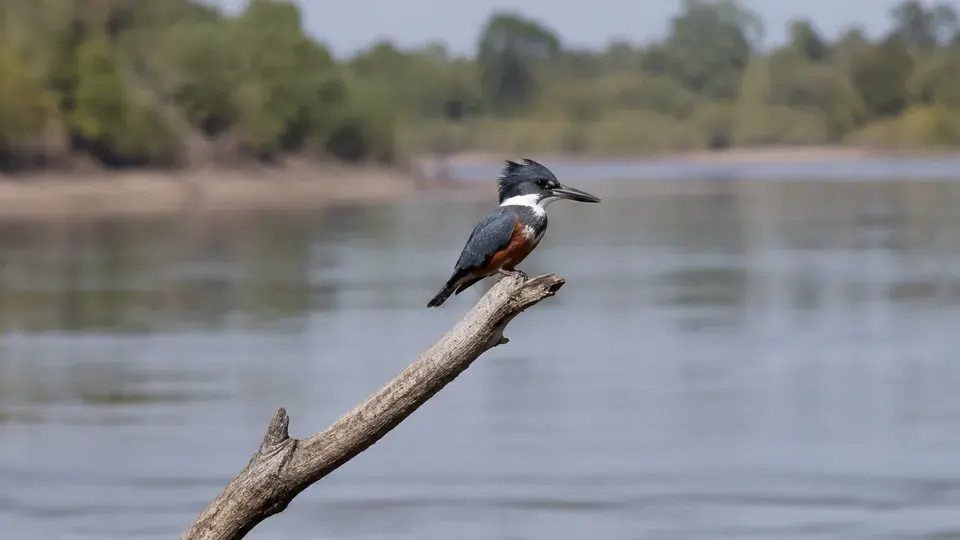
The Ringed Kingfisher is a large, heavy-billed kingfisher with blue-grey upperparts and rich chestnut underparts. A high exposed perch above a river is a promising search point. Here the Amazon association means the documented Peruvian Iquitos–Nauta and Ucayali tributary itinerary, not every part of the basin. Species reference: https://www.allaboutbirds.org/guide/Ringed_Kingfisher/lifehistory
Comportement et reproduction

Taille
Species-specific body-length measurement not verified.
Poids
Species-specific weight not verified.
Espérance de vie
Species-specific lifespan not verified.
Statut
A current formal global assessment was not verified.

A bird watches from a convenient perch, dives to seize prey and returns above the water. Cornell notes that hovering occurs less often than in Belted Kingfishers. Fish are swallowed head first. Excavated nesting burrows in earthen banks are important but must never be approached for a close look inside.

Meilleurs sites d'observation

Paysage fluvial Amazon — habitat des croisières fluviales

Amazon

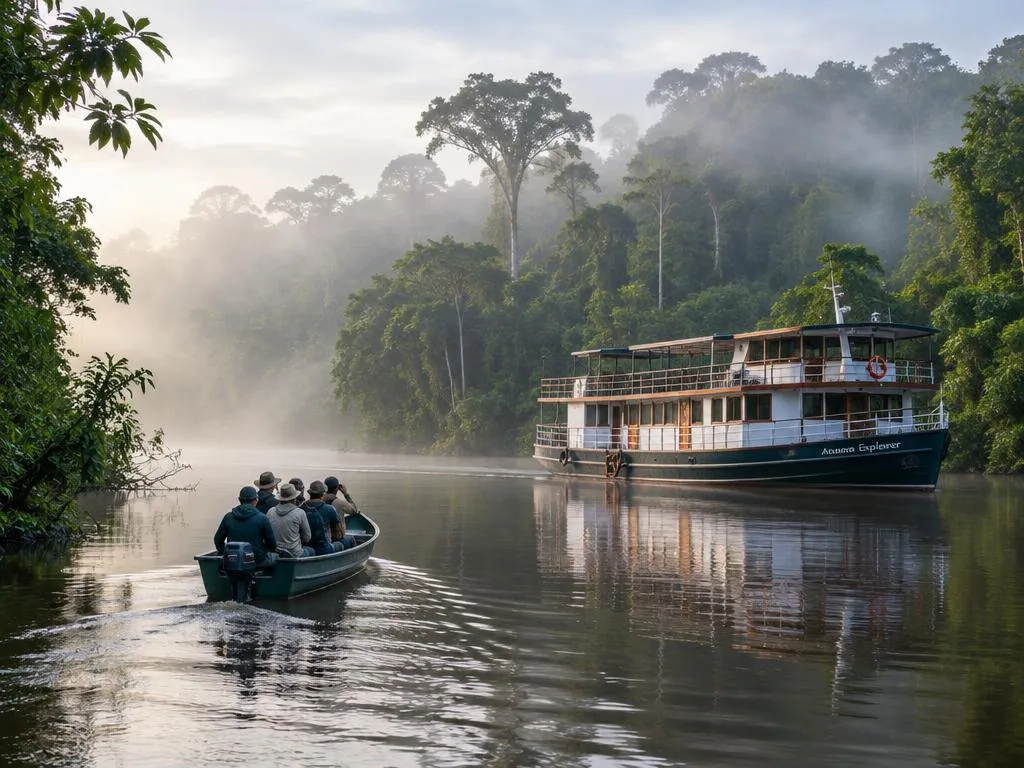
Peru — Iquitos/Nauta, Ucayali and connected tributaries (2017 cruise) Guided skiff/side-channel viewing; not guaranteed from main ship. Scan river-edge trees, banks and open water.
Explorer les croisières fluviales

Les destinations décrivent l'habitat de l'espèce et ne garantissent pas une escale. Certains animaux s'observent lors d'excursions terrestres optionnelles ou dans des réserves protégées.

Faits insolites sur le Ringed Kingfisher

  • It has a heavy bill and ragged crest.
  • Fish are swallowed head first.
  • Females show a blue-grey breast band.
  • It nests in earthen burrows.
  • It usually hunts from a perch.
  • Its diet is mainly fish.

Meilleure période pour voir le Ringed Kingfisher

The local cruise account records a single March 2017 itinerary and cannot support an annually recurring season. No numerical months are assigned. The availability of a visible hunting perch matters during an excursion, but regional hydrology alone is not evidence for a month-by-month occurrence calendar.

Ringed Kingfisher : calendrier saisonnier par destination

Highlighted months reflect the stated local evidence, not guaranteed encounters. Neutral months mean no verified monthly viewing window, not absence. Observation records and recommended viewing windows are distinct.

Amazon

The March 2017 cruise list is a single dated itinerary, not a recurring seasonal source. No months assigned.

janv.févr.marsavr.maijuinjuil.aoûtsept.oct.nov.déc.
Explorer les croisières fluviales

Où vit le Ringed Kingfisher

Rivers, lakes and ponds with hunting perches are characteristic. The species can use other waters too, provided prey can be detected and suitable perches are available. Small dark shaded creeks are less typical. Along the registered itinerary, exposed branches over side channels are more useful search targets than the canopy interior.

Ce que mange le Ringed Kingfisher

Freshwater fish predominate, with crustaceans, amphibians, reptiles and large insects also reported. Cornell describes prey being located from above and captured with the bill. A fish held at a distance is rarely identifiable to species. No quantified diet from the registered Peruvian cruise reach was verified.

L'espèce en un coup d'œil

Nom commun
Ringed Kingfisher
Scientific name
Megaceryle torquata
Groupe animal
Birds
Taille
Species-specific body-length measurement not verified.
Poids
Species-specific weight not verified.
Espérance de vie
Species-specific lifespan not verified.
Statut
A current formal global assessment was not verified.
Identité
The large bill, ragged crest, broad white neck collar and chestnut belly are important. Adult males are chestnut from breast through belly; females have a blue-grey breast band separated from the chestnut by a narrow pale border. Immatures can show intermediate-looking features, so assess the complete pattern.

Ringed Kingfisher : foire aux questions

Où puis-je voir le Ringed Kingfisher ?
Amazon. Follow the guide’s scan of bare branches and riverbank supports. Wait through a hunting attempt instead of moving directly under the bird. Keep well away from bank burrows, where boat wake and close approaches can be harmful. A side-channel skiff usually offers better opportunities than a fast-moving main vessel.
Quel est le meilleur moment pour voir le Ringed Kingfisher ?
The local cruise account records a single March 2017 itinerary and cannot support an annually recurring season. No numerical months are assigned. The availability of a visible hunting perch matters during an excursion, but regional hydrology alone is not evidence for a month-by-month occurrence calendar.
Quelle taille le Ringed Kingfisher peut-il atteindre ?
Species-specific body-length measurement not verified.. Poids adulte : Species-specific weight not verified.. La taille varie selon l'âge, le sexe et la population.
Comment dois-je me comporter en présence de le Ringed Kingfisher ?
Follow the guide’s scan of bare branches and riverbank supports. Wait through a hunting attempt instead of moving directly under the bird. Keep well away from bank burrows, where boat wake and close approaches can be harmful. A side-channel skiff usually offers better opportunities than a fast-moving main vessel.
Que mange le Ringed Kingfisher ?
Freshwater fish predominate, with crustaceans, amphibians, reptiles and large insects also reported. Cornell describes prey being located from above and captured with the bill. A fish held at a distance is rarely identifiable to species. No quantified diet from the registered Peruvian cruise reach was verified.
Les observations de la faune sont-elles garanties lors d'une croisière fluviale ?
Non. Les animaux se déplacent librement et les itinéraires, la météo, les restrictions d'accès ainsi que les conditions locales influencent chaque sortie. Confirme l'itinéraire réel et le programme d'excursions avant de réserver.

Compare la faune dans les mêmes destinations

Découvre d'autres birds répertoriés dans ces destinations. Un environnement similaire ne signifie pas que les animaux partagent les mêmes habitudes ou la même saison d'observation.

Comparaison des espèces par groupe animal et destination
Ringed kingfisher en zone humide — Amazon, faune des croisières fluvialesRinged KingfisherAmazon kingfisher en zone humide — Amazon, faune des croisières fluvialesAmazon KingfisherAnhinga en zone humide — Amazon, faune des croisières fluvialesAnhinga
Groupe animalBirdsGroupe animalBirdsGroupe animalBirds
DestinationsAmazonDestinationsAmazonDestinationsAmazon
Scientific name
Megaceryle torquata

Megaceryle torquata

Scientific name
Scientific name
Taille
Species-specific body-length measurement not verified.
Taille
Taille
Poids
Species-specific weight not verified.
Poids
Poids
Espérance de vie
Species-specific lifespan not verified.
Espérance de vie
Espérance de vie
Statut
A current formal global assessment was not verified.
Statut
Statut
Identité
The large bill, ragged crest, broad white neck collar and chestnut belly are important.

The large bill, ragged crest, broad white neck collar and chestnut belly are important. Adult males are chestnut from breast through belly; females have a blue-grey breast band separated from the chestnut by a narrow pale border. Immatures can show intermediate-looking features, so assess the complete pattern.

Identité
Identité
Habitat
Rivers, lakes and ponds with hunting perches are characteristic.

Rivers, lakes and ponds with hunting perches are characteristic. The species can use other waters too, provided prey can be detected and suitable perches are available. Small dark shaded creeks are less typical. Along the registered itinerary, exposed branches over side channels are more useful search targets than the canopy interior.

Habitat
Habitat
Alimentation
Freshwater fish predominate, with crustaceans, amphibians, reptiles and large insects also reported.

Freshwater fish predominate, with crustaceans, amphibians, reptiles and large insects also reported. Cornell describes prey being located from above and captured with the bill. A fish held at a distance is rarely identifiable to species. No quantified diet from the registered Peruvian cruise reach was verified.

Alimentation
Alimentation
Meilleure saison
The local cruise account records a single March 2017 itinerary and cannot support an annually recurring season.

The local cruise account records a single March 2017 itinerary and cannot support an annually recurring season. No numerical months are assigned. The availability of a visible hunting perch matters during an excursion, but regional hydrology alone is not evidence for a month-by-month occurrence calendar.

Meilleure saison
Meilleure saison
Saisonnalité par destination
AmazonNo verified monthly viewing evidence

The March 2017 cruise list is a single dated itinerary, not a recurring seasonal source. No months assigned.

Saisonnalité par destinationSaisonnalité par destination
Espèce précédenteRing-necked DuckEspèce suivanteRock Bunting
Toute la faune fluviale
On this page
  • 01À propos
  • 02Comportement et reproduction
  • 03Meilleurs sites d'observation
  • 04Le savais-tu ?
  • 05Meilleure saison
  • 06Saisonnalité par destination
  • 07Habitat
  • 08Alimentation
  • 09L'espèce en un coup d'œil
  • 10Questions et réponses
  • 11Comparer

Find your river cruise

Planifie ton voyage

Trouve ton prochain voyage fluvial

Compare les destinations, les programmes d'excursions et les dates en fonction des animaux et des habitats que tu rêves de découvrir.

  • Excursions quotidiennes à terre
  • Observation responsable de la faune
  • Bateaux de croisière fluviale intimistes
Explorer les croisières fluviales