Circuit Gourmet : Brothers - Daedalus - Safaga (Salem Express) (Port Ghalib - Hurghada)
Destiny · Égypte · 7 nuits
À propos de cet itinéraire
Ce circuit de plongée gastronomique en mer Rouge égyptienne visite des sites emblématiques comme les îles Brothers, le récif Daedalus et l'épave du Salem Express. Les plongeurs peuvent s'attendre à des plongées dérivantes exaltantes avec de forts courants, offrant des rencontres fréquentes avec de grandes espèces pélagiques et des écosystèmes coralliens dynamiques. L'itinéraire s'adresse aux plongeurs expérimentés à la recherche d'une aventure sous-marine palpitante au milieu d'environnements marins variés et d'une topographie spectaculaire. L'exploration se déroule dans des eaux riches en nutriments, connues pour leurs populations actives de requins et leurs superbes formations récifales, promettant un voyage inoubliable.
Régions sur cet itinéraire
Points forts
Abu Kafan
Abu Kafan, meaning 'Father of the Deep,' is a long and narrow reef known for its stunning deep walls and abundant marine life. The northern plateau is a hotspot for pelagic species, including hammerhead sharks, while the southern side offers diverse coral formations and reef fish. Strong currents typically characterize dives here, making it an exhilarating experience.
- Deep wall dives
- Hammerhead sharks
- Vibrant coral reefs
- Drift diving
Aida II Wreck
The Aida II is another significant wreck in the Brothers Islands, a supply ship that sank in 1957. Resting at depths between 25 and 60 meters, its structure is heavily colonized by gorgonians, sponges, and soft corals. It provides a fascinating dive site with a history and abundant marine life.
- Supply ship wreck
- Coral encrusted
- Historical wreck
- Marine habitat
Best of Safaga Panorama Reef
Panorama Reef, located in the Safaga region, is known for its vibrant and diverse coral ecosystems. It features deep drop-offs and large schools of fish, making it a dynamic dive site. The reef's structure supports a wide array of marine life, including various reef fish and potential sightings of larger pelagics.
- Vibrant coral ecosystems
- Deep drop-offs
- Large fish schools
- Dynamic dive site
Big Brother
Big Brother Island features a historic lighthouse and two prominent wrecks: the Aida and the Numidia. The Aida, an Egyptian transport ship, lies on the reef slope, while the Numidia, a cargo ship from 1901, rests upright between 10 and 85 meters. Both wrecks are beautifully covered in corals and teeming with marine life, offering captivating exploration.
- Numidia and Aida wrecks
- Coral-encrusted structures
- Historical dive site
- Abundant reef life
Little Brother
Little Brother is known for its impressive reef drop-off, which is vibrantly adorned with soft corals and gorgonians. The wall dives here often reveal diverse reef fish, including anthias, groupers, fusiliers, and bannerfish. Encounters with larger marine life like snapper, mackerel, barracuda, tuna, and Napoleon wrasse are also common.
- Rich soft coral gardens
- Spectacular wall dives
- Diverse reef fish
- Occasional pelagic sightings
Numidia Wreck
The Numidia wreck, located off Big Brother, is a 145-meter-long English merchant ship that sank in 1901. Resting at depths between 8 and 85 meters, it is an impressive artificial reef covered in soft corals and marine growth. The wreck hosts numerous fish species and offers opportunities for wreck penetration for experienced divers.
- Large cargo ship wreck
- Coral-covered structure
- Wreck penetration
- Rich marine habitat
Red Sea
The Red Sea is globally celebrated for its rich biodiversity, featuring extensive coral reefs, diverse fish populations, and a wide array of pelagic species. Its clear, warm waters and dramatic underwater topography, including deep walls and pinnacles, offer exceptional diving conditions. The region is known for its strong currents which bring nutrients, attracting various marine life.
- Rich biodiversity
- Clear, warm waters
- Strong currents
- Diverse coral reefs
Safaga
The Safaga region offers diverse diving experiences, including the historical Salem Express wreck and vibrant reef systems like Best of Safaga Panorama Reef and Abu Kafan. These sites feature deep drop-offs, stunning coral formations, and abundant marine life, ranging from colorful reef fish to potential sightings of larger pelagic species.
- Wreck and reef dives
- Diverse coral formations
- Deep drop-offs
- Abundant marine life
Salem Express
The Salem Express is a passenger ferry that sank in 1991, making it a poignant and historic dive site. The wreck is largely intact and lies at depths ranging from 12 to 30 meters. It is now covered in marine growth, providing a unique environment for exploration and reflecting a somber piece of maritime history.
- Historical wreck
- Marine growth
- Depths 12-30m
Prérequis
- Niveau requisAdvanced Open Water
- Plongées minimum enregistrées50
- ExpérienceLes plongeurs doivent avoir de l'expérience en plongée dérivante et en gestion des courants forts.
Bon à savoir
- A minimum of 50 logged dives is required for this itinerary.
- Divers are recommended to wait 24 hours after their last dive before flying.
- The itinerary and dive sites may change based on local regulations, weather, and the captain's discretion.
Program jour par jour
Jour 1: Embarquement – Port Ghalib
Le voyage commence par l'enregistrement à Port Ghalib. Les passagers s'installent dans leurs cabines, reçoivent un briefing de bienvenue et se préparent pour une semaine de plongée passionnante en mer Rouge. Le yacht reste au port pour la nuit.
Jour 2: Îles Brothers – Point chaud pélagique
Aujourd'hui marque l'arrivée aux îles Brothers, deux pinacles isolés réputés pour leurs forts courants et leur abondante vie pélagique. Les plongeurs explorent les parois de ces îles, rencontrant souvent de grands bancs de poissons et diverses espèces de requins. Les coraux mous vibrants ajoutent au paysage sous-marin spectaculaire, offrant des plongées dérivantes palpitantes.
Jour 3: Îles Brothers – Épave et Récifs
Continuant aux îles Brothers, les plongées d'aujourd'hui peuvent inclure l'exploration de l'épave Numidia, un impressionnant cargo recouvert de coraux et de vie marine. La zone est également connue pour ses murs de récifs immaculés, offrant des opportunités d'apercevoir une diversité de poissons de récif, de murènes et éventuellement des tortues. Des courants forts caractérisent généralement ces plongées.
Jour 4: Îles Brothers – Vie Marine Diverse
Aujourd'hui offre une exploration approfondie du riche écosystème marin des îles Brothers. Les plongeurs peuvent s'attendre à rencontrer divers bancs de poissons et une forte probabilité d'observations de requins, y compris des requins océaniques à pointes blanches, des requins gris de récif, des requins renards et des requins marteaux. Les environnements récifaux vibrants offrent d'excellentes conditions pour la photographie et l'observation d'une vie marine diversifiée.
Jour 5: Récif de Daedalus – Point chaud des requins marteaux
La plongée d'aujourd'hui se concentre sur le récif de Daedalus, un récif isolé au large connu pour ses remarquables populations de requins marteaux, en particulier pendant certaines saisons. Les plongeurs explorent les parois abruptes et les plateaux du récif, souvent balayés par de forts courants, créant des conditions idéales pour les observations pélagiques. Le phare emblématique offre une toile de fond saisissante à ce site de plongée éloigné et vibrant.
Jour 6: Récif de Daedalus – Écosystème Marin Diversifié
Pour conclure l'expérience du récif de Daedalus, les plongeurs continuent d'explorer son riche écosystème marin. Le récif est caractérisé par de superbes formations de coraux durs et mous, ainsi qu'une gamme diversifiée de poissons de récif. Les rencontres avec des requins océaniques à pointes blanches et divers autres bancs de poissons sont courantes, en particulier le long du plateau nord.
Jour 7: Safaga – Épave du Salem Express et Récifs
Le dernier jour de plongée se déroule dans la région de Safaga, avec un accent principal sur l'épave du Salem Express, un ferry de passagers poignant. Cette épave largement intacte est recouverte de croissance marine, offrant des opportunités d'exploration uniques. La zone autour de Safaga propose également des plongées sur des récifs vibrants qui servent d'excellentes plongées de clôture, comme Best of Safaga Panorama Reef et Abu Kafan.
Jour 8: Débarquement – Hurghada
Après le petit-déjeuner, les passagers débarquent à Hurghada, concluant ainsi leur aventure de plongée en mer Rouge. Les transferts vers l'aéroport ou la poursuite du voyage sont organisés.
Prochains départs
Aucun départ prévu pour cet itinéraire pour le moment.
Tous les itinéraires de ce bateau
- Brothers - Daedalus - Elphinstone (Marsa Alam) (Marsa Alam → Marsa Alam) · 8J7N
- Fury Shoals - Elphinstone - Safaga (Port Ghalib - Hurghada) · 7 nuits
- Brothers - Daedalus - Elphinstone (Port Ghalib - Port Ghalib) · 11 nuits
- Nord - Épaves (Hurghada - Hurghada) · 8J/7N
- Brothers - Daedalus - Elphinstone (Hurghada - Port Ghalib) · 7 nuits
- St. John's - Fury Shoals - Elphinstone (Marsa Alam - Port Ghalib) · 7 nuits
- St. John's - Fury Shoals (Marsa Alam - Marsa Alam) · 7 nuits
- Nord - Brothers (Hurghada, 8J/7N) · 8J7N
- St. John's - Fury Shoal - Elphinstone (Port Ghalib - Port Ghalib) · 7 nuits
- Nord Tiran - Dahab (Hurghada - Hurghada) · 10 nuits
- Brothers - Daedalus - Elphinstone (Port Ghalib) (Port Ghalib → Port Ghalib) · 8D7N
- Brothers - Daedalus - Elphinstone (Marsa Alam → Hurghada) · 8D7N
- Shark Workshop Liveaboard (Port Ghalib → Marsa Alam) · 8D7N
- Nord - Tiran (Hurghada - Hurghada) · 8J/7N
- Daedalus - Zabargad - Rocky - Elphinstone (Marsa Alam - Marsa Alam) · 7 nuits
- Daedalus - Fury Shoals - Elphinstone (Marsa Alam - Marsa Alam) · 7 nuits
- Daedalus - Fury Shoals - St. John's (Port Ghalib - Port Ghalib) · 7 nuits
- Elba - Zabargad - Rocky - St. John's (Marsa Alam - Marsa Alam) · 8 Jours / 7 Nuits
- North - Brothers - Daedalus - Elphinstone | Épaves et Requins (Hurghada - Hurghada) · 11 jours / 10 nuits
- North Safaga - Tiran - Brothers (Hurghada - Hurghada) · 12 Jours / 11 Nuits
- Brothers - Daedalus - Elphinstone (Hurghada, 8J/7N) · 8J/7N
- North - Safaga - Brothers (Hurghada - Hurghada) · 8 Jours / 7 Nuits
- Brothers - Daedalus - Elphinstone (Hurghada → Port Ghalib, 8J7N) · 8J7N
- Daedalus - Fury Shoals - St. John s (Port Ghalib - Port Ghalib) · 8 Jours / 7 Nuits
- Daedalus - Fury Shoals - St. Johns · 7 nuits
- Fury Shoals - Elphinstone - Safaga · 7 nights
- Nord - Safaga - Brother · 7 nuits
- Brothers - Daedalus - Elphinstone · 7 nuits
- St. Johns - Fury Shoals - Elphinstone · 7 nuits
- Brothers - Daedalus - Elphinstone · 7 nuits
À propos du bateau
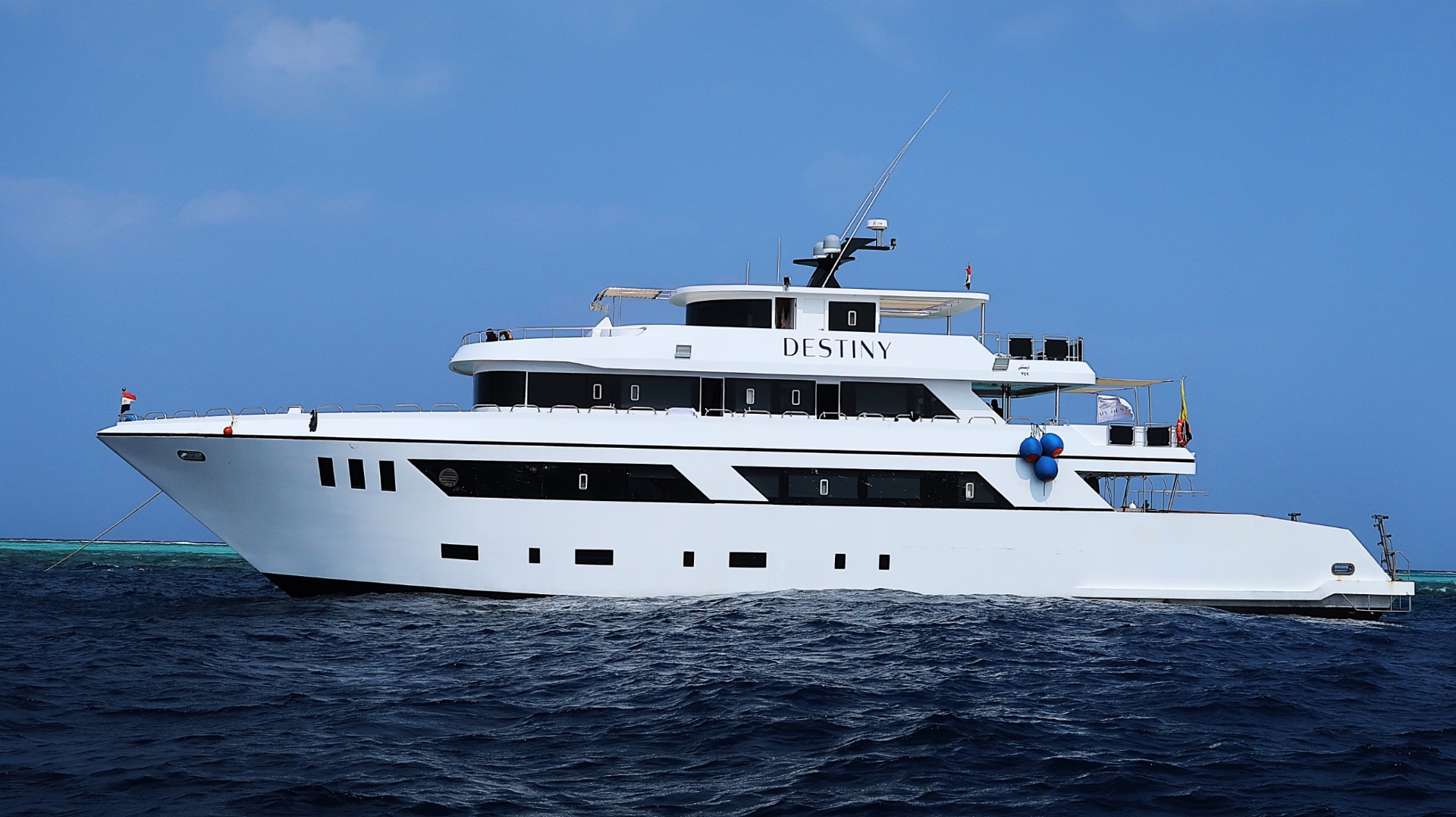 DestinyÉgypte