Bluerides – Blue Rides - Book Liveaboards worldwideOCEAN ADVENTURES
River CruisesRiversNature & WildlifeOur Promise
River CruisesRiversNature & WildlifeOur PromiseSign In

River destinations

  • River destinations
  • Amazon
  • Danube
  • Rhine
  • Mekong
  • Nile

Ships & departures

  • River Cruise Search
  • Deals

Nature & Wildlife

  • Nature & Wildlife

Travel support

  • Our Promise
  • Contact

Contact

Get in Touch

Get in touch anytime, we're happy to help you find the right trip or sort out any question.

EmailWrite us, we usually reply within a few hours.
contact@bluerides.com
WhatsAppChat with us on WhatsApp, Mon–Fri 10:00–16:00 (CET).
Start WhatsApp Chat
PhoneCall us, we're happy to help.
Free call, Mon–Fri 10 AM – 8 PM (CET).
Europe+49 800 1144 990USA+1 888 557 7735UK+44 800 707 4152Australia+61 2 8599 6113Canada+1 888 557 7735
Which river journey is yours?Answer 8 quick questions and find the river cruise that fits you.
8 questions, 1 minute·Plus Gift
Secure Payment MethodsYour payments are fully secured with AES-256 encryption.
Powered byStripeWiseAMEXPayGoogle PaySEPABank
Imprint·Terms & Conditions·Privacy Policy·About·Contact·Liability Waiver·Affiliate Program·Cruise·
Visit us here

© 2026 Blue Rides. All rights reserved.·

Bluerides – Blue Rides - Book Liveaboards worldwideOCEAN ADVENTURES
River CruisesRiversNature & WildlifeOur Promise
River CruisesRiversNature & WildlifeOur PromiseSign In
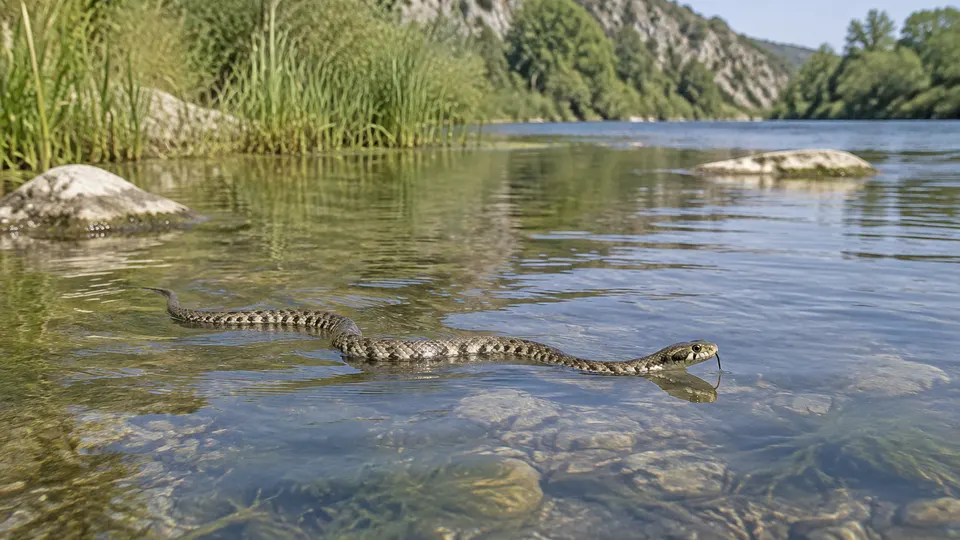
Grass snake in wetland habitat — Danube, River Cruises wildlife
Home›River Cruises›River Wildlife›Grass Snake

Grass SnakeNatrix natrixWhere and when to see them

Previous speciesGlossy IbisNext speciesGreat Black Hawk

Grass Snake at a glance

The Grass Snake links the Donau-Auen floodplain’s water and land habitats. The national park calls it Austria’s most common snake and describes an excellent swimmer and diver that takes much of its prey in or beside water. Commonness does not remove its conservation needs: the park also reports an Austrian vulnerable listing. Source: https://www.donauauen.at/en/facts/nature-science/fauna-engl/grass-snake

Behaviour & reproduction

Size
Males normally 60–70 cm (23.6–27.6 in); females 80–100 cm (31.5–39.4 in) total length in the Donau-Auen species account.
Weight
Species-specific weight not verified.
Lifespan
Species-specific lifespan not verified.
Status
Donau-Auen describes the species as vulnerable in Austria. A current formal global assessment was not verified.

A disturbed snake may slip quietly into water or another hiding place. The park describes communal overwintering in deep embankment cracks and old logs. Its 2025 account also records foul-smelling defensive secretions and death-feigning. These are defensive responses, not performances to provoke for photographs. https://www.donauauen.at/aktuelles/news/die-schlangen-der-auen-sind-erwacht

Top wildlife locations

Danube river landscape — River Cruises wildlife habitat

Danube

Austria: Donau-Auen floodplains east of Vienna towards Hainburg, on Vienna–Bratislava reach; optional shore/backwater excursion, not Passau or Budapest. Viewing guidance: Warm months; elusive bank-side swimmer or basker.
Explore river cruises

Destinations describe the species' habitat, not guaranteed cruise stops. Some animals require an optional inland excursion or are found in restricted reserves.

Fun facts about the Grass Snake

  • It is an excellent swimmer.
  • It also hunts on land.
  • Females are usually longer than males.
  • Pale neck patches have a dark rear border.
  • Almost black individuals occur.
  • Frogs and tadpoles are among its prey.
  • Disturbed snakes may feign death.

Best time to see the Grass Snake

The park describes overwintering and spring emergence, while the registry recommends warm-month bank watching. Neither establishes a recurring numerical visitor-observation calendar. Hibernation dates and mating dates are not converted into location months. Ask the park about current activity and trail conditions, and leave the month array empty.

Grass Snake: season matrix by destination

Highlighted months reflect the stated local evidence, not guaranteed encounters. Neutral months mean no verified monthly viewing window, not absence. Observation records and recommended viewing windows are distinct.

Danube

No qualifying local recurring monthly observation calendar was verified. Registry guidance is retained as qualitative context only; dated sightings, breeding dates and general migration patterns are not converted into months.

JanFebMarAprMayJunJulAugSepOctNovDec
Explore river cruises

Where the Grass Snake lives

The relevant reach is the Austrian Donau-Auen floodplain east of Vienna towards Hainburg, not other Danube cruise ports. Waterside banks, floodplain woodland and sheltered terrestrial refuges all matter. An animal may be seen swimming across quiet water or resting beside cover, making a permitted backwater walk more useful than open-channel deck watching.

What the Grass Snake eats

Donau-Auen lists frogs, toads, salamanders, fish and tadpoles as prey, captured around water and swallowed alive. This makes the snake a predator within the floodplain food web rather than a threat to visitors. Local prey proportions and differences between male, female and juvenile diets were not verified.

Species at a glance

Common name
Grass Snake
Scientific name
Natrix natrix
Animal group
Reptiles
Size
Males normally 60–70 cm (23.6–27.6 in); females 80–100 cm (31.5–39.4 in) total length in the Donau-Auen species account.
Weight
Species-specific weight not verified.
Lifespan
Species-specific lifespan not verified.
Status
Donau-Auen describes the species as vulnerable in Austria. A current formal global assessment was not verified.
Identification
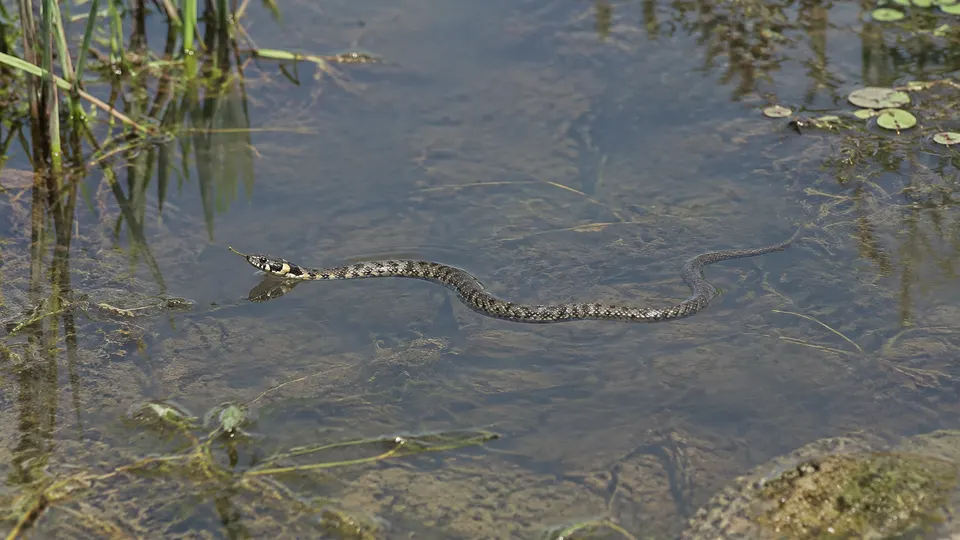
The park describes grey, brown or olive upperparts, dark spotting and strongly keeled scales. Pale neck patches may be white, yellow or orange-red and are bordered towards the tail by black. Very dark individuals occur. Young Aesculapian snakes can also have a collar, so a pale neck patch alone is not conclusive.

Grass Snake: frequently asked questions

Where can I see the Grass Snake?
Danube. Stay on authorised paths and watch banks without moving logs, reaching into holes or entering shallow pools. If a snake crosses a trail, give it space and let it pass. Do not handle it to inspect its collar or trigger defensive behaviour. A distant side photograph is sufficient for an expert to assess many observations.
When is the best time to see the Grass Snake?
The park describes overwintering and spring emergence, while the registry recommends warm-month bank watching. Neither establishes a recurring numerical visitor-observation calendar. Hibernation dates and mating dates are not converted into location months. Ask the park about current activity and trail conditions, and leave the month array empty.
How big does the Grass Snake get?
Males normally 60–70 cm (23.6–27.6 in); females 80–100 cm (31.5–39.4 in) total length in the Donau-Auen species account.. Adult weight: Species-specific weight not verified.. Size varies with age, sex and population.
How should I behave around the Grass Snake?
Stay on authorised paths and watch banks without moving logs, reaching into holes or entering shallow pools. If a snake crosses a trail, give it space and let it pass. Do not handle it to inspect its collar or trigger defensive behaviour. A distant side photograph is sufficient for an expert to assess many observations.
What does the Grass Snake eat?
Donau-Auen lists frogs, toads, salamanders, fish and tadpoles as prey, captured around water and swallowed alive. This makes the snake a predator within the floodplain food web rather than a threat to visitors. Local prey proportions and differences between male, female and juvenile diets were not verified.
Are wildlife sightings guaranteed on a river cruise?
No. Animals move freely and routes, weather, access restrictions and local conditions influence every outing. Confirm the actual itinerary and shore program before booking.

Compare wildlife in the same destinations

Explore other reptiles recorded in these destinations. Similar surroundings do not mean the animals share the same habits or viewing season.

Species comparison by animal group and destination
Grass snake in wetland habitat — Danube, River Cruises wildlifeGrass SnakeAesculapian Snake in wetland habitat — Danube, River Cruises wildlifeAesculapian SnakeDice snake in wetland habitat — Danube, River Cruises wildlifeDice Snake
Animal groupReptilesAnimal groupReptilesAnimal groupReptiles
DestinationsDanubeDestinationsDanubeDestinationsDanube
Scientific name
Natrix natrix
Scientific name
Scientific name
Previous speciesGlossy IbisNext speciesGreat Black Hawk
All river wildlife
On this page
  • 01About
  • 02Behaviour & reproduction
  • 03Top wildlife locations
  • 04Fun facts
  • 05Best season
  • 06Season matrix by destination
  • 07Habitat
  • 08Diet
  • 09Species at a glance
  • 10Questions & answers
  • 11Compare

Find your river cruise

Plan your trip

Find your next river journey

Compare destinations, shore programs and dates with the animals and habitats you would love to see.

  • Daily shore excursions
  • Responsible wildlife watching
  • Boutique river ships
Explore river cruises