Bluerides – Blue Rides - Book Liveaboards worldwideOCEAN ADVENTURES
River CruisesRiversNature & WildlifeOur Promise
River CruisesRiversNature & WildlifeOur PromiseSign In

River destinations

  • River destinations
  • Amazon
  • Danube
  • Rhine
  • Mekong
  • Nile

Ships & departures

  • River Cruise Search
  • Deals

Nature & Wildlife

  • Nature & Wildlife

Travel support

  • Our Promise
  • Contact

Contact

Get in Touch

Get in touch anytime, we're happy to help you find the right trip or sort out any question.

EmailWrite us, we usually reply within a few hours.
contact@bluerides.com
WhatsAppChat with us on WhatsApp, Mon–Fri 10:00–16:00 (CET).
Start WhatsApp Chat
PhoneCall us, we're happy to help.
Free call, Mon–Fri 10 AM – 8 PM (CET).
Europe+49 800 1144 990USA+1 888 557 7735UK+44 800 707 4152Australia+61 2 8599 6113Canada+1 888 557 7735
Which river journey is yours?Answer 8 quick questions and find the river cruise that fits you.
8 questions, 1 minute·Plus Gift
Secure Payment MethodsYour payments are fully secured with AES-256 encryption.
Powered byStripeWiseAMEXPayGoogle PaySEPABank
Imprint·Terms & Conditions·Privacy Policy·About·Contact·Liability Waiver·Affiliate Program·Cruise·Blog·
Visit us here

© 2026 Blue Rides. All rights reserved.

Bluerides – Blue Rides - Book Liveaboards worldwideOCEAN ADVENTURES
River CruisesRiversNature & WildlifeOur Promise
River CruisesRiversNature & WildlifeOur PromiseSign In
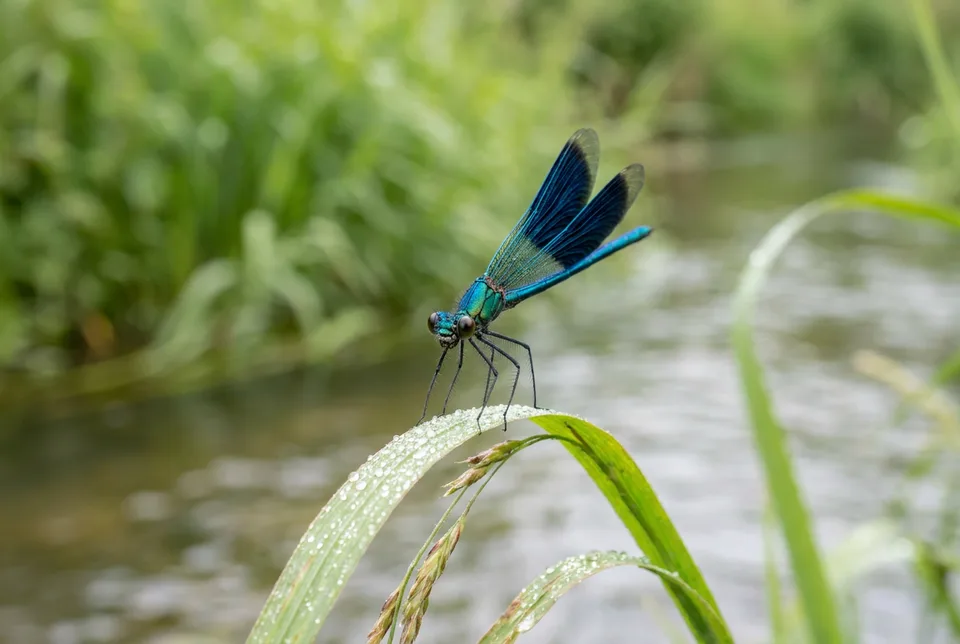
Banded Demoiselle in wetland habitat — Danube, River Cruises wildlifeAI-modified
Home›River Cruises›River Wildlife›Banded Demoiselle

Banded DemoiselleCalopteryx splendensWhere and when to see them

Previous speciesBald EagleNext speciesBar-tailed godwit

Banded Demoiselle at a glance

The Banded Demoiselle is a metallic-coloured damselfly with a fluttering flight that can look more butterfly-like than the direct flight visitors associate with larger dragonflies. Males have dark bands across the wings and a blue metallic body, while females are greener and lack the same strong wing bands. The registered River association is the Austrian Donau-Auen floodplain east of Vienna towards Hainburg on the Danube's Vienna–Bratislava reach. The national park specifically links the species to connected, flowing backwaters rather than the main navigation channel. This is a shore-excursion subject best appreciated at close but undisturbing range. Its life also connects two different worlds: aquatic larvae develop underwater, while adults use bankside vegetation and the air above the stream. The conspicuous adult therefore represents only one stage of a longer freshwater life cycle. Understanding that connection makes water quality and bank structure as important as the attractive wings.

Behaviour & reproduction

Size
Not verified
Weight
Species-specific weight not verified.
Lifespan
Not verified
Status
See sourced assessment

Donau-Auen describes territorial males using a distinctive whirring flight and attacking intruding members of the same species. Courtship includes presenting the pale underside near the tip of the abdomen and performing display flights. These interactions can make a short section of bank productive for observation without any need to follow individuals through vegetation. Females place eggs in aquatic plants and can submerge their whole bodies while laying. The park account describes a two-year larval development stage, with larvae occurring among roots at undercut banks and on aquatic vegetation. Adult flight is therefore only a brief visible part of a life substantially associated with the water below. A male repeatedly returning to a stem may be using a territorial perch rather than inviting approach. Stand back and watch the sequence of perching, flight and return. Never collect larvae, pull plants from the water or handle adults to inspect their wing pattern.

Top wildlife locations

Danube river landscape — River Cruises wildlife habitatAI-modified

Danube

Austria: Donau-Auen east of Vienna towards Hainburg, on the Vienna–Bratislava reach; optional shore excursion to suitable connected backwaters.
Explore river cruises

Destinations describe the species' habitat, not guaranteed cruise stops. Some animals require an optional inland excursion or are found in restricted reserves.

Fun facts about the Banded Demoiselle

  • It is a damselfly.
  • Males have a dark band rather than completely dark wings.
  • Females are metallic green.
  • Its flight can appear butterfly-like.
  • Males defend territories.
  • Courtship includes display of the underside near the abdominal tip.
  • Females can submerge while laying eggs.
  • Donau-Auen describes a two-year larval development stage.
  • Connected flowing backwaters support the registered Danube population.

Best time to see the Banded Demoiselle

The registry describes adult viewing in late spring and summer, and the species' dependence on suitable weather makes warm, calm observation periods a practical consideration. The retrieved Donau-Auen account establishes local habitat and life history but does not provide an original numerical month range for adult occurrence. Consequently, the location calendar remains empty. British flight-season information must not be transferred automatically to an Austrian Danube site, even when it seems broadly compatible with the registry wording. Larvae occupy the water for much longer than adults are conspicuous above the bank, so an adult viewing season is not the same thing as the full period of local presence. Ask the park guide about current emergence and permitted backwater routes. Sun, wind and shade can alter visibility within one day. A patient visit to suitable connected backwater habitat is more meaningful than treating a generic European flight calendar as a precise cruise-date prediction.

Banded Demoiselle: season matrix by destination

Highlighted months reflect the stated local evidence, not guaranteed encounters. Neutral months mean no verified monthly viewing window, not absence. Observation records and recommended viewing windows are distinct.

Danube

The registry suggests late-spring/summer adult viewing. The national park provides local habitat and life-history evidence but no verified numerical adult-occurrence calendar in the material read.

JanFebMarAprMayJunJulAugSepOctNovDec
Explore river cruises

Where the Banded Demoiselle lives

The local Donau-Auen account identifies connected, free-flowing backwaters as the important habitat, with the species occurring in limited numbers. The British Dragonfly Society similarly associates it with slow-flowing lowland streams and rivers, especially where suitable vegetation and muddy substrates occur. These descriptions should not be simplified into a preference for any stagnant pool: gentle flow and the structure of the river margin matter. Roots beneath undercut banks and aquatic plants support the larval stage, while emergent and bankside vegetation provide adult perches and egg-laying opportunities. On a Danube cruise, an authorised floodplain walk east of Vienna is therefore more relevant than scanning the fast, broad navigation channel. Dredging, pollution, excessive vegetation removal and altered water availability can affect the habitat system. Access should remain on established paths, because trampling a narrow strip of bank can damage the very vegetation that makes a demoiselle site suitable.

What the Banded Demoiselle eats

Banded Demoiselles are predators in both their aquatic larval stage and their flying adult stage. Adults take small insects, while larvae capture small aquatic animals within the vegetation and root structures where they live. This life-stage distinction is more informative than describing the species simply as an insect seen above a stream. However, the original local and specialist accounts retrieved for this profile do not provide a Donau-Auen prey inventory, measured dietary proportions or a seasonal feeding study. Particular prey species and percentages therefore remain unverified. The national park's description of several flight patterns, including prey-related flight, shows that not every movement is courtship or territorial defence. Patient observation may reveal a brief hunting excursion followed by a return to a perch, although prey can be too small to identify. Do not introduce insects, disturb aquatic vegetation or collect larvae to demonstrate feeding. Natural activity is sufficient to show the animal's role in the freshwater food web.

Species at a glance

Common name
Banded Demoiselle
Scientific name
Calopteryx splendens
Animal group
Insects
Size
Approximately 5 cm (2.0 in) body length and up to 6–7 cm (2.4–2.8 in) wingspan in the Donau-Auen account; British Dragonfly Society gives 45 mm (1.8 in) body length.
Weight
Species-specific weight not verified.
Lifespan
Donau-Auen describes a two-year larval development stage; a separate adult lifespan was not verified.
Status
A current formal global assessment was not verified. Donau-Auen and British Dragonfly Society regional conservation statements are not treated as a newly checked global assessment.
Identification
Male Banded Demoiselles have a metallic blue body and a broad dark blue-black area across each wing, leaving the base and tip relatively clear. Females have a metallic green body and more evenly translucent greenish wings. The British Dragonfly Society contrasts males with Beautiful Demoiselles, whose wings are much more extensively darkened; the females of the two species are more difficult to separate and should be checked carefully. Colour changes with lighting, so metallic blue can appear almost black from one angle and bright from another. The butterfly-like flight is helpful for locating a demoiselle but is not sufficient to identify the species. Wait for an adult to perch and assess the distribution of wing pigment rather than relying on body colour alone. Do not import North American jewelwing names from an image search into a European identification. A clear, undisturbed photograph of the wings can support confirmation by a knowledgeable local guide.

Banded Demoiselle: frequently asked questions

Where can I see the Banded Demoiselle?
Danube. Find a permitted path beside a suitable slow-flowing backwater and watch the bank vegetation before moving closer. Metallic colour or a fluttering flight may draw attention first, but a settled adult often gives the best view of wing pattern. Remain still near a productive section and allow individuals to return to their usual perches. Binoculars with good close focus or a camera zoom can reveal detail without handling the insect. Avoid leaning into vegetation, entering the water or collecting specimens, and do not move a resting adult onto a more photogenic stem. The registered Danube association is Donau-Auen east of Vienna towards Hainburg, not all Austrian or Hungarian riverbanks. Males and females differ, so search for both without expecting every individual to carry a dark band. Repeated territorial flights can be studied from one position, offering useful behavioural observation while keeping pressure on the narrow river margin low.
When is the best time to see the Banded Demoiselle?
The registry describes adult viewing in late spring and summer, and the species' dependence on suitable weather makes warm, calm observation periods a practical consideration. The retrieved Donau-Auen account establishes local habitat and life history but does not provide an original numerical month range for adult occurrence. Consequently, the location calendar remains empty. British flight-season information must not be transferred automatically to an Austrian Danube site, even when it seems broadly compatible with the registry wording. Larvae occupy the water for much longer than adults are conspicuous above the bank, so an adult viewing season is not the same thing as the full period of local presence. Ask the park guide about current emergence and permitted backwater routes. Sun, wind and shade can alter visibility within one day. A patient visit to suitable connected backwater habitat is more meaningful than treating a generic European flight calendar as a precise cruise-date prediction.
How big does the Banded Demoiselle get?
Approximately 5 cm (2.0 in) body length and up to 6–7 cm (2.4–2.8 in) wingspan in the Donau-Auen account; British Dragonfly Society gives 45 mm (1.8 in) body length.. Adult weight: Species-specific weight not verified.. Size varies with age, sex and population.
How should I behave around the Banded Demoiselle?
Find a permitted path beside a suitable slow-flowing backwater and watch the bank vegetation before moving closer. Metallic colour or a fluttering flight may draw attention first, but a settled adult often gives the best view of wing pattern. Remain still near a productive section and allow individuals to return to their usual perches. Binoculars with good close focus or a camera zoom can reveal detail without handling the insect. Avoid leaning into vegetation, entering the water or collecting specimens, and do not move a resting adult onto a more photogenic stem. The registered Danube association is Donau-Auen east of Vienna towards Hainburg, not all Austrian or Hungarian riverbanks. Males and females differ, so search for both without expecting every individual to carry a dark band. Repeated territorial flights can be studied from one position, offering useful behavioural observation while keeping pressure on the narrow river margin low.
What does the Banded Demoiselle eat?
Banded Demoiselles are predators in both their aquatic larval stage and their flying adult stage. Adults take small insects, while larvae capture small aquatic animals within the vegetation and root structures where they live. This life-stage distinction is more informative than describing the species simply as an insect seen above a stream. However, the original local and specialist accounts retrieved for this profile do not provide a Donau-Auen prey inventory, measured dietary proportions or a seasonal feeding study. Particular prey species and percentages therefore remain unverified. The national park's description of several flight patterns, including prey-related flight, shows that not every movement is courtship or territorial defence. Patient observation may reveal a brief hunting excursion followed by a return to a perch, although prey can be too small to identify. Do not introduce insects, disturb aquatic vegetation or collect larvae to demonstrate feeding. Natural activity is sufficient to show the animal's role in the freshwater food web.
Are wildlife sightings guaranteed on a river cruise?
No. Animals move freely and routes, weather, access restrictions and local conditions influence every outing. Confirm the actual itinerary and shore program before booking.

Compare wildlife in the same destinations

Explore other insects recorded in these destinations. Similar surroundings do not mean the animals share the same habits or viewing season.

Species comparison by animal group and destination
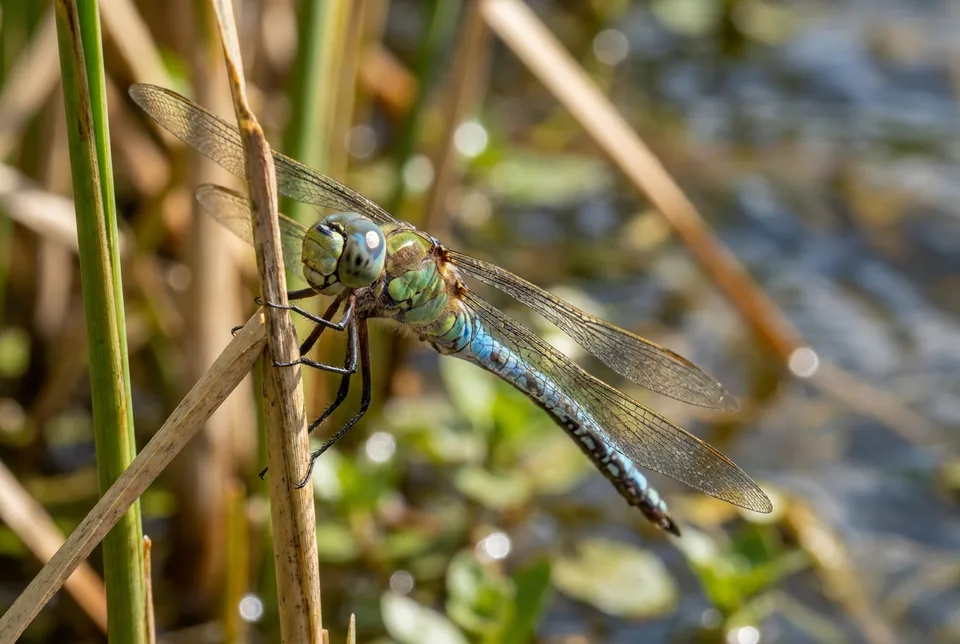
Banded Demoiselle in wetland habitat — Danube, River Cruises wildlifeAI-modifiedBanded DemoiselleEmperor Dragonfly in wetland habitat — Danube, River Cruises wildlifeAI-modifiedEmperor Dragonfly
Animal groupInsectsAnimal groupInsects
DestinationsDanubeDestinationsDanube
Scientific name
Calopteryx splendens
Scientific name
Previous speciesBald EagleNext speciesBar-tailed godwit
All river wildlife
On this page
  • 01About
  • 02Behaviour & reproduction
  • 03Top wildlife locations
  • 04Fun facts
  • 05Best season
  • 06Season matrix by destination
  • 07Habitat
  • 08Diet
  • 09Species at a glance
  • 10Questions & answers
  • 11Compare

Find your river cruise

AI-modified
Plan your trip

Find your next river journey

Compare destinations, shore programs and dates with the animals and habitats you would love to see.

  • Daily shore excursions
  • Responsible wildlife watching
  • Boutique river ships
Explore river cruises