Bluerides – Blue Rides - Book Liveaboards worldwideOCEAN ADVENTURES
River CruisesRiversNature & WildlifeOur Promise
River CruisesRiversNature & WildlifeOur PromiseSign In

River destinations

  • River destinations
  • Amazon
  • Danube
  • Rhine
  • Mekong
  • Nile

Ships & departures

  • River Cruise Search
  • Deals

Nature & Wildlife

  • Nature & Wildlife

Travel support

  • Our Promise
  • Contact

Contact

Get in Touch

Get in touch anytime, we're happy to help you find the right trip or sort out any question.

EmailWrite us, we usually reply within a few hours.
contact@bluerides.com
WhatsAppChat with us on WhatsApp, Mon–Fri 10:00–16:00 (CET).
Start WhatsApp Chat
PhoneCall us, we're happy to help.
Free call, Mon–Fri 10 AM – 8 PM (CET).
Europe+49 800 1144 990USA+1 888 557 7735UK+44 800 707 4152Australia+61 2 8599 6113Canada+1 888 557 7735
Which river journey is yours?Answer 8 quick questions and find the river cruise that fits you.
8 questions, 1 minute·Plus Gift
Secure Payment MethodsYour payments are fully secured with AES-256 encryption.
Powered byStripeWiseAMEXPayGoogle PaySEPABank
Imprint·Terms & Conditions·Privacy Policy·About·Contact·Liability Waiver·Affiliate Program·Cruise·Blog·
Visit us here

© 2026 Blue Rides. All rights reserved.

Bluerides – Blue Rides - Book Liveaboards worldwideOCEAN ADVENTURES
River CruisesRiversNature & WildlifeOur Promise
River CruisesRiversNature & WildlifeOur PromiseSign In
Asian Palm Swift in wetland habitat — Mekong, River Cruises wildlifeAI-modified
Home›River Cruises›River Wildlife›Asian Palm Swift

Asian Palm SwiftCypsiurus balasiensisWhere and when to see them

Previous speciesAsian OpenbillNext speciesBald Eagle

Asian Palm Swift at a glance

The Asian Palm Swift is a small aerial bird closely associated with palms used for nesting and roosting. It belongs to the swift family rather than the swallows, despite sharing their insect-catching airspace. The River registry places it at Tra Su flooded forest in the Vietnamese Mekong delta, as an optional shore excursion from Chau Doc. The original local evidence is an official page reproducing a BirdLife and IEBR survey checklist, not a promise that the species will be visible from the main Mekong channel. Original observations from Singapore provide particularly useful biological detail about the nest, which is attached beneath a palm frond using saliva-bound material. These observations describe the species' behaviour at that site and are not a Vietnamese breeding timetable. For a visitor, the important habitat combination is open aerial feeding space with suitable palms nearby. The flooded forest setting alone does not explain the bird's presence as fully as that broader vegetation structure.

Behaviour & reproduction

Size
Species-specific measurement not verified from the authoritative original material read.
Weight
Species-specific weight not verified.
Lifespan
Species-specific lifespan not verified.
Status
See sourced assessment

Asian Palm Swifts spend feeding periods in the air, with the long-winged silhouette often easier to notice than subtle plumage. Their association with palms becomes especially clear at roosting and nesting sites. The Bird Ecology Study Group documented an adult feeding two chicks at a palm-frond nest in Singapore, including a chick positioned on the apron as the young became too large to remain together inside the small nest. The nest was a half-cup attached to the underside of a hanging frond, with saliva binding the material to the surface. Importantly, that account says the Asian Palm Swift's eggs are not glued to the nest, correcting an attractive but misleading generalisation from other palm swifts. These are valuable original behavioural observations, but their dates and local breeding conditions should not be transferred to Tra Su. Avoid approaching occupied palms or attempting to expose a nest hidden beneath a frond.

Top wildlife locations

Mekong river landscape — River Cruises wildlife habitatAI-modified

Mekong

Vietnam Mekong delta: Tra Su flooded forest, optional shore excursion from Chau Doc; not main-channel deck wildlife.
Explore river cruises

Destinations describe the species' habitat, not guaranteed cruise stops. Some animals require an optional inland excursion or are found in restricted reserves.

Fun facts about the Asian Palm Swift

  • It belongs to the swift family, Apodidae.
  • Palms provide nesting and roosting sites.
  • The nest can hang beneath a palm frond.
  • Saliva binds nest material to the frond.
  • Original observations document plant floss and feathers in nest construction.
  • The cited Singapore account says its eggs are not glued to the nest.
  • Adults feed chicks at the small palm-frond nest.
  • The registered Mekong locality is Tra Su near Chau Doc.
  • The local checklist is occurrence evidence, not a verified monthly calendar.

Best time to see the Asian Palm Swift

The Tra Su source lists Asian Palm Swift among birds recorded by the BirdLife and IEBR survey team, but the retrieved species entry does not establish a local month-by-month season. The registry identifies the checklist as historical survey evidence, and no numerical months are assigned here. The Singapore nesting observation has a clear local date, but it belongs to a different country and cannot support a Vietnamese nesting or viewing calendar. Broad regional distribution likewise does not prove year-round visibility at one excursion stop. At Tra Su, current weather, insect activity, palm use and the route available to visitors will influence what can be seen. Ask a local guide whether swifts are currently using the area and where a safe open-sky viewpoint is available. A general Mekong cruise season should not be substituted for species-specific evidence. The meaningful planning advice is to combine the historical checklist with current local knowledge while keeping the unresolved calendar explicit.

Asian Palm Swift: season matrix by destination

Highlighted months reflect the stated local evidence, not guaranteed encounters. Neutral months mean no verified monthly viewing window, not absence. Observation records and recommended viewing windows are distinct.

Mekong

The official BirdLife/IEBR survey checklist establishes historical presence but no species-specific local month schedule. Singapore breeding observations are not transferred to Tra Su.

JanFebMarAprMayJunJulAugSepOctNovDec
Explore river cruises

Where the Asian Palm Swift lives

Suitable palms and adjacent feeding airspace are central to understanding Asian Palm Swift habitat. Original Singapore observations describe nesting and roosting in fan palms and mention use of several other palm types. The documented site stood beside a road and buildings, showing that the species' association with palms can extend into human-modified landscapes. That does not mean every palm-lined settlement contains a colony. In the River registry, the relevant place is Tra Su flooded forest, reached as an optional excursion from Chau Doc in the Mekong delta. The official survey checklist establishes the species there but does not identify a particular nesting palm, boardwalk viewpoint or main-channel location. Look at the wider landscape around the excursion site, including open sky and palm crowns, rather than restricting attention to water beneath the boat. Retaining mature palms and avoiding disturbance to occupied fronds are meaningful habitat considerations for this aerial specialist.

What the Asian Palm Swift eats

Asian Palm Swifts take small airborne invertebrates while flying, placing them among the aerial insectivores rather than the birds that probe mud or dive for fish. Their feeding habitat is therefore three-dimensional airspace above and around vegetation. A swift crossing a flooded forest may be taking insects over the canopy without using the water directly. The original Singapore nest observation confirms adults provisioning chicks, but the retrieved account does not identify the prey delivered or provide a measured dietary breakdown. A Tra Su-specific prey list, seasonal insect relationship and numerical food proportions were not verified. These gaps should not be filled by assuming that all small swifts select identical prey. Observers can still distinguish active aerial feeding from direct travel by watching repeated turns and passes through the same airspace. Do not release insects or place food near palms to attract birds. Natural feeding activity and undisturbed nest visits provide more reliable ecological information.

Species at a glance

Common name
Asian Palm Swift
Scientific name
Cypsiurus balasiensis
Animal group
Birds
Size
Species-specific measurement not verified from the authoritative original material read.
Weight
Species-specific weight not verified.
Lifespan
Species-specific lifespan not verified.
Status
A current formal global assessment was not verified. The Tra Su survey checklist establishes historical occurrence, not current abundance.
Identification
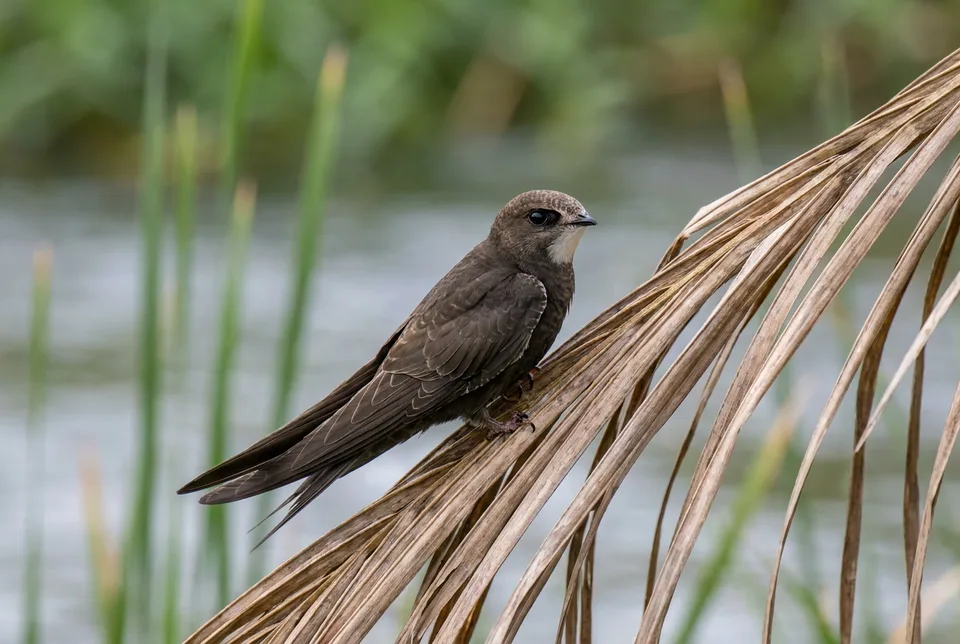
A small, slender swift with long narrow wings and a deeply forked tail is the starting impression for Asian Palm Swift. Its generally subdued brownish appearance can be difficult to judge against a bright sky, making shape and flight important alongside plumage. Palm association is useful context but not a sufficient identification feature, because other aerial birds can pass over the same trees. Swallows and swiftlets need to be considered by a local guide when the view is distant or brief. Look for several passes rather than assigning a name from one dark silhouette. Sexes are not readily separated by a simple conspicuous colour difference in ordinary field views, and the original local checklist does not supply a Tra Su-specific identification key. A photograph showing the tail shape and wing proportions can help, provided it is obtained without approaching nests. When the diagnostic outline is not visible, retain an unidentified swift rather than inferring species solely from the registry.

Asian Palm Swift: frequently asked questions

Where can I see the Asian Palm Swift?
Mekong. At Tra Su, include the airspace above palms and forest edges in a wildlife scan instead of looking only for birds on the water. A fixed viewing point can be more effective than continuously moving, because swifts may make repeated passes through the same patch of sky. Locate the bird with the naked eye before raising binoculars, and keep attention on footing when using boardwalks or towers. Identification can be difficult against bright sky, so wait for views with a darker background or a favourable angle. If birds are repeatedly approaching a palm, remain well back and do not search beneath fronds for nests. The registered association is an optional Chau Doc-area shore excursion, not guaranteed deck wildlife on the Mekong main channel. Avoid playing calls, disturbing roosts or using flash at occupied palms. A brief but well-described flight observation is preferable to a close approach that disrupts feeding or nest attendance.
When is the best time to see the Asian Palm Swift?
The Tra Su source lists Asian Palm Swift among birds recorded by the BirdLife and IEBR survey team, but the retrieved species entry does not establish a local month-by-month season. The registry identifies the checklist as historical survey evidence, and no numerical months are assigned here. The Singapore nesting observation has a clear local date, but it belongs to a different country and cannot support a Vietnamese nesting or viewing calendar. Broad regional distribution likewise does not prove year-round visibility at one excursion stop. At Tra Su, current weather, insect activity, palm use and the route available to visitors will influence what can be seen. Ask a local guide whether swifts are currently using the area and where a safe open-sky viewpoint is available. A general Mekong cruise season should not be substituted for species-specific evidence. The meaningful planning advice is to combine the historical checklist with current local knowledge while keeping the unresolved calendar explicit.
How big does the Asian Palm Swift get?
Species-specific measurement not verified from the authoritative original material read.. Adult weight: Species-specific weight not verified.. Size varies with age, sex and population.
How should I behave around the Asian Palm Swift?
At Tra Su, include the airspace above palms and forest edges in a wildlife scan instead of looking only for birds on the water. A fixed viewing point can be more effective than continuously moving, because swifts may make repeated passes through the same patch of sky. Locate the bird with the naked eye before raising binoculars, and keep attention on footing when using boardwalks or towers. Identification can be difficult against bright sky, so wait for views with a darker background or a favourable angle. If birds are repeatedly approaching a palm, remain well back and do not search beneath fronds for nests. The registered association is an optional Chau Doc-area shore excursion, not guaranteed deck wildlife on the Mekong main channel. Avoid playing calls, disturbing roosts or using flash at occupied palms. A brief but well-described flight observation is preferable to a close approach that disrupts feeding or nest attendance.
What does the Asian Palm Swift eat?
Asian Palm Swifts take small airborne invertebrates while flying, placing them among the aerial insectivores rather than the birds that probe mud or dive for fish. Their feeding habitat is therefore three-dimensional airspace above and around vegetation. A swift crossing a flooded forest may be taking insects over the canopy without using the water directly. The original Singapore nest observation confirms adults provisioning chicks, but the retrieved account does not identify the prey delivered or provide a measured dietary breakdown. A Tra Su-specific prey list, seasonal insect relationship and numerical food proportions were not verified. These gaps should not be filled by assuming that all small swifts select identical prey. Observers can still distinguish active aerial feeding from direct travel by watching repeated turns and passes through the same airspace. Do not release insects or place food near palms to attract birds. Natural feeding activity and undisturbed nest visits provide more reliable ecological information.
Are wildlife sightings guaranteed on a river cruise?
No. Animals move freely and routes, weather, access restrictions and local conditions influence every outing. Confirm the actual itinerary and shore program before booking.

Compare wildlife in the same destinations

Explore other birds recorded in these destinations. Similar surroundings do not mean the animals share the same habits or viewing season.

Species comparison by animal group and destination
Asian Palm Swift in wetland habitat — Mekong, River Cruises wildlifeAI-modifiedAsian Palm SwiftAsian openbill in wetland habitat — Mekong, River Cruises wildlifeAI-modifiedAsian OpenbillBlack-capped Kingfisher in wetland habitat — Mekong, River Cruises wildlifeAI-modifiedBlack-capped Kingfisher
Animal groupBirdsAnimal groupBirdsAnimal groupBirds
DestinationsMekongDestinationsMekongDestinationsMekong
Scientific name
Cypsiurus balasiensis
Scientific name
Scientific name
Previous speciesAsian OpenbillNext speciesBald Eagle
All river wildlife
On this page
  • 01About
  • 02Behaviour & reproduction
  • 03Top wildlife locations
  • 04Fun facts
  • 05Best season
  • 06Season matrix by destination
  • 07Habitat
  • 08Diet
  • 09Species at a glance
  • 10Questions & answers
  • 11Compare

Find your river cruise

AI-modified
Plan your trip

Find your next river journey

Compare destinations, shore programs and dates with the animals and habitats you would love to see.

  • Daily shore excursions
  • Responsible wildlife watching
  • Boutique river ships
Explore river cruises