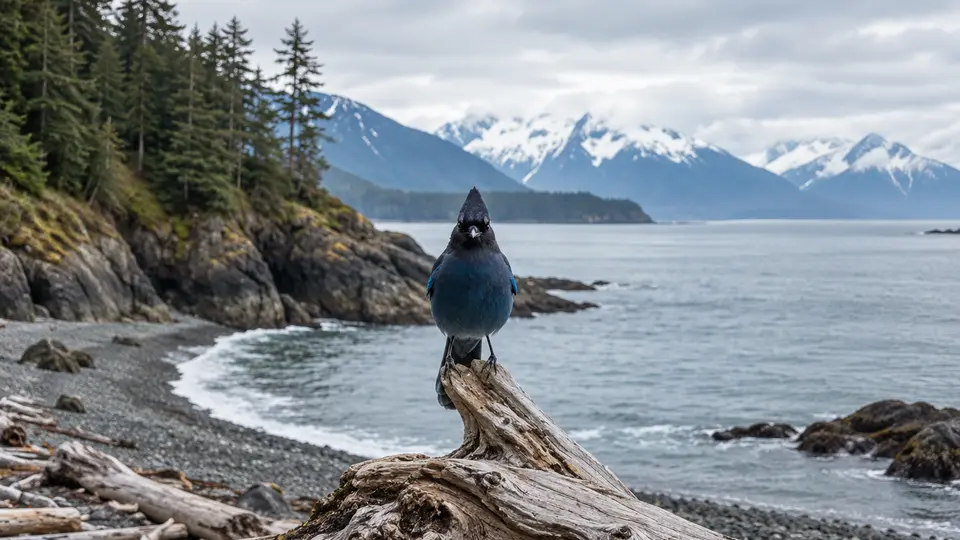
Steller's Jay in its natural habitat, AI illustration

Steller's JayCyanocitta stelleriWhere and when to see them

Steller's Jay at a glance

Steller's jay is a bold, crested member of the crow family inhabiting western North American forests. Its dark head contrasts with a rich blue body, making it distinctive around the forested coasts of southeastern Alaska. Intelligent and opportunistic, it may investigate picnic areas, but its natural life centres on woodland food and shelter. It is not distributed across all of Alaska, and treeless northern shores are outside its usual habitat.

Behaviour & reproduction

Size
Length 30–34 cm
Weight
100–140 g
Lifespan
Not reliably established
Status
Least Concern

Pairs occupy woodland territories during breeding, while looser groups may form at other times. Jays search foliage, branches and the ground, cache food for later use and watch other animals closely. Their loud calls often reveal them before they are visible, and they can imitate other birds, including raptors. Around people they may become confident scavengers, a habit that should not be encouraged through feeding. They are known for their intelligence and problem-solving abilities, particularly in accessing food. Their calls can be very diverse, and they frequently mimic red-tailed hawks or other raptors, possibly to scare away competitors from food sources.

Top wildlife locations

Alaska wildlife habitat

Alaska

Forested coastal trails and wooded settlements in southeastern Alaska provide plausible viewing without a major inland excursion. The species is not widespread statewide, and northern tundra coasts or treeless landing areas are unsuitable.

Destinations describe the species' habitat, not guaranteed cruise stops. Some animals require an optional inland excursion or are found in restricted reserves.

Fun facts about the Steller's Jay

  • Its blue appearance comes largely from feather structure rather than blue pigment.
  • It stores food in caches for later retrieval.
  • The nest can include a substantial mud component.
  • Its vocal repertoire includes imitations of other bird species.

Best time to see the Steller's Jay

Steller's jays are resident within their Alaskan range, so suitable forest can be visited throughout the year. May through September provides longer daylight and easier coastal trail access. Breeding birds may be quieter or more defensive near nests, and neither calls nor sightings are assured. Winter months offer unique opportunities to observe jays when snow cover limits ground foraging, leading them to be more active in trees and sometimes near human settlements. Spring can be interesting for observing courtship displays, though birds may be more reclusive.

Steller's Jay: season matrix by destination

Travel and observation windows vary by region. Highlighted months are an orientation for planning, not confirmed sightings or a guarantee of access.

Alaska

A convenient daylight and trail-access window for a resident bird, not a migration season; local forest distribution determines prospects.

JanFebMarAprMayJunJulAugSepOctNovDec
Cruise ships in Alaska

Where the Steller's Jay lives

Coniferous and mixed forests are typical, including spruce-hemlock woodland, forest edges and wooded settlements. In southeastern Alaska, coastal forest trails can provide suitable habitat close to the sea. Open tundra, exposed beaches and largely treeless islands offer little prospect unless woodland is nearby. They are often found in mature coniferous forests but will also utilize mixed woodlands. In some areas, they adapt well to suburban environments where suitable trees and food sources are present, though this is less common in remote Alaskan regions.

What the Steller's Jay eats

An adaptable omnivore, it eats seeds, nuts, berries, insects and other invertebrates. Eggs, nestlings and small vertebrates are taken opportunistically. Cached foods can be important when fresh supplies decline, while human scraps are an avoidable supplement that can create unhealthy dependence. Acorns and pine nuts are favorite natural foods, often stored for winter. They can also consume small rodents and lizards, especially during times of high energy demand.

Species at a glance

Common name
Steller's Jay
Scientific name
Cyanocitta stelleri
Animal group
Birds
Size
Length 30–34 cm
Weight
100–140 g
Lifespan
Not reliably established
Status
Least Concern
Identification
A tall crest, dark head and blue body distinguish it from the uncrested Canada jay, which is mainly grey and white. Beyond the blue body and dark head, a small white patch above the eye and faint blue barring on the wings are distinguishing features. The shade of blue can vary geographically, but the overall pattern is consistent.

Steller's Jay: frequently asked questions

Where can I see the Steller's Jay?
Alaska. Listen along southeastern Alaskan forest trails and watch from a respectful distance. Keep food secured, never lure birds with snacks, and retreat if adults give persistent alarm calls near a nest. Their noisy calls, ranging from harsh 'shklee-shklee' to varied whistles, are often the first sign of their presence. Look for them moving among the upper branches of conifers or hopping on the forest floor, especially near picnic areas or campgrounds.
When is the best time to see the Steller's Jay?
Steller's jays are resident within their Alaskan range, so suitable forest can be visited throughout the year. May through September provides longer daylight and easier coastal trail access. Breeding birds may be quieter or more defensive near nests, and neither calls nor sightings are assured. Winter months offer unique opportunities to observe jays when snow cover limits ground foraging, leading them to be more active in trees and sometimes near human settlements. Spring can be interesting for observing courtship displays, though birds may be more reclusive.
How big does the Steller's Jay get?
Length 30–34 cm. Adult weight: 100–140 g. Size varies with age, sex and population.
How should I behave around the Steller's Jay?
Listen along southeastern Alaskan forest trails and watch from a respectful distance. Keep food secured, never lure birds with snacks, and retreat if adults give persistent alarm calls near a nest. Their noisy calls, ranging from harsh 'shklee-shklee' to varied whistles, are often the first sign of their presence. Look for them moving among the upper branches of conifers or hopping on the forest floor, especially near picnic areas or campgrounds.
What does the Steller's Jay eat?
An adaptable omnivore, it eats seeds, nuts, berries, insects and other invertebrates. Eggs, nestlings and small vertebrates are taken opportunistically. Cached foods can be important when fresh supplies decline, while human scraps are an avoidable supplement that can create unhealthy dependence. Acorns and pine nuts are favorite natural foods, often stored for winter. They can also consume small rodents and lizards, especially during times of high energy demand.
Are wildlife sightings guaranteed on an adventure cruise?
No. Animals move freely and routes, weather, access restrictions and local conditions influence every outing. Confirm the actual itinerary and shore program before booking.

Compare wildlife in the same destinations

Explore other birds recorded in these destinations. Similar surroundings do not mean the animals share the same habits or viewing season.

Species comparison by animal group and destination
Steller's JaySteller's JayArctic TernArctic TernBald EagleBald Eagle
Animal groupBirdsAnimal groupBirdsAnimal groupBirds
DestinationsAlaskaDestinationsAlaska, Norway, ArcticDestinationsAlaska, Florida, New England
All wildlife destinations
Plan your trip

Find your next wildlife adventure

Compare destinations, shore programs and dates with the animals and habitats you would love to see.

  • Naturalist-led shore excursions
  • Responsible wildlife watching
  • Small expedition ships

Newsletter

Take Blue Rides with you

Adventure cruise offers, last-minute deals and trip inspiration.

Free, unsubscribe anytime. Details: Privacy Policy

Partner with Blue Rides

Affiliate Program

Recommend adventure cruises and earn commission on every confirmed booking.

Share. Track. Earn.

Your footage, our stage

Send us your videos or pictures.

Captured remarkable nature or wildlife on your journey? Share it with us, we may feature it on Blue Rides.