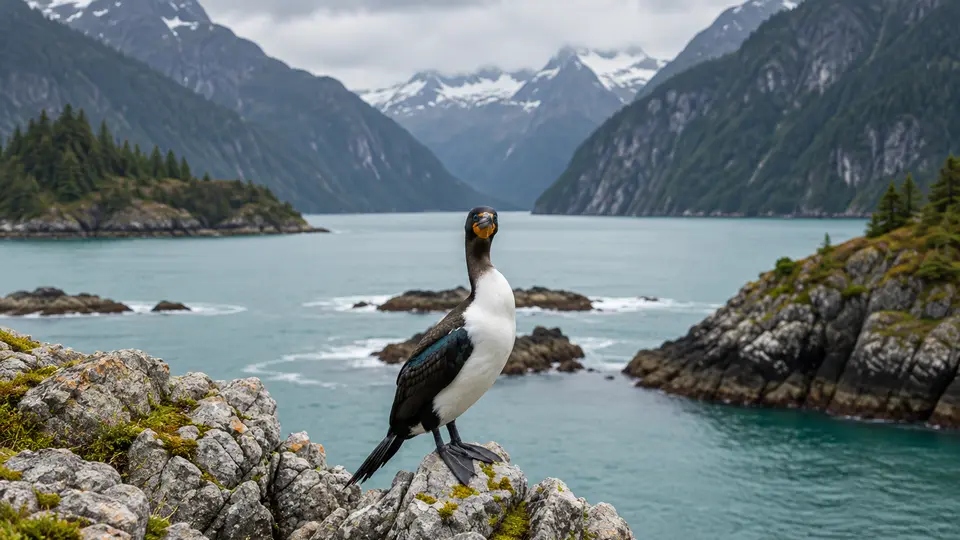
New Zealand king shag in its natural habitatAI-modified

New Zealand king shagLeucocarbo carunculatusWhere and when to see them

New Zealand king shag at a glance

The New Zealand king shag is a large, strikingly patterned cormorant restricted to the Marlborough Sounds region. Its tiny geographical range and small population make it one of New Zealand's most localized seabirds. Adults have white underparts, a dark back and pale pink feet, with bright facial ornaments becoming conspicuous during breeding. Colonies occupy rocky sites, while feeding occurs in nearby marine waters rather than freshwater lakes or rivers.

Behaviour & reproduction

Size
76 cm (29.9 in) body length
Weight
2.0-2.5 kg (4.4-5.5 lb)
Lifespan
Not reliably established
Status
Vulnerable

King shags breed and roost communally, using a limited network of rocky islands and stacks. Pairs construct substantial nests, and adults commute to feeding grounds within the surrounding sounds. Birds may rest upright for extended periods between fishing trips. Colony disturbance is especially consequential because suitable occupied sites are few. Their daily distribution changes with feeding conditions, so even a known roost should not be treated as a dependable viewing stop. Courtship displays involve bowing, head-shaking, and mutual preening, strengthening pair bonds on the breeding grounds. Young birds often remain in the vicinity of their natal colony for their first year.

Top wildlife locations

New Zealand wildlife habitatAI-modified

New Zealand

Only the Marlborough Sounds offer realistic opportunities, using distant coastal viewpoints or vessel decks near rocky habitat. Colonies are sensitive, often inaccessible, and should never be treated as casual landing destinations.

Destinations describe the species' habitat, not guaranteed cruise stops. Some animals require an optional inland excursion or are found in restricted reserves.

Fun facts about the New Zealand king shag

  • Its entire natural breeding range lies within the Marlborough Sounds region.
  • Breeding adults develop conspicuous orange-yellow facial caruncles.
  • Despite the name blue-eyed shag being used for its wider group, the vivid blue is mainly the eye ring.
  • A small number of colonies holds the species' entire breeding population.

Best time to see the New Zealand king shag

King shags remain in the Marlborough Sounds throughout the year, so no migratory arrival defines a viewing season. Warmer months usually offer more comfortable deck observation. Breeding commonly involves the cooler part of the year, but timing varies and colonies require protection regardless. Breeding can occur at any time of the year, with peak activity often observed in autumn and winter. Chicks fledge after approximately 60 days, remaining dependent on adults for a period thereafter.

New Zealand king shag: season matrix by destination

Travel and observation windows vary by region. Highlighted months are an orientation for planning, not confirmed sightings or a guarantee of access.

New Zealand

A generally comfortable regional travel window, not a breeding-season claim; resident birds occur year-round but access and weather vary.

JanFebMarAprMayJunJulAugSepOctNovDec
Cruise ships in New Zealand

Where the New Zealand king shag lives

Sheltered marine waters of the Marlborough Sounds support feeding, while rocky islets and coastal stacks provide nesting and roosting sites. The species is geographically restricted and absent from most New Zealand coastlines. Colony access is sensitive and may be prohibited. This restricted range means they are particularly vulnerable to localized habitat degradation and disturbance. Their preference for steep, rocky coastlines offers protection from some terrestrial predators.

What the New Zealand king shag eats

Bottom-associated marine fish dominate the diet, including flatfish and other fishes living near the seabed. Adults forage in the sounds and return to rocky resting sites between trips. Their dependence on local marine prey links population health closely to regional environmental conditions. Prey is typically caught by pursuit diving, with individuals consuming multiple small fish per dive. The birds often swallow fish headfirst while still underwater.

Species at a glance

Common name
New Zealand king shag
Scientific name
Leucocarbo carunculatus
Animal group
Birds
Size
76 cm (29.9 in) body length
Weight
2.0-2.5 kg (4.4-5.5 lb)
Lifespan
Not reliably established
Status
Vulnerable
Identification
Its large size, pink feet, white upperwing patch and Marlborough Sounds range distinguish king shag from the smaller pied shag with dark feet. The deep black-blue plumage of the back and wings contrasts sharply with the pure white underparts. A prominent orange facial wattle is present during the breeding season.

New Zealand king shag: frequently asked questions

Where can I see the New Zealand king shag?
New Zealand. Use a telescope from an established shore viewpoint or binoculars from a distant deck. Never request a close colony approach or landing. If resting birds become alert or shift position, increase separation immediately. Scanning for their distinctive white breast and neck against dark rock can help locate them from a distance. Patient observation from afar is key, as any sign of agitation indicates you are too close.
When is the best time to see the New Zealand king shag?
King shags remain in the Marlborough Sounds throughout the year, so no migratory arrival defines a viewing season. Warmer months usually offer more comfortable deck observation. Breeding commonly involves the cooler part of the year, but timing varies and colonies require protection regardless. Breeding can occur at any time of the year, with peak activity often observed in autumn and winter. Chicks fledge after approximately 60 days, remaining dependent on adults for a period thereafter.
How big does the New Zealand king shag get?
76 cm (29.9 in) body length. Adult weight: 2.0-2.5 kg (4.4-5.5 lb). Size varies with age, sex and population.
How should I behave around the New Zealand king shag?
Use a telescope from an established shore viewpoint or binoculars from a distant deck. Never request a close colony approach or landing. If resting birds become alert or shift position, increase separation immediately. Scanning for their distinctive white breast and neck against dark rock can help locate them from a distance. Patient observation from afar is key, as any sign of agitation indicates you are too close.
What does the New Zealand king shag eat?
Bottom-associated marine fish dominate the diet, including flatfish and other fishes living near the seabed. Adults forage in the sounds and return to rocky resting sites between trips. Their dependence on local marine prey links population health closely to regional environmental conditions. Prey is typically caught by pursuit diving, with individuals consuming multiple small fish per dive. The birds often swallow fish headfirst while still underwater.
Are wildlife sightings guaranteed on an adventure cruise?
No. Animals move freely and routes, weather, access restrictions and local conditions influence every outing. Confirm the actual itinerary and shore program before booking.

Compare wildlife in the same destinations

Explore other birds recorded in these destinations. Similar surroundings do not mean the animals share the same habits or viewing season.

Species comparison by animal group and destination
New Zealand king shagAI-modifiedNew Zealand king shagAustralasian gannetAI-modifiedAustralasian gannetBar-tailed godwitAI-modifiedBar-tailed godwit
Animal groupBirdsAnimal groupBirdsAnimal groupBirds
DestinationsNew ZealandDestinationsNew ZealandDestinationsAustralia, New Zealand
Scientific nameLeucocarbo carunculatusScientific nameScientific name
All wildlife destinations
AI-modified
Plan your trip

Find your next wildlife adventure

Compare destinations, shore programs and dates with the animals and habitats you would love to see.

  • Naturalist-led shore excursions
  • Responsible wildlife watching
  • Small expedition ships