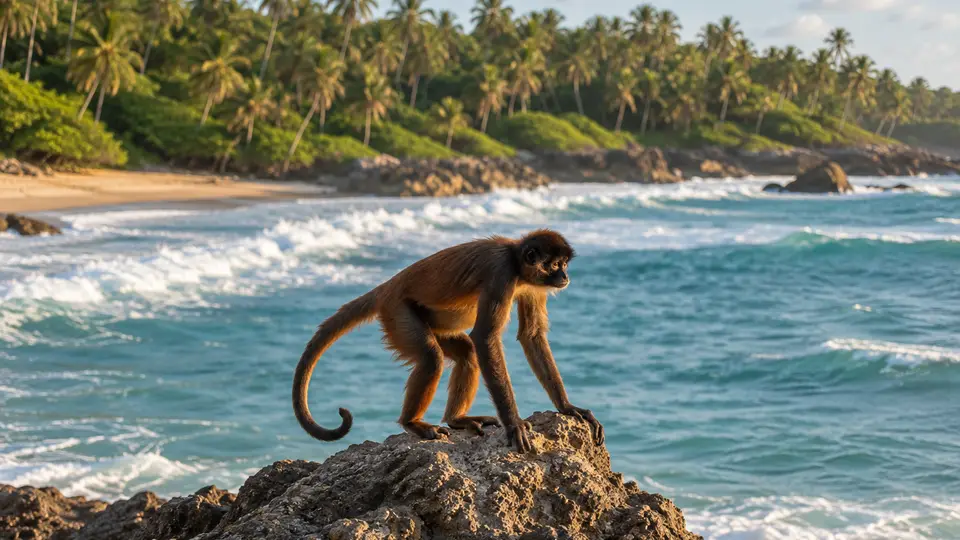
Geoffroy's Spider Monkey in its natural habitat, AI illustration

Geoffroy's Spider Monkey: where and when to see them

Ateles geoffroyi

Geoffroy's Spider Monkey at a glance

Geoffroy's spider monkey is a long-limbed canopy primate native to parts of Mexico and Central America. Its exceptionally mobile arms and gripping tail allow it to cross forest gaps with impressive control. Coat color varies among populations, so no single shade identifies every individual. The species depends heavily on fruiting trees and connected forest. Hunting, forest clearance and fragmentation have caused serious declines, making protected habitat and movement corridors essential to its survival.

Behaviour & reproduction

Size
30-63 cm body length, plus 63-85 cm tail
Weight
6-9 kg
Lifespan
Not reliably established
Status
Endangered

Communities divide into changing subgroups that travel and feed separately before rejoining, a social arrangement known as fission-fusion. Individuals adjust their associations as fruit availability changes across the forest. They suspend themselves from branches using their arms and tail, communicate with loud calls and usually remain high above ground. Females invest heavily in single offspring, which cling to the mother and remain dependent for an extended period, limiting the population's recovery rate. The fission-fusion social structure allows for flexible group sizes, optimizing foraging efficiency in a patchy food environment. They exhibit complex vocalizations, including whinnies, screams, and barks, used for communication within and between subgroups across the forest canopy.

Top wildlife locations

Costa Rica wildlife habitat

Costa Rica

Protected lowland forest, including some coastal forest trails, offers plausible viewing from land. Distribution is patchy, and an inland excursion may be necessary where coastal visitor areas lack mature connected canopy.

Adventure cruises in Costa Rica
Mexico wildlife habitat

Mexico

The species occurs in southeastern tropical forests, including some Caribbean coastal forest remnants. Most ports require a guided forest excursion, often inland, and fragmented tourist shorelines should not be assumed to support monkeys.

Adventure cruises in Mexico

Destinations describe the species' habitat, not guaranteed cruise stops. Some animals require an optional inland excursion or are found in restricted reserves.

Fun facts about the Geoffroy's Spider Monkey

  • The underside of the tail tip has a bare gripping surface.
  • Its thumbs are greatly reduced, helping the hands function as hooks.
  • Social groups repeatedly split and reunite during normal daily travel.
  • Females usually produce one infant after several years between births.

Best time to see the Geoffroy's Spider Monkey

Dry-season forest walks often offer easier access and clearer views, but monkeys remain present year-round where suitable forest persists. Fruiting patterns determine daily movements more directly than tourism seasons. Early morning is often useful, while exact timing should follow local guide knowledge. In areas with pronounced dry seasons, their movements might become more concentrated around remaining water sources or evergreen forest patches. While their arboreal nature makes them challenging to spot from a distance, patience during shore excursions into suitable forest trails can be rewarded.

Geoffroy's Spider Monkey: season matrix by destination

Travel and observation windows vary by region. Highlighted months are an orientation for planning, not confirmed sightings or a guarantee of access.

Costa Rica

This broadly favors Pacific-side trail access during drier weather, not a monkey breeding season; Caribbean rainfall patterns differ.

JanFebMarAprMayJunJulAugSepOctNovDec
Cruise ships in Costa Rica

Mexico

These generally drier travel months suit southeastern forest excursions; local distribution and fruiting trees, rather than season alone, determine viewing prospects.

JanFebMarAprMayJunJulAugSepOctNovDec
Cruise ships in Mexico

Where the Geoffroy's Spider Monkey lives

It occupies tropical evergreen, semi-evergreen and some seasonally dry forests where tall trees and connected crowns provide feeding and travel routes. Mature forest is especially important. Coastal forests can support it locally, but isolated ornamental trees or heavily cleared shorelines are inadequate habitat. They utilize a wide vertical range within the forest canopy, from the subcanopy to the emergent layer, navigating efficiently through the interconnected branches. Maintaining these continuous canopy pathways is crucial for their survival and dispersal, as they rarely descend to the forest floor.

What the Geoffroy's Spider Monkey eats

Ripe fruit supplies most food, supplemented by young leaves, flowers and smaller amounts of other plant material. Feeding groups track scattered productive trees. By swallowing fruits and depositing seeds elsewhere, spider monkeys contribute to forest regeneration and the movement of large-seeded plants. Their preference for ripe, soft fruits makes them highly effective seed dispersers, particularly for large-seeded pioneer tree species. This dietary specialization means they often cover extensive areas daily in search of dispersed fruit patches.

Species at a glance

Common name
Geoffroy's Spider Monkey
Scientific name
Ateles geoffroyi
Animal group
Mammals
Size
30-63 cm body length, plus 63-85 cm tail
Weight
6-9 kg
Lifespan
Not reliably established
Status
Endangered
Identification
Its extremely long limbs, reduced thumbs and prehensile tail distinguish it from the stockier howler monkeys and the smaller, shorter-limbed capuchins. Individuals often have distinctive facial markings, including a pale ring around the eyes and a dark muzzle, which can aid in distinguishing them. Their typically dark fur can range from reddish-brown to black, with lighter undersides and often paler hands and feet.

Geoffroy's Spider Monkey: frequently asked questions

Where can I see the Geoffroy's Spider Monkey?
Costa Rica, Mexico. Observe quietly from established forest trails without feeding, calling to or pursuing groups. Keep clear of branches directly beneath agitated animals, and never approach an infant; habituation and close human contact can expose monkeys to disease and conflict. Avoid making sudden movements or loud noises as these can alarm the group and cause them to retreat higher into the canopy. Their high arboreal lifestyle means binoculars are essential for clear observation from the forest floor.
When is the best time to see the Geoffroy's Spider Monkey?
Dry-season forest walks often offer easier access and clearer views, but monkeys remain present year-round where suitable forest persists. Fruiting patterns determine daily movements more directly than tourism seasons. Early morning is often useful, while exact timing should follow local guide knowledge. In areas with pronounced dry seasons, their movements might become more concentrated around remaining water sources or evergreen forest patches. While their arboreal nature makes them challenging to spot from a distance, patience during shore excursions into suitable forest trails can be rewarded.
How big does the Geoffroy's Spider Monkey get?
30-63 cm body length, plus 63-85 cm tail. Adult weight: 6-9 kg. Size varies with age, sex and population.
How should I behave around the Geoffroy's Spider Monkey?
Observe quietly from established forest trails without feeding, calling to or pursuing groups. Keep clear of branches directly beneath agitated animals, and never approach an infant; habituation and close human contact can expose monkeys to disease and conflict. Avoid making sudden movements or loud noises as these can alarm the group and cause them to retreat higher into the canopy. Their high arboreal lifestyle means binoculars are essential for clear observation from the forest floor.
What does the Geoffroy's Spider Monkey eat?
Ripe fruit supplies most food, supplemented by young leaves, flowers and smaller amounts of other plant material. Feeding groups track scattered productive trees. By swallowing fruits and depositing seeds elsewhere, spider monkeys contribute to forest regeneration and the movement of large-seeded plants. Their preference for ripe, soft fruits makes them highly effective seed dispersers, particularly for large-seeded pioneer tree species. This dietary specialization means they often cover extensive areas daily in search of dispersed fruit patches.
Are wildlife sightings guaranteed on an adventure cruise?
No. Animals move freely and routes, weather, access restrictions and local conditions influence every outing. Confirm the actual itinerary and shore program before booking.

Compare wildlife in the same destinations

Explore other mammals recorded in these destinations. Similar surroundings do not mean the animals share the same habits or viewing season.

Species comparison by animal group and destination
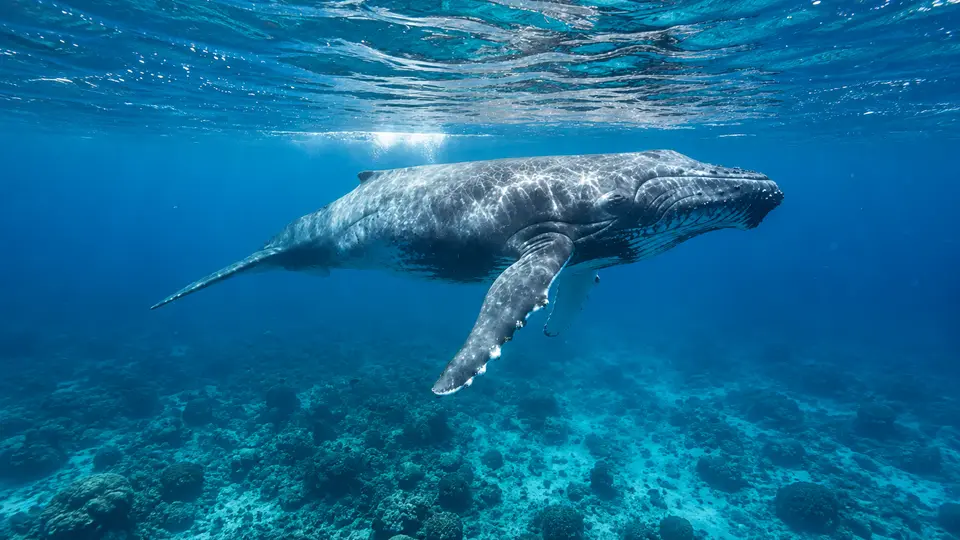
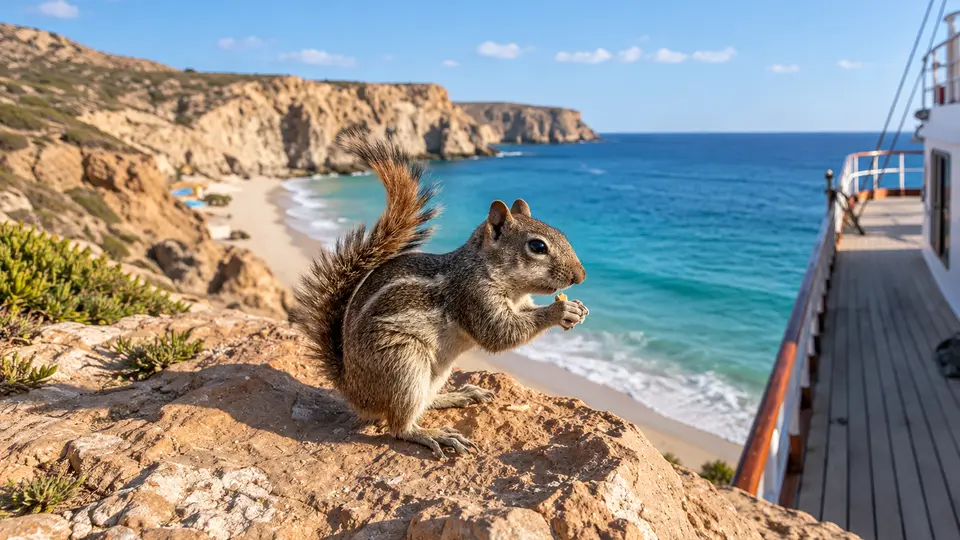
Geoffroy's Spider MonkeyGeoffroy's Spider MonkeyBaja California Rock SquirrelBaja California Rock SquirrelBlue WhaleBlue Whale
Animal groupMammalsAnimal groupMammalsAnimal groupMammals
DestinationsCosta Rica, MexicoDestinationsMexicoDestinationsMexico, Norway, Portugal, Antarctica, Arctic, Maldives, New Zealand
All wildlife destinations
Plan your trip

Find your next wildlife adventure

Compare destinations, shore programs and dates with the animals and habitats you would love to see.

  • Naturalist-led shore excursions
  • Responsible wildlife watching
  • Small expedition ships

Newsletter

Take Blue Rides with you

Adventure cruise offers, last-minute deals and trip inspiration.

Free, unsubscribe anytime. Details: Privacy Policy

Partner with Blue Rides

Affiliate Program

Recommend adventure cruises and earn commission on every confirmed booking.

Share. Track. Earn.

Your footage, our stage

Send us your videos or pictures.

Captured beautiful landscapes or wildlife? Share your videos and pictures with us, we may feature them on Blue Rides.