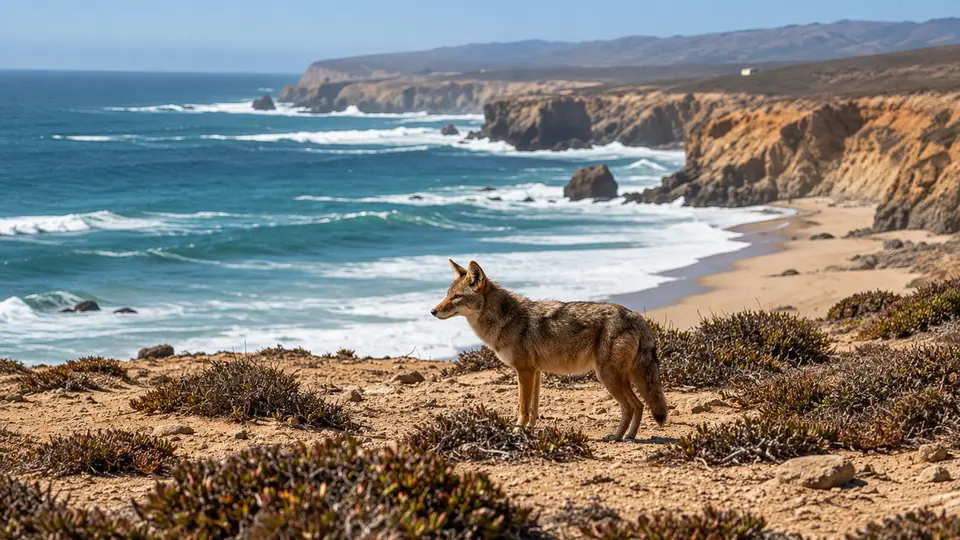
Coyote in its natural habitat, AI illustration

Coyote: where and when to see them

Canis latrans

Coyote at a glance

The coyote is an adaptable North American canid found across much of Mexico, from dry scrub and grassland to agricultural and urban edges. It can also use coastal desert and dunes where food and shelter are available. Smaller and more lightly built than a wolf, it survives through flexible feeding and behaviour. Coastal encounters are possible in suitable regions, but this is a terrestrial mammal, not an animal tied specifically to beaches.

Behaviour & reproduction

Size
100–135 cm total length
Weight
7–20 kg
Lifespan
6–10 years in the wild
Status
Least Concern

Coyotes may forage alone, travel as pairs or cooperate within family groups, depending on prey and local conditions. They communicate through scent, posture and a varied repertoire of yips and howls. Activity often peaks around dawn, dusk or nighttime, especially where people are numerous. Breeding pairs usually share care of their pups, and older offspring sometimes remain nearby, helping explain why an apparently solitary hunter can belong to a stable social group. Pups are typically born in underground dens or sheltered locations, often between April and May after a gestation period of about 63 days. The distinctive 'yipping' chorus often heard at dusk or dawn serves to advertise territory and social cohesion among pack members.

Top wildlife locations

Mexico wildlife habitat

Mexico

Coastal desert scrub and dune margins, particularly in northwestern Mexico, offer plausible habitat viewed from established paths. Encounters are unpredictable; some suitable areas require inland excursions rather than beach walks.

Adventure cruises in Mexico
Destinations describe the species' habitat, not guaranteed cruise stops. Some animals require an optional inland excursion or are found in restricted reserves.

Fun facts about the Coyote

  • Coyotes use both hunting and scavenging rather than relying on one feeding strategy.
  • Their group howls can make a few animals sound like a much larger gathering.
  • Both members of a breeding pair commonly contribute to pup care.
  • They can hybridize with other closely related Canis species.

Best time to see the Coyote

Coyotes are resident year-round, with visibility governed more by local habitat and daily temperature than migration. Cooler months can make coastal desert watching more comfortable. No single Mexico-wide seasonal window is reliable because climate and accessibility differ markedly between regions. During the hot, dry season, coyotes may be more active during cooler nighttime hours to conserve energy and find water sources. Their activity patterns can shift dramatically based on local temperature extremes, often making early morning or late evening observations more fruitful.

Coyote: season matrix by destination

Travel and observation windows vary by region. Highlighted months are an orientation for planning, not confirmed sightings or a guarantee of access.

Mexico

Resident populations occur year-round, but Mexico is too geographically varied for a defensible country-wide shore-observation window without a specific locality.

JanFebMarAprMayJunJulAugSepOctNovDec
Cruise ships in Mexico

Where the Coyote lives

Mexican habitats include deserts, thorn scrub, grasslands, open woodland and farmland. Some populations use coastal dunes and scrub behind beaches, but extensive dense tropical forest is generally less characteristic. Suitable observation areas need cover, prey and space away from heavy disturbance. In Mexico, coyotes are remarkably adaptable, thriving from sea level to over 4,000 meters (13,000 feet) in mountainous regions. They readily colonize suburban areas and agricultural lands, demonstrating their ability to coexist with human development.

What the Coyote eats

Rodents, rabbits and other small mammals are important prey, supplemented by carrion, insects, fruits and occasional larger animals. Coastal individuals may exploit stranded food. Unsecured rubbish and deliberate feeding can alter behaviour dangerously, so human food should never become part of an encounter. In coastal regions, coyotes frequently scavenge beaches for dead fish, marine mammals, and other washed-up organic matter. They also prey on ground-nesting birds and their eggs when available, especially in grassland and scrub habitats.

Species at a glance

Common name
Coyote
Scientific name
Canis latrans
Animal group
Mammals
Size
100–135 cm total length
Weight
7–20 kg
Lifespan
6–10 years in the wild
Status
Least Concern
Identification
A narrow muzzle, large pointed ears and a bushy tail usually carried low distinguish the coyote from most domestic dogs and the larger, heavier-headed wolf. Their lanky build and relatively small paws, compared to their body size, are distinguishing features. The coyote's fur color varies from grayish-brown to reddish-brown, often with lighter underparts and darker markings on the legs and back.

Coyote: frequently asked questions

Where can I see the Coyote?
Mexico. Observe from a distance and never feed or approach a coyote. Keep children close and pets leashed; if one approaches persistently, stand tall, make noise and retreat calmly without running or blocking its escape. Be aware of their territorial nature; a persistent coyote may be communicating a boundary. Always carry bear spray or a sturdy stick for self-defense in areas where coyotes are common, though encounters are rarely aggressive.
When is the best time to see the Coyote?
Coyotes are resident year-round, with visibility governed more by local habitat and daily temperature than migration. Cooler months can make coastal desert watching more comfortable. No single Mexico-wide seasonal window is reliable because climate and accessibility differ markedly between regions. During the hot, dry season, coyotes may be more active during cooler nighttime hours to conserve energy and find water sources. Their activity patterns can shift dramatically based on local temperature extremes, often making early morning or late evening observations more fruitful.
How big does the Coyote get?
100–135 cm total length. Adult weight: 7–20 kg. Size varies with age, sex and population.
How should I behave around the Coyote?
Observe from a distance and never feed or approach a coyote. Keep children close and pets leashed; if one approaches persistently, stand tall, make noise and retreat calmly without running or blocking its escape. Be aware of their territorial nature; a persistent coyote may be communicating a boundary. Always carry bear spray or a sturdy stick for self-defense in areas where coyotes are common, though encounters are rarely aggressive.
What does the Coyote eat?
Rodents, rabbits and other small mammals are important prey, supplemented by carrion, insects, fruits and occasional larger animals. Coastal individuals may exploit stranded food. Unsecured rubbish and deliberate feeding can alter behaviour dangerously, so human food should never become part of an encounter. In coastal regions, coyotes frequently scavenge beaches for dead fish, marine mammals, and other washed-up organic matter. They also prey on ground-nesting birds and their eggs when available, especially in grassland and scrub habitats.
Are wildlife sightings guaranteed on an adventure cruise?
No. Animals move freely and routes, weather, access restrictions and local conditions influence every outing. Confirm the actual itinerary and shore program before booking.

Compare wildlife in the same destinations

Explore other mammals recorded in these destinations. Similar surroundings do not mean the animals share the same habits or viewing season.

Species comparison by animal group and destination
CoyoteCoyoteBaja California Rock SquirrelBaja California Rock SquirrelBlue WhaleBlue Whale
Animal groupMammalsAnimal groupMammalsAnimal groupMammals
DestinationsMexicoDestinationsMexicoDestinationsMexico, Norway, Portugal, Antarctica, Arctic, Maldives, New Zealand
All wildlife destinations
Plan your trip

Find your next wildlife adventure

Compare destinations, shore programs and dates with the animals and habitats you would love to see.

  • Naturalist-led shore excursions
  • Responsible wildlife watching
  • Small expedition ships

Newsletter

Take Blue Rides with you

Adventure cruise offers, last-minute deals and trip inspiration.

Free, unsubscribe anytime. Details: Privacy Policy

Partner with Blue Rides

Affiliate Program

Recommend adventure cruises and earn commission on every confirmed booking.

Share. Track. Earn.

Your footage, our stage

Send us your videos or pictures.

Captured beautiful landscapes or wildlife? Share your videos and pictures with us, we may feature them on Blue Rides.