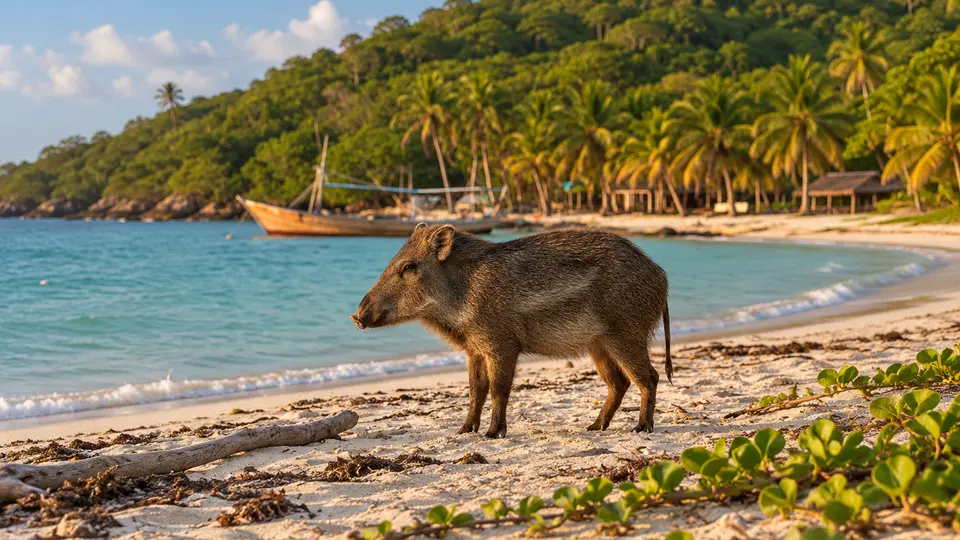
Collared Peccary in its natural habitat, AI illustration

Collared PeccaryDicotyles tajacuWhere and when to see them

Collared Peccary at a glance

The collared peccary is a compact, hoofed mammal of the Americas, recognisable by its coarse dark coat and pale shoulder collar. Although piglike in appearance, it belongs to a separate family with distinctive teeth, scent glands and social habits. Its remarkable ecological flexibility allows it to occupy humid tropical forest, dry woodland and desert scrub. Family groups can be important seed consumers and agents of soil disturbance.

Behaviour & reproduction

Size
80-105 cm body length
Weight
15-30 kg
Lifespan
10-15 years
Status
Least Concern

Peccaries usually live in cohesive groups that maintain contact through grunts, scent marking and mutual rubbing. They forage with their snouts close to the ground, digging and turning litter for food. Activity shifts with temperature and disturbance, often concentrating around cooler hours in hot environments. Groups may rest together in shade or dense cover. When alarmed, they can clack their teeth and defend themselves rather than immediately retreat. They maintain well-defined home ranges, which they mark with a dorsal scent gland. Group sizes typically range from 5 to 15 individuals, though larger aggregations can occur where resources are abundant.

Top wildlife locations

Costa Rica wildlife habitat

Costa Rica

Protected Pacific coastal forest and lowland reserve trails provide plausible habitat. Some opportunities are near the shore, while others require inland excursions; animals remain unpredictable and should never be approached.

Mexico wildlife habitat

Mexico

Tropical coastal woodland and northern thorn scrub can hold peccaries, but routine waterfront observation is unlikely. A guided terrestrial excursion into suitable protected habitat is usually needed, sometimes well inland.

Destinations describe the species' habitat, not guaranteed cruise stops. Some animals require an optional inland excursion or are found in restricted reserves.

Fun facts about the Collared Peccary

  • Peccaries are not members of the pig family.
  • A gland on the lower back produces scent used in social communication.
  • Their canines are comparatively straight rather than curling outward like many pig tusks.
  • In arid habitats, cactus pads can supply both nourishment and water.

Best time to see the Collared Peccary

There is no universal viewing season across its broad range. Drier months often improve trail access in tropical reserves, while extreme heat reduces daytime activity in northern Mexico. Local rainfall, water availability and protection from hunting are more useful predictors than calendar dates alone. In Costa Rica, the dry season (roughly December to April) generally offers easier trail conditions for viewing. For Mexico, early morning or late afternoon observations are often best to avoid peak heat, especially in northern regions.

Collared Peccary: season matrix by destination

Travel and observation windows vary by region. Highlighted months are an orientation for planning, not confirmed sightings or a guarantee of access.

Costa Rica

This generally drier Pacific-side travel window improves trail access, not guaranteed sightings; Caribbean rainfall patterns differ.

JanFebMarAprMayJunJulAugSepOctNovDec
Cruise ships in Costa Rica

Mexico

Cooler months can suit terrestrial observation in many regions, but Mexico's varied climates require destination-specific planning.

JanFebMarAprMayJunJulAugSepOctNovDec
Cruise ships in Mexico

Where the Collared Peccary lives

Habitats range from tropical rainforest and seasonally dry forest to thorn scrub and semiarid grassland mosaics. Dense shelter, accessible food and water influence local use. Coastal forests can support populations, but many practical viewing opportunities require inland reserve visits. They are highly adaptable and thrive in both arid scrublands and humid tropical forests. In Costa Rica, they are commonly found in lowland forests and dry forest fragments, while in Mexico, they occupy a wide variety of habitats including deserts and mountain foothills.

What the Collared Peccary eats

Roots, tubers, fruits, seeds and green vegetation form most of the diet. In dry regions, succulent plants provide food and moisture. Peccaries also consume invertebrates and occasional small animal material, with the balance changing according to habitat and seasonal availability. Their strong snouts are well-adapted for rooting up underground plant parts. They play a significant ecological role as seed dispersers and soil aerators in many ecosystems.

Species at a glance

Common name
Collared Peccary
Scientific name
Dicotyles tajacu
Animal group
Mammals
Size
80-105 cm body length
Weight
15-30 kg
Lifespan
10-15 years
Status
Least Concern
Identification
A pale shoulder collar and relatively small body distinguish it from the larger white-lipped peccary, whose contrasting white markings concentrate around the mouth. The collared peccary's body is covered in coarse, grizzled gray to blackish hair. Unlike pigs, they have a short, almost vestigial tail and a small, pointed head.

Collared Peccary: frequently asked questions

Where can I see the Collared Peccary?
Costa Rica, Mexico. Keep well back, leave groups an unobstructed escape route and never stand between adults and young. Do not feed or follow them into cover; retreat calmly if animals approach or clack their teeth. Always maintain a respectful distance to avoid disturbing their natural behavior. Observing them quietly from a distance allows for better insights into their social dynamics and foraging habits.
When is the best time to see the Collared Peccary?
There is no universal viewing season across its broad range. Drier months often improve trail access in tropical reserves, while extreme heat reduces daytime activity in northern Mexico. Local rainfall, water availability and protection from hunting are more useful predictors than calendar dates alone. In Costa Rica, the dry season (roughly December to April) generally offers easier trail conditions for viewing. For Mexico, early morning or late afternoon observations are often best to avoid peak heat, especially in northern regions.
How big does the Collared Peccary get?
80-105 cm body length. Adult weight: 15-30 kg. Size varies with age, sex and population.
How should I behave around the Collared Peccary?
Keep well back, leave groups an unobstructed escape route and never stand between adults and young. Do not feed or follow them into cover; retreat calmly if animals approach or clack their teeth. Always maintain a respectful distance to avoid disturbing their natural behavior. Observing them quietly from a distance allows for better insights into their social dynamics and foraging habits.
What does the Collared Peccary eat?
Roots, tubers, fruits, seeds and green vegetation form most of the diet. In dry regions, succulent plants provide food and moisture. Peccaries also consume invertebrates and occasional small animal material, with the balance changing according to habitat and seasonal availability. Their strong snouts are well-adapted for rooting up underground plant parts. They play a significant ecological role as seed dispersers and soil aerators in many ecosystems.
Are wildlife sightings guaranteed on an adventure cruise?
No. Animals move freely and routes, weather, access restrictions and local conditions influence every outing. Confirm the actual itinerary and shore program before booking.

Compare wildlife in the same destinations

Explore other mammals recorded in these destinations. Similar surroundings do not mean the animals share the same habits or viewing season.

Species comparison by animal group and destination
Collared PeccaryCollared PeccaryBaja California Rock SquirrelBaja California Rock SquirrelBlue WhaleBlue Whale
Animal groupMammalsAnimal groupMammalsAnimal groupMammals
DestinationsCosta Rica, MexicoDestinationsMexicoDestinationsMexico, Norway, Portugal, Antarctica, Arctic, Maldives, New Zealand
All wildlife destinations
Plan your trip

Find your next wildlife adventure

Compare destinations, shore programs and dates with the animals and habitats you would love to see.

  • Naturalist-led shore excursions
  • Responsible wildlife watching
  • Small expedition ships

Newsletter

Take Blue Rides with you

Adventure cruise offers, last-minute deals and trip inspiration.

Free, unsubscribe anytime. Details: Privacy Policy

Partner with Blue Rides

Affiliate Program

Recommend adventure cruises and earn commission on every confirmed booking.

Share. Track. Earn.

Your footage, our stage

Send us your videos or pictures.

Captured remarkable nature or wildlife on your journey? Share it with us, we may feature it on Blue Rides.