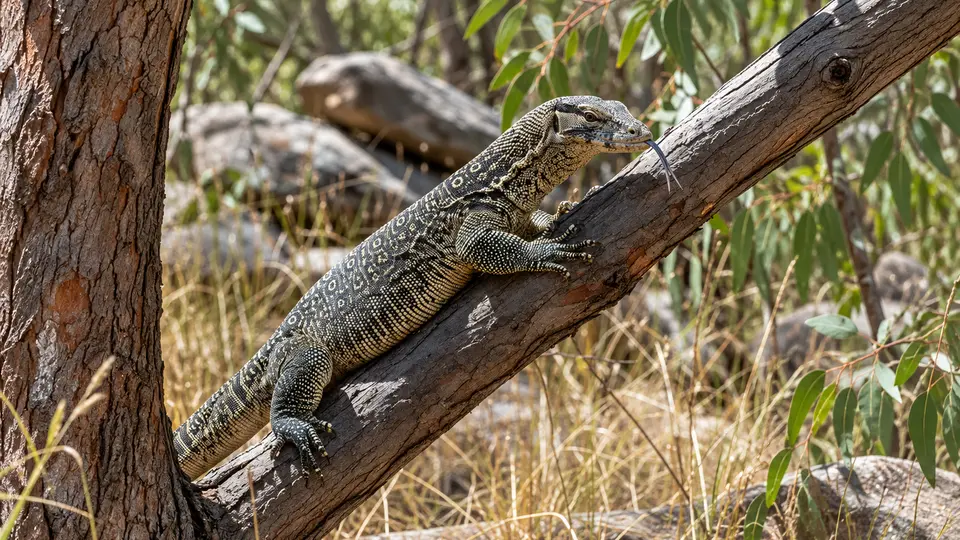
Lace monitor in its natural habitatAI-modified

Lace monitorVaranus variusWhere and when to see them

Lace monitor at a glance

The lace monitor is a large Australian goanna found through much of the country's east. Its long claws, muscular limbs and balancing tail suit a life divided between the ground and trees. Pale spots and bands usually break up the dark body, although some individuals have a striking broad-banded pattern. As both predator and scavenger, it links woodland food webs and helps remove carrion from forest floors and surrounding open areas.

Behaviour & reproduction

Size
1.5–2 m (4.9–6.6 ft) total length
Weight
5–14 kg (11–31 lb)
Lifespan
Not reliably established
Status
Least Concern

Lace monitors travel across the ground while investigating scents with their forked tongues, then climb readily when disturbed or searching for food. They may circle around the far side of a trunk as a person approaches. Activity increases in warm conditions, while colder periods bring prolonged sheltering. Females in many populations excavate active termite mounds to lay eggs, exploiting their relatively stable conditions and sometimes returning to help young emerge. Lace monitors are excellent climbers, often seen high in trees using their strong claws and prehensile tail for balance. They possess a keen sense of smell, using their Jacobson's organ to detect prey and carrion over significant distances.

Top wildlife locations

Australia wildlife habitatAI-modified

Australia

Eastern coastal eucalypt reserves and wooded picnic areas provide plausible shore-accessible habitat. No remote expedition is necessarily required, but animals are localized and should never be attracted with food or approached around bins.


Destinations describe the species' habitat, not guaranteed cruise stops. Some animals require an optional inland excursion or are found in restricted reserves.

Fun facts about the Lace monitor

  • The strongly banded appearance called Bell's form is a color variant, not a separate species.
  • Termites can repair the opening after a female deposits eggs inside their mound.
  • A female may return to excavate an exit for hatchlings from the hardened mound.
  • The forked tongue samples chemical information rather than functioning as a sting.

Best time to see the Lace monitor

Warmer months generally provide the best chance of active animals in eastern Australia, especially spring through early autumn in southern areas. Northern populations experience different temperature patterns. Moderate warmth can be more useful than extreme heat, when monitors may seek shelter. In more temperate regions, sightings are most common during sunny periods following cooler weather, when monitors emerge to bask and forage. While northern populations are active year-round, activity peaks there during the dry season when food sources can become more concentrated.

Lace monitor: season matrix by destination

Travel and observation windows vary by region. Highlighted months are an orientation for planning, not confirmed sightings or a guarantee of access.

Australia

This window suits warmer-season activity in southeastern coastal Australia; tropical and subtropical conditions differ, and extreme heat can reduce visible activity.

JanFebMarAprMayJunJulAugSepOctNovDec
Cruise ships in Australia

Where the Lace monitor lives

They occupy forests, woodlands and wooded edges, including coastal eucalypt country and some suburban reserves. Large trees provide climbing refuges and hollows, while fallen timber and leaf litter offer feeding opportunities. They are not confined to remote or undisturbed bush. They are particularly associated with eucalypt forests and open woodlands, sometimes venturing into urban fringes where suitable trees remain. Their range extends along the east coast of Australia, from Victoria through New South Wales and Queensland, and inland to parts of the Great Dividing Range.

What the Lace monitor eats

Their diet includes insects, reptiles, birds, eggs and small mammals, together with carrion. Tree climbing gives access to nests and arboreal prey. At picnic grounds they may investigate scraps, but deliberate feeding creates unsafe associations between people and food. They are opportunistic feeders and apex predators in their ecosystem, playing a role in scavenging and population control. Hatchlings and younger monitors consume a higher proportion of insects and smaller invertebrates as they grow.

Species at a glance

Common name
Lace monitor
Scientific name
Varanus varius
Animal group
Reptiles
Size
1.5–2 m (4.9–6.6 ft) total length
Weight
5–14 kg (11–31 lb)
Lifespan
Not reliably established
Status
Least Concern
Identification
Its dark body with pale spotting and banding, especially on the throat and tail, distinguishes it from the typically sandy, finely patterned perentie. Their long, powerful tail is often banded with black and yellow or cream, accounting for roughly two thirds of their total length. Adults can reach lengths of over two meters, though most encountered individuals are smaller.

Lace monitor: frequently asked questions

Where can I see the Lace monitor?
Australia. Keep well back and leave a clear route to trees or cover. Never feed a monitor or stand between it and a refuge; its claws, teeth and tail can cause injury. When encountered, they may display a 'freeze and assess' behavior before retreating or climbing. Always maintain a respectful distance of at least several meters to avoid startling the animal and to ensure your safety and theirs.
When is the best time to see the Lace monitor?
Warmer months generally provide the best chance of active animals in eastern Australia, especially spring through early autumn in southern areas. Northern populations experience different temperature patterns. Moderate warmth can be more useful than extreme heat, when monitors may seek shelter. In more temperate regions, sightings are most common during sunny periods following cooler weather, when monitors emerge to bask and forage. While northern populations are active year-round, activity peaks there during the dry season when food sources can become more concentrated.
How big does the Lace monitor get?
1.5–2 m (4.9–6.6 ft) total length. Adult weight: 5–14 kg (11–31 lb). Size varies with age, sex and population.
How should I behave around the Lace monitor?
Keep well back and leave a clear route to trees or cover. Never feed a monitor or stand between it and a refuge; its claws, teeth and tail can cause injury. When encountered, they may display a 'freeze and assess' behavior before retreating or climbing. Always maintain a respectful distance of at least several meters to avoid startling the animal and to ensure your safety and theirs.
What does the Lace monitor eat?
Their diet includes insects, reptiles, birds, eggs and small mammals, together with carrion. Tree climbing gives access to nests and arboreal prey. At picnic grounds they may investigate scraps, but deliberate feeding creates unsafe associations between people and food. They are opportunistic feeders and apex predators in their ecosystem, playing a role in scavenging and population control. Hatchlings and younger monitors consume a higher proportion of insects and smaller invertebrates as they grow.
Are wildlife sightings guaranteed on an adventure cruise?
No. Animals move freely and routes, weather, access restrictions and local conditions influence every outing. Confirm the actual itinerary and shore program before booking.

Compare wildlife in the same destinations

Explore other reptiles recorded in these destinations. Similar surroundings do not mean the animals share the same habits or viewing season.

Species comparison by animal group and destination
Lace monitorAI-modifiedLace monitorFlatback sea turtleAI-modifiedFlatback sea turtleGreen Sea TurtleAI-modifiedGreen Sea Turtle
Animal groupReptilesAnimal groupReptilesAnimal groupReptiles
DestinationsAustraliaDestinationsAustraliaDestinationsCosta Rica, Florida, Galapagos, Mexico, Cape Verde, Egypt, Greece, Seychelles, Turkey, Indonesia, Maldives, Thailand, Vietnam, Australia, Fiji, Polynesia
Scientific nameVaranus variusScientific nameScientific name
All wildlife destinations
AI-modified
Plan your trip

Find your next wildlife adventure

Compare destinations, shore programs and dates with the animals and habitats you would love to see.

  • Naturalist-led shore excursions
  • Responsible wildlife watching
  • Small expedition ships