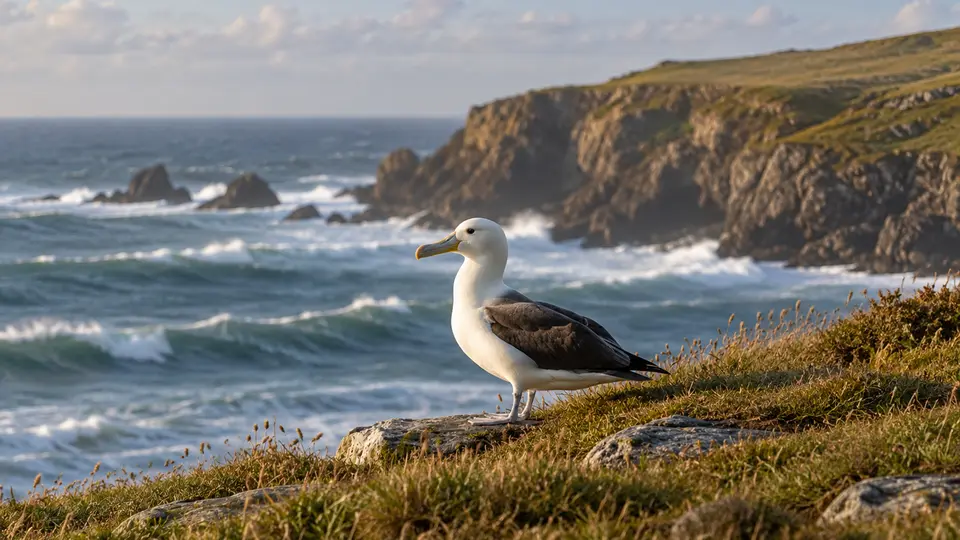
Buller's albatross in its natural habitatAI-modified

Buller's albatrossThalassarche bulleriWhere and when to see them

Buller's albatross at a glance

Buller's albatross is a compact Southern Ocean albatross with a finely patterned grey head and a striking yellow-and-black bill. It breeds only in the New Zealand region, with northern and southern populations using different island groups and breeding schedules. Most of its life is spent at sea, where wind-powered travel allows it to cover enormous distances. Fisheries interactions are a significant conservation issue, particularly when birds take bait or food around fishing operations.

Behaviour & reproduction

Size
76-81 cm (30-32 in) long; 2.0-2.2 m (6.6-7.2 ft) wingspan
Weight
2-3 kg (4.4-6.6 lb)
Lifespan
35 years (related species)
Status
Near Threatened

At sea, Buller's albatross alternates gliding arcs with occasional wingbeats, adjusting its flight to wind and waves. It often searches alone but joins feeding gatherings around natural prey concentrations or vessels. Breeding pairs perform bill movements, calls and mutual displays at their nest sites. Both parents incubate the single egg and provision the chick, with long foraging trips linking remote colonies to productive marine areas far beyond the breeding islands. Courtship displays often involve elaborate head-shaking and bill-pointing movements between mates. Chicks are fed regurgitated food by both parents, who undertake extensive oceanic journeys to secure sufficient provisions during the chick-rearing period.

Top wildlife locations

New Zealand wildlife habitatAI-modified

New Zealand

Southern coastal headlands and existing vessel decks offer plausible distant views over feeding waters. Breeding islands are generally inaccessible or restricted, and a standard mainland shore visit does not provide colony access.
Destinations describe the species' habitat, not guaranteed cruise stops. Some animals require an optional inland excursion or are found in restricted reserves.

Fun facts about the Buller's albatross

  • Its breeding range is confined to the New Zealand region.
  • Northern and southern populations have different breeding calendars.
  • Pairs lay just one egg in a breeding attempt.
  • The name honors New Zealand ornithologist Walter Buller.

Best time to see the Buller's albatross

Observation opportunities vary around New Zealand because northern and southern populations breed on different schedules. Around southern coasts, summer through autumn can be a useful watch period. Wind, food distribution and viewing location matter, and colony breeding dates should not be applied uniformly nationwide. From October to May, adult birds are concentrated at their breeding colonies around the Snares, Solander, and Chatham Islands. Juveniles and non-breeders may be present in pelagic waters year-round, but specific hot spots for viewing depend on oceanographic conditions.

Buller's albatross: season matrix by destination

Travel and observation windows vary by region. Highlighted months are an orientation for planning, not confirmed sightings or a guarantee of access.

New Zealand

A useful southern New Zealand watch window, not a nationwide peak; northern and southern breeding populations follow different schedules.

JanFebMarAprMayJunJulAugSepOctNovDec
Cruise ships in New Zealand

Where the Buller's albatross lives

Its habitat is overwhelmingly marine, encompassing shelf edges, productive coastal waters and the open ocean. Breeding occurs on remote New Zealand islands, on vegetated slopes, cliffs or terraces. Most colonies are inaccessible to ordinary visitors, so distant coastal or deck observations are more realistic. While breeding is restricted to a few subantarctic islands, individuals can be sighted widely across the Tasman Sea and south-western Pacific Ocean, ranging from Australia to South America. Non-breeding birds frequently disperse eastward across the Pacific, often reaching the coasts of Chile and Peru.

What the Buller's albatross eats

Squid, fish and crustaceans form its natural diet, supplemented opportunistically by carrion and fishing waste. Much food is taken near the sea surface. Attraction to baited hooks and discarded catch exposes these birds to fishing hazards rather than indicating a safe or desirable feeding opportunity. These albatrosses primarily forage during the day, using their keen eyesight to spot prey near the surface. They are known to follow fishing vessels, scavenging discards, which unfortunately increases their risk of entanglement or bycatch.

Species at a glance

Common name
Buller's albatross
Scientific name
Thalassarche bulleri
Animal group
Birds
Size
76-81 cm (30-32 in) long; 2.0-2.2 m (6.6-7.2 ft) wingspan
Weight
2-3 kg (4.4-6.6 lb)
Lifespan
35 years (related species)
Status
Near Threatened
Identification
Its grey head, pale forehead and black bill edged with bright yellow distinguish it from the mostly pale-headed white-capped albatross and differently patterned grey-headed albatross. The underside of the wings shows broad black margins, while the rest is white, a key feature for identification in flight. Its medium size, compared to larger albatross species, and diagnostic bill coloration make it a relatively easy species to identify with good views.

Buller's albatross: frequently asked questions

Where can I see the Buller's albatross?
New Zealand. Scan offshore from safe headlands or a stable deck, using binoculars to study the bill pattern. Stay behind cliff barriers, never offer food, and do not seek access to restricted breeding islands. When viewing from a boat, scan the horizon for their distinctive flight pattern, which can lead you to feeding aggregations. Patience is key, as these birds cover vast distances and can be elusive even in their known foraging grounds.
When is the best time to see the Buller's albatross?
Observation opportunities vary around New Zealand because northern and southern populations breed on different schedules. Around southern coasts, summer through autumn can be a useful watch period. Wind, food distribution and viewing location matter, and colony breeding dates should not be applied uniformly nationwide. From October to May, adult birds are concentrated at their breeding colonies around the Snares, Solander, and Chatham Islands. Juveniles and non-breeders may be present in pelagic waters year-round, but specific hot spots for viewing depend on oceanographic conditions.
How big does the Buller's albatross get?
76-81 cm (30-32 in) long; 2.0-2.2 m (6.6-7.2 ft) wingspan. Adult weight: 2-3 kg (4.4-6.6 lb). Size varies with age, sex and population.
How should I behave around the Buller's albatross?
Scan offshore from safe headlands or a stable deck, using binoculars to study the bill pattern. Stay behind cliff barriers, never offer food, and do not seek access to restricted breeding islands. When viewing from a boat, scan the horizon for their distinctive flight pattern, which can lead you to feeding aggregations. Patience is key, as these birds cover vast distances and can be elusive even in their known foraging grounds.
What does the Buller's albatross eat?
Squid, fish and crustaceans form its natural diet, supplemented opportunistically by carrion and fishing waste. Much food is taken near the sea surface. Attraction to baited hooks and discarded catch exposes these birds to fishing hazards rather than indicating a safe or desirable feeding opportunity. These albatrosses primarily forage during the day, using their keen eyesight to spot prey near the surface. They are known to follow fishing vessels, scavenging discards, which unfortunately increases their risk of entanglement or bycatch.
Are wildlife sightings guaranteed on an adventure cruise?
No. Animals move freely and routes, weather, access restrictions and local conditions influence every outing. Confirm the actual itinerary and shore program before booking.

Compare wildlife in the same destinations

Explore other birds recorded in these destinations. Similar surroundings do not mean the animals share the same habits or viewing season.

Species comparison by animal group and destination
Buller's albatrossAI-modifiedBuller's albatrossAustralasian gannetAI-modifiedAustralasian gannetBar-tailed godwitAI-modifiedBar-tailed godwit
Animal groupBirdsAnimal groupBirdsAnimal groupBirds
DestinationsNew ZealandDestinationsNew ZealandDestinationsAustralia, New Zealand
Scientific nameThalassarche bulleriScientific nameScientific name
All wildlife destinations
AI-modified
Plan your trip

Find your next wildlife adventure

Compare destinations, shore programs and dates with the animals and habitats you would love to see.

  • Naturalist-led shore excursions
  • Responsible wildlife watching
  • Small expedition ships