Bluerides – Blue Rides - Book Liveaboards worldwideOCEAN ADVENTURES
River CruisesRiversNature & WildlifeOur Promise
River CruisesRiversNature & WildlifeOur PromiseSign In

River destinations

  • River destinations
  • Amazon
  • Danube
  • Rhine
  • Mekong
  • Nile

Ships & departures

  • River Cruise Search
  • Deals

Nature & Wildlife

  • Nature & Wildlife

Travel support

  • Our Promise
  • Contact

Contact

Get in Touch

Get in touch anytime, we're happy to help you find the right trip or sort out any question.

EmailWrite us, we usually reply within a few hours.
contact@bluerides.com
WhatsAppChat with us on WhatsApp, Mon–Fri 10:00–16:00 (CET).
Start WhatsApp Chat
PhoneCall us, we're happy to help.
Free call, Mon–Fri 10 AM – 8 PM (CET).
Europe+49 800 1144 990USA+1 888 557 7735UK+44 800 707 4152Australia+61 2 8599 6113Canada+1 888 557 7735
Which river journey is yours?Answer 8 quick questions and find the river cruise that fits you.
8 questions, 1 minute·Plus Gift
Secure Payment MethodsYour payments are fully secured with AES-256 encryption.
Powered byStripeWiseAMEXPayGoogle PaySEPABank
Imprint·Terms & Conditions·Privacy Policy·About·Contact·Liability Waiver·Affiliate Program·Cruise·
Visit us here

© 2026 Blue Rides. All rights reserved.·

Bluerides – Blue Rides - Book Liveaboards worldwideOCEAN ADVENTURES
River CruisesRiversNature & WildlifeOur Promise
River CruisesRiversNature & WildlifeOur PromiseSign In
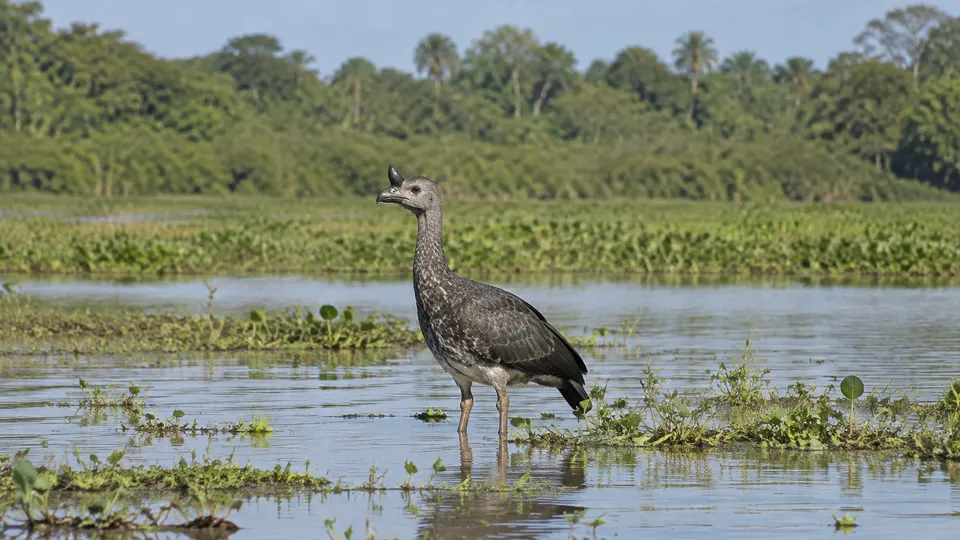
Horned screamer in wetland habitat — Amazon, River Cruises wildlife
Home›River Cruises›River Wildlife›Horned Screamer

Horned ScreamerAnhima cornutaWhere and when to see them

Previous speciesHoopoeNext speciesKentish Plover

Horned Screamer at a glance

The horned screamer is a large South American wetland bird related to ducks and geese, although its upright stance and heavy body can look more like those of an oversized terrestrial fowl. Its name refers to a slender projection on the crown, not to the separate spurs on the wings. The dark head, neck and upper body contrast with a pale belly, while the loud voice can reveal a bird before its outline is obvious. Within the registered Amazon destination, a March 2017 naturalist cruise around Iquitos and Nauta recorded the species on most days. That report concerns the Ucayali and connected Peruvian waterways, not every part of the Amazon Basin. It also does not establish that each named tributary produced a sighting. Brazil's Rio Negro–Anavilhanas reach is a separate component of the destination and cannot inherit this Peruvian evidence. Historical occurrence, broad distribution and a reliable visitor calendar must remain distinct.

Behaviour & reproduction

Size
Not verified
Weight
Not verified
Lifespan
Not verified
Status
See sourced assessment

Horned screamers are non-migratory birds that may occur in pairs or small groups, using both waterside vegetation and elevated perches. The university account describes long-lasting pair bonds, mutual preening and loud vocal communication. Their calls serve social and territorial functions, so hearing repeated notes does not necessarily mean that a large flock is present. Despite their size, they can fly and soar, and may rest in trees or shrubs beside wetlands. On the ground they walk, graze, stand and preen rather than behaving like a continuously diving waterbird. Both parents participate in incubation and care of the young in the species account, but those general breeding details do not establish a Peruvian monthly nesting calendar. The March 2017 cruise report mentions eggs observed by some participants; it should not be used to advertise nest visits. Observe adult behaviour from a distance and never provoke a territorial response for a photograph or recording.

Top wildlife locations

Amazon river landscape — River Cruises wildlife habitat

Amazon

Peru: the registered Iquitos/Nauta, Ucayali and connected-tributary cruise reach. The March 2017 report records birds seen and heard on most days, without assigning every encounter to a named tributary. No Brazil Rio Negro–Anavilhanas sighting claim is added.

Explore river cruises

Destinations describe the species' habitat, not guaranteed cruise stops. Some animals require an optional inland excursion or are found in restricted reserves.

Fun facts about the Horned Screamer

  • It belongs to the same order as ducks, geese and swans.
  • Its slender crown projection is distinct from its wing spurs.
  • Young birds do not have the fully developed adult crown ornament.
  • Males and females have similar plumage.
  • It can perch in waterside trees despite its heavy appearance.
  • It can soar as well as use flapping flight.
  • Pairs engage in mutual preening.
  • Both parents participate in incubation in the university account.
  • Its loud voice can reveal it before observers locate the bird.

Best time to see the Horned Screamer

The strongest locally dated evidence here is the 18–26 March 2017 naturalist cruise species list. Horned screamers were seen and heard on most days during that Peruvian voyage, and some participants observed eggs. This validates historical March occurrence and a breeding-related observation, but not an annual March peak or a general March nesting schedule. No comparative local calendar showing better and poorer viewing months was established, so months remains empty. The species' non-migratory status does not prove equally reliable visibility at every stop throughout the year. Vegetation, disturbance, actual excursion routing and current wetland access may all affect what visitors can see. Broad statements about Amazon high water or low water must not replace screamer-specific seasonal evidence, nor can Peru observations be transferred to Rio Negro–Anavilhanas. Ask for recent observations on the precise route and request quiet wetland-edge viewing, without visiting nests or using playback to force a response.

Horned Screamer: season matrix by destination

Highlighted months reflect the stated local evidence, not guaranteed encounters. Neutral months mean no verified monthly viewing window, not absence. Observation records and recommended viewing windows are distinct.

Amazon

March 2017 documents historical occurrence and an egg observation, not a validated recurring viewing or nesting calendar.

JanFebMarAprMayJunJulAugSepOctNovDec
Explore river cruises

Where the Horned Screamer lives

Freshwater marshes, swamps, lakes, ponds and river margins provide the species' characteristic setting. Wooded banks and wet savannas offer elevated perches close to feeding areas, so a screamer may be above the water rather than standing visibly on a bank. The relevant cruise habitat is the wetland edge and connected backwater landscape, not simply the central navigation channel. The registered record covers an Iquitos–Nauta itinerary using the Ucayali and connected waterways in Peru. Its reference itinerary includes Yarapa, Yanallpa Creek, Zapote, Pacaya, El Dorado and Supay Creek, but the screamer entry does not identify a separate occurrence on each. These waterways should therefore remain itinerary context rather than a list of confirmed screamer sites. No corresponding Rio Negro–Anavilhanas occurrence was validated for this draft. Wetland vegetation, quiet access and the presence of suitable perches matter more to an actual excursion than attaching the bird indiscriminately to the entire Amazon destination.

What the Horned Screamer eats

Horned screamers are primarily plant eaters, taking vegetation from their wetland surroundings rather than specialising in fish. The university account describes feeding on plant material, and grazing is among its documented behaviours. That is a useful distinction from many conspicuous river birds whose attention is directed towards catching aquatic animals. Watch for a bird walking and picking at vegetation, but do not assume that every pause or lowered head represents a clearly identified food item. The exact plants eaten on the registered Peruvian itinerary were not documented in the source passage, and this draft does not invent a local menu. General feeding biology also cannot establish a month-by-month viewing season. Never offer greens, scatter food on a bank or encourage a guide to draw birds towards a landing. Natural feeding depends on undisturbed vegetation and safe access between feeding and resting places. A distant grazing bird is a valid observation without being brought closer for photography.

Species at a glance

Common name
Horned Screamer
Scientific name
Anhima cornuta
Animal group
Birds
Size
71–92 cm (28–36 in) body length; the university account also gives an approximately 1.7 m (5.6 ft) wingspan.
Weight
Approximately 3.15 kg (6.94 lb) average in the university species account; not a full sex-specific or population-specific range.
Lifespan
Species-specific lifespan not verified; the university account explicitly reports no known lifespan information.
Status
Least Concern in BirdLife International's 2024 assessment; population trend reported as stable. This global category does not guarantee local abundance or undisturbed wetland habitat.
Identification
A horned screamer combines a large, heavy body, relatively small head, long legs and a dark upper body contrasting with a pale abdomen. The slender upright crown projection is distinctive when visible, but distance, vegetation and viewing angle can conceal it. A short, slightly downcurved bill and conspicuous pale speckling around the head help complete the impression. Males and females look similar, so plumage alone is not a dependable way to sex a bird. The wing spurs are a real anatomical feature, but should not be expected in every perched view or exposed by disturbing the animal. Immatures lack the fully developed adult crown ornament. Loud calls can support an identification made with an experienced guide, although a heard-only record should remain labelled as such. Start with body shape, head pattern, wetland setting and voice; do not require a close-up of the horn or infer identification from impressive size alone.

Horned Screamer: frequently asked questions

Where can I see the Horned Screamer?
Amazon. Listen first, then scan trees, shrubs and open wetland margins for a large, upright dark-and-white bird. The March 2017 observers described loud, ape-like calls, a useful reminder that an unfamiliar sound may come from a bird rather than a mammal. A perched screamer can be easier to locate than one partly concealed in bank vegetation. Use binoculars to examine the head and overall pattern rather than moving closer solely to resolve the slender crown projection. Keep the skiff quiet, avoid landing in marsh vegetation and allow feeding birds to continue without changing direction. Do not use recorded calls, approach a suspected nest or encourage adults to display their wing spurs. The trip report's mention of eggs is not a recommendation to seek nests. Sightings may require a guided side-channel outing rather than observation from the main ship. Record heard-only encounters honestly and distinguish them from a bird that was actually seen.
When is the best time to see the Horned Screamer?
The strongest locally dated evidence here is the 18–26 March 2017 naturalist cruise species list. Horned screamers were seen and heard on most days during that Peruvian voyage, and some participants observed eggs. This validates historical March occurrence and a breeding-related observation, but not an annual March peak or a general March nesting schedule. No comparative local calendar showing better and poorer viewing months was established, so months remains empty. The species' non-migratory status does not prove equally reliable visibility at every stop throughout the year. Vegetation, disturbance, actual excursion routing and current wetland access may all affect what visitors can see. Broad statements about Amazon high water or low water must not replace screamer-specific seasonal evidence, nor can Peru observations be transferred to Rio Negro–Anavilhanas. Ask for recent observations on the precise route and request quiet wetland-edge viewing, without visiting nests or using playback to force a response.
How big does the Horned Screamer get?
71–92 cm (28–36 in) body length; the university account also gives an approximately 1.7 m (5.6 ft) wingspan.. Adult weight: Approximately 3.15 kg (6.94 lb) average in the university species account; not a full sex-specific or population-specific range.. Size varies with age, sex and population.
How should I behave around the Horned Screamer?
Listen first, then scan trees, shrubs and open wetland margins for a large, upright dark-and-white bird. The March 2017 observers described loud, ape-like calls, a useful reminder that an unfamiliar sound may come from a bird rather than a mammal. A perched screamer can be easier to locate than one partly concealed in bank vegetation. Use binoculars to examine the head and overall pattern rather than moving closer solely to resolve the slender crown projection. Keep the skiff quiet, avoid landing in marsh vegetation and allow feeding birds to continue without changing direction. Do not use recorded calls, approach a suspected nest or encourage adults to display their wing spurs. The trip report's mention of eggs is not a recommendation to seek nests. Sightings may require a guided side-channel outing rather than observation from the main ship. Record heard-only encounters honestly and distinguish them from a bird that was actually seen.
What does the Horned Screamer eat?
Horned screamers are primarily plant eaters, taking vegetation from their wetland surroundings rather than specialising in fish. The university account describes feeding on plant material, and grazing is among its documented behaviours. That is a useful distinction from many conspicuous river birds whose attention is directed towards catching aquatic animals. Watch for a bird walking and picking at vegetation, but do not assume that every pause or lowered head represents a clearly identified food item. The exact plants eaten on the registered Peruvian itinerary were not documented in the source passage, and this draft does not invent a local menu. General feeding biology also cannot establish a month-by-month viewing season. Never offer greens, scatter food on a bank or encourage a guide to draw birds towards a landing. Natural feeding depends on undisturbed vegetation and safe access between feeding and resting places. A distant grazing bird is a valid observation without being brought closer for photography.
Are wildlife sightings guaranteed on a river cruise?
No. Animals move freely and routes, weather, access restrictions and local conditions influence every outing. Confirm the actual itinerary and shore program before booking.

Compare wildlife in the same destinations

Explore other birds recorded in these destinations. Similar surroundings do not mean the animals share the same habits or viewing season.

Species comparison by animal group and destination
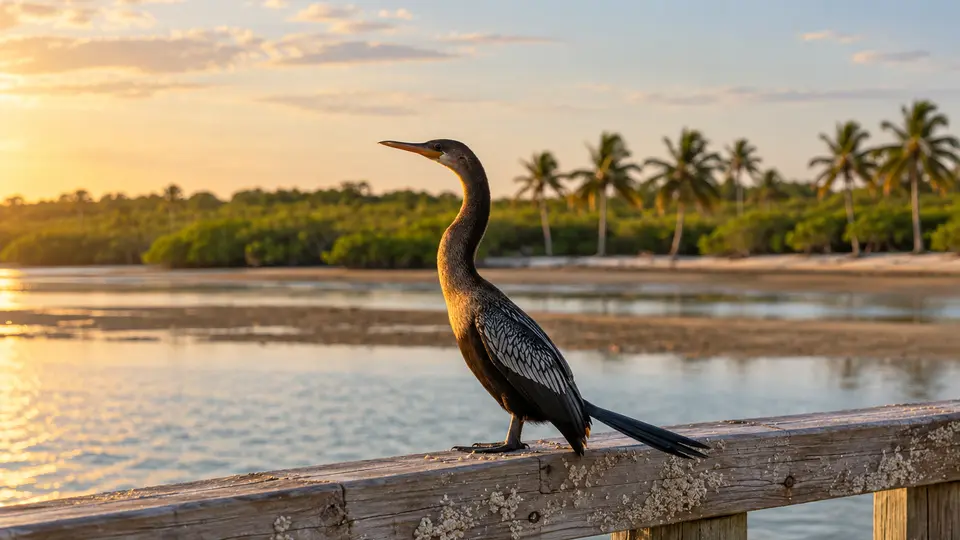
Horned screamer in wetland habitat — Amazon, River Cruises wildlifeHorned ScreamerAmazon kingfisher in wetland habitat — Amazon, River Cruises wildlifeAmazon KingfisherAnhinga in wetland habitat — Amazon, River Cruises wildlifeAnhinga
Animal groupBirdsAnimal groupBirdsAnimal groupBirds
DestinationsAmazonDestinationsAmazonDestinationsAmazon
Scientific name
Anhima cornuta
Scientific name
Scientific name
Previous speciesHoopoeNext speciesKentish Plover
All river wildlife
On this page
  • 01About
  • 02Behaviour & reproduction
  • 03Top wildlife locations
  • 04Fun facts
  • 05Best season
  • 06Season matrix by destination
  • 07Habitat
  • 08Diet
  • 09Species at a glance
  • 10Questions & answers
  • 11Compare

Find your river cruise

Plan your trip

Find your next river journey

Compare destinations, shore programs and dates with the animals and habitats you would love to see.

  • Daily shore excursions
  • Responsible wildlife watching
  • Boutique river ships
Explore river cruises