Bluerides – Blue Rides - 世界中のダイビングクルーズを予約OCEAN ADVENTURES
リバークルーズ河川自然と野生動物私たちの約束
リバークルーズ河川自然と野生動物私たちの約束ログイン

リバークルーズの目的地

  • リバークルーズの目的地
  • Amazon
  • Danube
  • Rhine
  • Mekong
  • Nile

客船と出発日

  • リバークルーズ検索
  • お得な情報

自然と野生動物

  • 自然と野生動物

トラベルサポート

  • 私たちの約束
  • お問い合わせ

お問い合わせ

お問い合わせ

いつでもお気軽にご連絡ください。旅選びからご質問まで喜んでお手伝いします。

メールメールでどうぞ。通常は数時間以内に返信します。
contact@bluerides.com
WhatsAppWhatsAppでご連絡ください。月〜金 10:00〜16:00(CET)。
WhatsAppでチャットを始める
電話お電話ください,ご質問に喜んでお答えします。
通話無料、月〜金 10:00〜20:00(CET)。
ヨーロッパ+49 800 1144 990アメリカ+1 888 557 7735イギリス+44 800 707 4152オーストラリア+61 2 8599 6113カナダ+1 888 557 7735
Which river journey is yours?Answer 8 quick questions and find the river cruise that fits you.
8 questions, 1 minute·Plus Gift
安全なお支払い方法お支払いはAES-256暗号化により完全に保護されています。
提供元StripeWiseAMEXPayGoogle PaySEPABank
特定商取引法に基づく表記·利用規約·プライバシーポリシー·私たちについて·お問い合わせ·免責同意書·アフィリエイトプログラム·Cruise·
こちらでフォロー

© 2026 Blue Rides. 無断複製・転載を禁じます。·

Bluerides – Blue Rides - 世界中のダイビングクルーズを予約OCEAN ADVENTURES
リバークルーズ河川自然と野生動物私たちの約束
リバークルーズ河川自然と野生動物私たちの約束ログイン
湿地のAnhinga — Amazon、リバークルーズの野生動物
ホーム›リバークルーズ›リバー・ワイルドライフ›Anhinga

AnhingaAnhinga anhinga出会える場所と時期

前の種American Wigeon次の種Ash-breasted Antbird

ひと目でわかるAnhinga

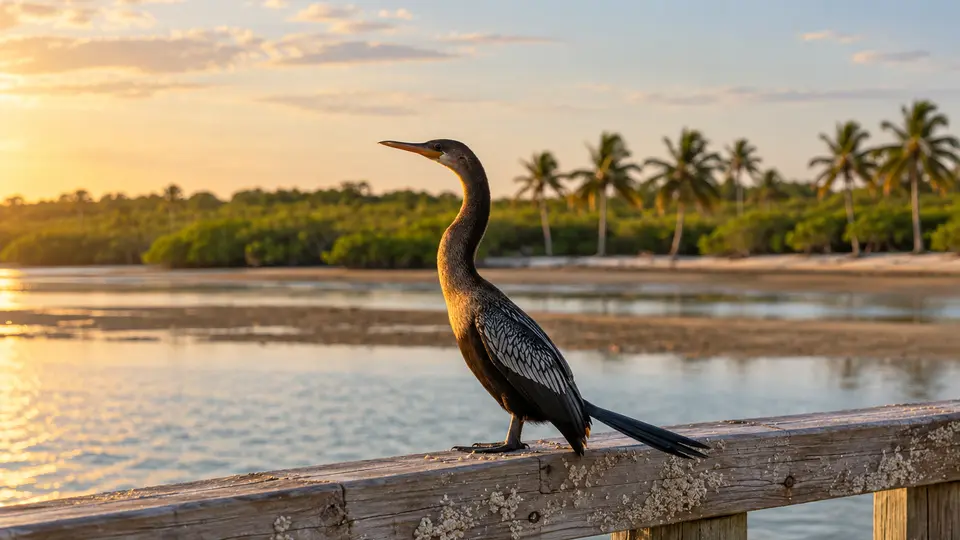
The Anhinga is a slender fish-eating waterbird with a long neck, pointed bill and extended tail. It hunts underwater but is often easiest to notice perched above the water with its wings open. The River registry associates it with a Peruvian Amazon cruise covering Iquitos and Nauta, the Ucayali and connected tributaries. In the original March 2017 report, two birds were recorded along the Zapote River, one flying and one perched in an overhanging tree. That precise account is more informative than a general statement that anhingas occur throughout tropical wetlands, but it remains a historical observation rather than a present-day abundance estimate. Cornell describes the species as favouring shallow, sheltered and slow-moving waters, usually freshwater. Its hunting method and need for nearby perches link the water to the bank vegetation. A quiet side-channel excursion therefore offers a better ecological setting for observation than an expectation of birds scattered across the main navigation channel.
行動と繁殖

サイズ
Species-specific size not verified in the material read.
体重
Species-specific weight not verified.
寿命
Species-specific lifespan not verified.
ステータス
See sourced assessment

Anhingas swim underwater while hunting fish and commonly use nearby perches for drying and sunning. A bird may remain nearly motionless on a branch after a feeding session, making patient bank scanning worthwhile. Cornell describes slow underwater stalking around submerged vegetation, followed by a rapid thrust of the bill into the side of a fish. This differs from simply chasing prey continuously through open water. Nesting can occur in loose groups and alongside other colonial waterbirds. The male begins placing sticks and green material before pairing, collects most of the material, and the female completes the nest structure. These species-level details come from Cornell's account and are not evidence of breeding on the registered Peruvian itinerary. The original cruise observation included both a flying bird and a perched individual, illustrating how different activities create different viewing opportunities. Give perched birds room to remain settled rather than approaching until they leave the branch.

野生動物観察のベストスポット

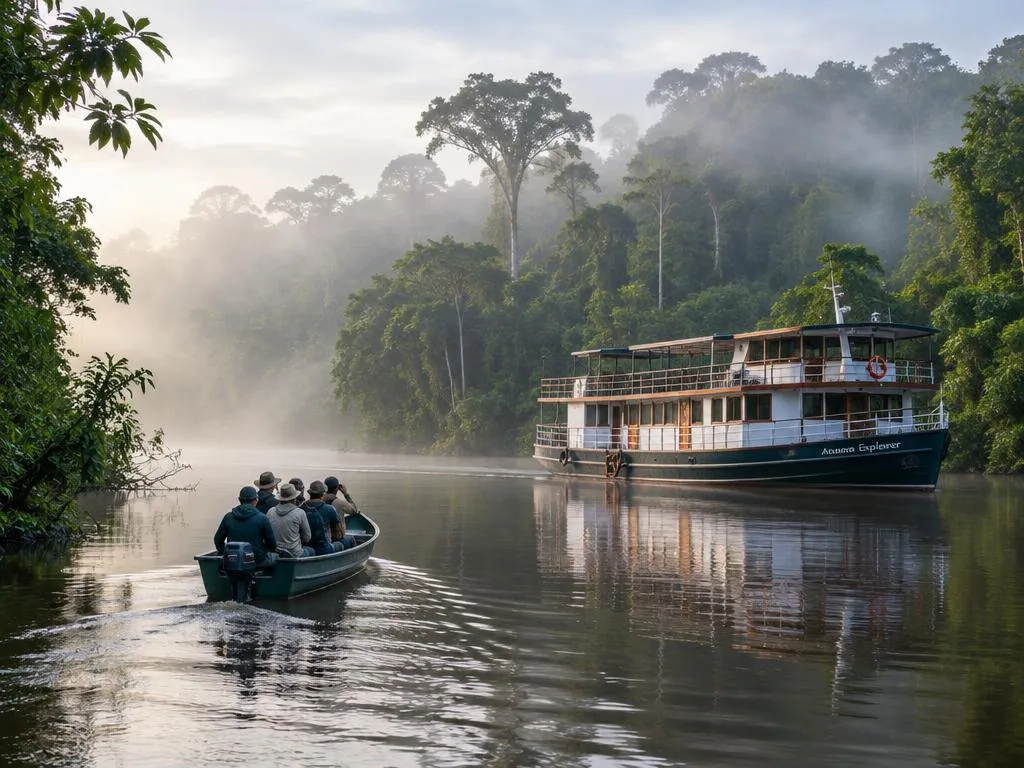
Amazonの河川風景 — リバークルーズの生息地

Amazon

Peru: Iquitos/Nauta, Ucayali and connected tributaries on the 2017 cruise; the original Anhinga observation was specifically along the Zapote River.
リバークルーズを探す

目的地は該当する種の生息地を示しており、必ずしもクルーズの寄港地とは限りません。一部の動物は、オプションの陸上観光や制限された保護区でのみ見ることができます。

Anhingaに関する豆知識

  • It hunts fish underwater.
  • The bill is straight and pointed rather than prominently hooked.
  • Cornell describes side-spearing of fish.
  • Nearby perches are used for drying and sunning.
  • Sheltered freshwater is characteristic habitat.
  • It can nest near other colonial waterbirds.
  • Males begin nest construction before pairing.
  • Females differ from males in head and neck colour.
  • The registered Zapote River observation dates to March 2017.

Anhingaのベストシーズン

The original Peruvian Amazon species list is dated 18–26 March 2017 and records two Anhingas along the Zapote River. March is therefore a supported historical observation month for the registered Amazon association. It is not a verified annual peak, and the report does not establish the species' complete local calendar. Broad descriptions of tropical distribution or residency cannot fill the remaining months automatically. On a future excursion, access to quiet side channels, water conditions and the availability of exposed perches may influence what can be seen more directly than the month alone. Ask the operator for recent observations on the actual route and whether the planned skiff outing reaches suitable sheltered water. The original record should remain scoped to its place and date rather than being promoted to guaranteed viewing throughout the Amazon basin. A patient scan of overhanging trees can still be worthwhile whenever local guides consider the habitat appropriate.

Anhinga:目的地別のシーズン一覧

Highlighted months reflect the stated local evidence, not guaranteed encounters. Neutral months mean no verified monthly viewing window, not absence. Observation records and recommended viewing windows are distinct.

Amazon

The 18–26 March 2017 species list reports two birds on the Zapote River. March indicates historical occurrence, not an established annual peak or full local calendar.

1月2月3月4月5月6月7月8月9月10月11月12月
リバークルーズを探す

Anhingaの生息地

Shallow, sheltered water with submerged structure and nearby perches is central to the Anhinga's ecology. Cornell emphasises slow-moving waters, banks and branches used for drying and sunning, and notes that extensive open-water areas are generally less characteristic habitat. Freshwater is especially important, although nesting and feeding environments need not always have identical salinity. The registered Peruvian evidence comes from the Zapote River within a broader Amazon cruise itinerary that included the Iquitos–Nauta corridor and Ucayali-connected waterways. Overhanging trees in quiet channels are therefore a useful habitat feature to examine. The presence of a large river alone is insufficient: water depth, shelter, underwater vegetation and accessible resting perches shape the places a bird can use. Retaining bankside vegetation benefits more than the visible perched bird, because the same river margin can support feeding cover and other wetland wildlife. Follow the guide's route instead of entering narrow vegetated areas to force a closer view.

Anhingaの食べ物

Fish make up the great majority of the Anhinga diet in Cornell's account, with much smaller amounts of crustaceans and other invertebrates. The bird hunts by swimming slowly underwater around submerged vegetation and striking with a rapid forward movement of its pointed bill. Fish are commonly pierced through the side, sometimes with both mandibles and sometimes with the upper mandible alone for smaller prey. This side-spearing method is consistent with stalking rather than prolonged high-speed pursuit. A capture may be difficult to see from a boat because the decisive movement occurs below the surface, while later handling can be more visible. No Zapote-specific prey species or dietary percentages were verified. Avoid supplying a local fish list from general Amazon biodiversity information. Never throw fish towards an anhinga or encourage a guide to bait it; naturally occurring hunting and subsequent resting provide the relevant ecological sequence without altering the bird's behaviour.

種の特徴まとめ

一般的な名称
Anhinga
Scientific name
Anhinga anhinga
動物グループ
Birds
サイズ
Species-specific size not verified in the material read.
体重
Species-specific weight not verified.
寿命
Species-specific lifespan not verified.
ステータス
A current formal global assessment was not verified. The Peruvian trip report is historical occurrence evidence only.
識別方法
The most useful structural combination is a very long, slender neck, a straight pointed bill and a long tail. Anhingas can resemble cormorants, especially when perched with their wings open, but cormorants have a more obviously hooked bill tip. Wing spreading alone is therefore not diagnostic. Adult males are predominantly dark, while females show paler brownish colouring on the head, neck and upper breast. Light patches and streaking on the wings can be visible on a settled bird, depending on distance and angle. A swimming individual may carry much of the body low in the water, leaving the neck especially conspicuous. Do not identify a distant dark bird solely from that posture, because visibility and water conditions can distort silhouettes. Wait for the bill profile or a clear perch view. In the registered Peruvian setting, compare all features with the guide's local knowledge rather than assuming that every wing-drying waterbird is an Anhinga.

Anhinga:よくある質問

Anhingaはどこで見られる?
Amazon. Scan branches projecting above sheltered water, paying particular attention to dark birds with long necks and tails. An open-wing posture can make an Anhinga conspicuous, but birds also perch with the wings folded, when the outline may be much narrower. Remain quiet while the skiff pauses and let the guide maintain an appropriate distance. If a swimming bird disappears, watch the surrounding water without moving directly over its last position. On resurfacing, a low body and prominent neck can be easier to notice than the rest of the bird. The registered historical sighting was on the Zapote River, not a promise of deck views throughout the main Amazon channel. Do not crowd a drying perch, cut branches for a better angle or approach a colonial nesting area. A settled bird provides time to study bill shape and plumage, whereas a disturbance-induced flight removes both the viewing opportunity and the animal's resting time.
Anhingaを見るのに最適な時期は?
The original Peruvian Amazon species list is dated 18–26 March 2017 and records two Anhingas along the Zapote River. March is therefore a supported historical observation month for the registered Amazon association. It is not a verified annual peak, and the report does not establish the species' complete local calendar. Broad descriptions of tropical distribution or residency cannot fill the remaining months automatically. On a future excursion, access to quiet side channels, water conditions and the availability of exposed perches may influence what can be seen more directly than the month alone. Ask the operator for recent observations on the actual route and whether the planned skiff outing reaches suitable sheltered water. The original record should remain scoped to its place and date rather than being promoted to guaranteed viewing throughout the Amazon basin. A patient scan of overhanging trees can still be worthwhile whenever local guides consider the habitat appropriate.
Anhingaはどのくらいの大きさになる?
Species-specific size not verified in the material read.。成体の体重:Species-specific weight not verified.。サイズは年齢、性別、個体群によって異なるよ。
Anhingaの近くではどう振る舞えばいい?
Scan branches projecting above sheltered water, paying particular attention to dark birds with long necks and tails. An open-wing posture can make an Anhinga conspicuous, but birds also perch with the wings folded, when the outline may be much narrower. Remain quiet while the skiff pauses and let the guide maintain an appropriate distance. If a swimming bird disappears, watch the surrounding water without moving directly over its last position. On resurfacing, a low body and prominent neck can be easier to notice than the rest of the bird. The registered historical sighting was on the Zapote River, not a promise of deck views throughout the main Amazon channel. Do not crowd a drying perch, cut branches for a better angle or approach a colonial nesting area. A settled bird provides time to study bill shape and plumage, whereas a disturbance-induced flight removes both the viewing opportunity and the animal's resting time.
Anhingaは何を食べる?
Fish make up the great majority of the Anhinga diet in Cornell's account, with much smaller amounts of crustaceans and other invertebrates. The bird hunts by swimming slowly underwater around submerged vegetation and striking with a rapid forward movement of its pointed bill. Fish are commonly pierced through the side, sometimes with both mandibles and sometimes with the upper mandible alone for smaller prey. This side-spearing method is consistent with stalking rather than prolonged high-speed pursuit. A capture may be difficult to see from a boat because the decisive movement occurs below the surface, while later handling can be more visible. No Zapote-specific prey species or dietary percentages were verified. Avoid supplying a local fish list from general Amazon biodiversity information. Never throw fish towards an anhinga or encourage a guide to bait it; naturally occurring hunting and subsequent resting provide the relevant ecological sequence without altering the bird's behaviour.
リバークルーズで野生動物の遭遇は保証されている?
いいえ。動物は自由に移動するし、ルート、天候、立ち入り制限、現地の状況がすべての外出に影響するんだ。予約前に実際の旅程と岸上プログラムを確認してね。

同じ目的地の野生動物を比較する

これらの目的地で記録されている他のbirdsを見てみよう。似たような環境であっても、動物の習性や観測時期が同じとは限りません。

動物グループと目的地別の種比較
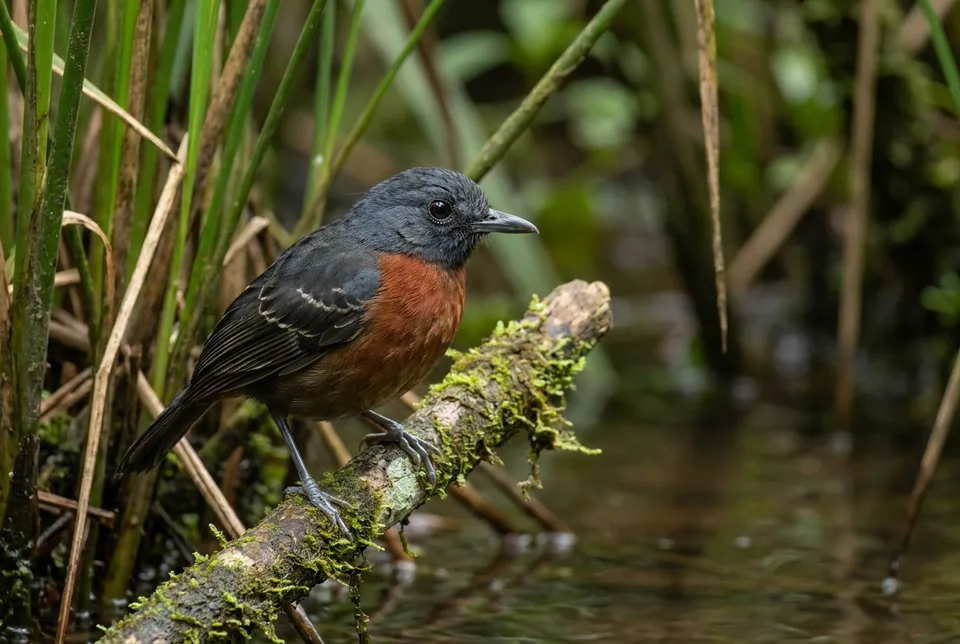
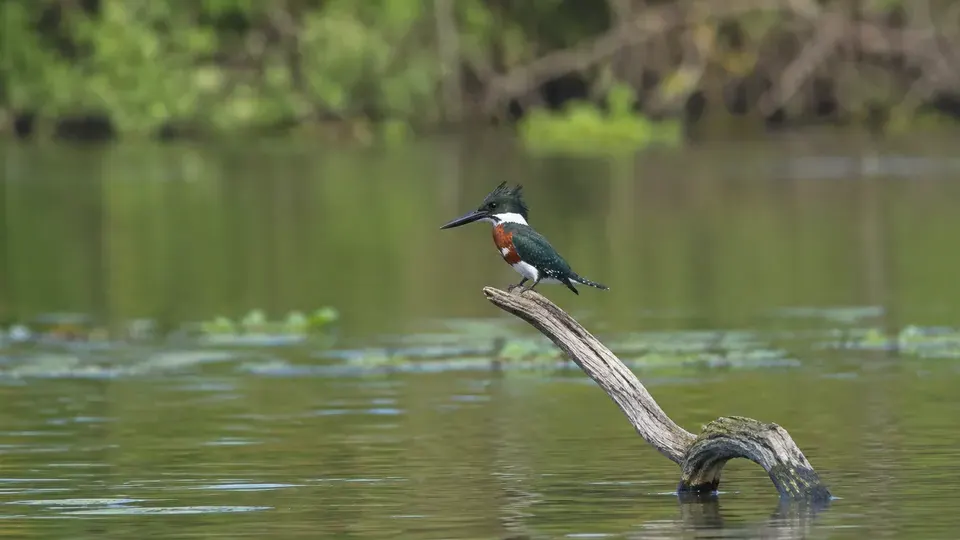
湿地のAnhinga — Amazon、リバークルーズの野生動物Anhinga湿地のAmazon kingfisher — Amazon、リバークルーズの野生動物Amazon Kingfisher湿地のAsh-breasted Antbird — Amazon、リバークルーズの野生動物Ash-breasted Antbird
動物グループBirds動物グループBirds動物グループBirds
目的地Amazon目的地Amazon目的地Amazon
Scientific name
Anhinga anhinga

Anhinga anhinga

Scientific name
Scientific name
サイズ
Species-specific size not verified in the material read.
サイズ
サイズ
体重
Species-specific weight not verified.
体重
体重
寿命
Species-specific lifespan not verified.
寿命
寿命
ステータス
See sourced assessment
ステータス
ステータス
識別方法
The most useful structural combination is a very long, slender neck, a straight pointed bill and a long tail.

The most useful structural combination is a very long, slender neck, a straight pointed bill and a long tail. Anhingas can resemble cormorants, especially when perched with their wings open, but cormorants have a more obviously hooked bill tip. Wing spreading alone is therefore not diagnostic. Adult males are predominantly dark, while females show paler brownish colouring on the head, neck and upper breast. Light patches and streaking on the wings can be visible on a settled bird, depending on distance and angle. A swimming individual may carry much of the body low in the water, leaving the neck especially conspicuous. Do not identify a distant dark bird solely from that posture, because visibility and water conditions can distort silhouettes. Wait for the bill profile or a clear perch view. In the registered Peruvian setting, compare all features with the guide's local knowledge rather than assuming that every wing-drying waterbird is an Anhinga.

識別方法
識別方法
生息地
Shallow, sheltered water with submerged structure and nearby perches is central to the Anhinga's ecology.

Shallow, sheltered water with submerged structure and nearby perches is central to the Anhinga's ecology. Cornell emphasises slow-moving waters, banks and branches used for drying and sunning, and notes that extensive open-water areas are generally less characteristic habitat. Freshwater is especially important, although nesting and feeding environments need not always have identical salinity. The registered Peruvian evidence comes from the Zapote River within a broader Amazon cruise itinerary that included the Iquitos–Nauta corridor and Ucayali-connected waterways. Overhanging trees in quiet channels are therefore a useful habitat feature to examine. The presence of a large river alone is insufficient: water depth, shelter, underwater vegetation and accessible resting perches shape the places a bird can use. Retaining bankside vegetation benefits more than the visible perched bird, because the same river margin can support feeding cover and other wetland wildlife. Follow the guide's route instead of entering narrow vegetated areas to force a closer view.

生息地
生息地
食性
Fish make up the great majority of the Anhinga diet in Cornell's account, with much smaller amounts of crustaceans and other invertebrates.

Fish make up the great majority of the Anhinga diet in Cornell's account, with much smaller amounts of crustaceans and other invertebrates. The bird hunts by swimming slowly underwater around submerged vegetation and striking with a rapid forward movement of its pointed bill. Fish are commonly pierced through the side, sometimes with both mandibles and sometimes with the upper mandible alone for smaller prey. This side-spearing method is consistent with stalking rather than prolonged high-speed pursuit. A capture may be difficult to see from a boat because the decisive movement occurs below the surface, while later handling can be more visible. No Zapote-specific prey species or dietary percentages were verified. Avoid supplying a local fish list from general Amazon biodiversity information. Never throw fish towards an anhinga or encourage a guide to bait it; naturally occurring hunting and subsequent resting provide the relevant ecological sequence without altering the bird's behaviour.

食性
食性
ベストシーズン
The original Peruvian Amazon species list is dated 18–26 March 2017 and records two Anhingas along the Zapote River.

The original Peruvian Amazon species list is dated 18–26 March 2017 and records two Anhingas along the Zapote River. March is therefore a supported historical observation month for the registered Amazon association. It is not a verified annual peak, and the report does not establish the species' complete local calendar. Broad descriptions of tropical distribution or residency cannot fill the remaining months automatically. On a future excursion, access to quiet side channels, water conditions and the availability of exposed perches may influence what can be seen more directly than the month alone. Ask the operator for recent observations on the actual route and whether the planned skiff outing reaches suitable sheltered water. The original record should remain scoped to its place and date rather than being promoted to guaranteed viewing throughout the Amazon basin. A patient scan of overhanging trees can still be worthwhile whenever local guides consider the habitat appropriate.

ベストシーズン
ベストシーズン
目的地別シーズン表
AmazonNo verified monthly viewing evidence

The 18–26 March 2017 species list reports two birds on the Zapote River. March indicates historical occurrence, not an established annual peak or full local calendar.

目的地別シーズン表目的地別シーズン表
前の種American Wigeon次の種Ash-breasted Antbird
すべての川の野生動物
On this page
  • 01約
  • 02行動と繁殖
  • 03野生動物観察のベストスポット
  • 04豆知識
  • 05ベストシーズン
  • 06目的地別シーズン表
  • 07生息地
  • 08食性
  • 09種の特徴まとめ
  • 10よくある質問
  • 11比較する

Find your river cruise

旅行を計画する

次のリバークルーズを探す

見たい動物や生息地に合わせて、目的地、岸上プログラム、日程を比較しましょう。

  • 毎日の岸上観光
  • 責任ある野生動物ウォッチング
  • ブティック・リバーシップ
リバークルーズを探す