Bluerides – Blue Rides - दुनिया भर में लिवअबोर्ड डाइविंग बुक करेंOCEAN ADVENTURES
रिवर क्रूज़नदियाँप्रकृति और वन्यजीवहमारा वादा
रिवर क्रूज़नदियाँप्रकृति और वन्यजीवहमारा वादासाइन इन करें

River गंतव्य

  • River गंतव्य
  • Amazon
  • Danube
  • Rhine
  • Mekong
  • Nile

जहाज़ और प्रस्थान

  • River Cruise खोजें
  • ऑफ़र

प्रकृति और वन्यजीव

  • प्रकृति और वन्यजीव

यात्रा सहायता

  • हमारा वादा
  • संपर्क

संपर्क करें

संपर्क करें

कभी भी संपर्क करें, हम आपकी यात्रा चुनने या किसी भी सवाल में मदद करने को तैयार हैं।

ईमेलहमें लिखें, आमतौर पर कुछ ही घंटों में जवाब देते हैं।
contact@bluerides.com
व्हाट्सएपव्हाट्सएप पर हमसे चैट करें, सोम–शुक्र 10:00–16:00 (CET)।
WhatsApp चैट शुरू करें
फ़ोनहमें कॉल करें, हम खुशी से मदद करेंगे।
फ्री कॉल, सोम–शुक्र 10:00–20:00 (CET)।
यूरोप+49 800 1144 990यूएसए+1 888 557 7735यूके+44 800 707 4152ऑस्ट्रेलिया+61 2 8599 6113कनाडा+1 888 557 7735
Which river journey is yours?Answer 8 quick questions and find the river cruise that fits you.
8 questions, 1 minute·Plus Gift
सुरक्षित भुगतान विधियाँआपके भुगतान AES-256 एन्क्रिप्शन द्वारा पूरी तरह सुरक्षित हैं।
द्वारा संचालितStripeWiseAMEXPayGoogle PaySEPABank
छाप·नियम और शर्तें·गोपनीयता नीति·हमारे बारे में·संपर्क करें·दायित्व अस्वीकरण·संबद्ध कार्यक्रम·Cruise·
यहाँ हमसे जुड़ें

© 2026 Blue Rides. सर्वाधिकार सुरक्षित।·

Bluerides – Blue Rides - दुनिया भर में लिवअबोर्ड डाइविंग बुक करेंOCEAN ADVENTURES
रिवर क्रूज़नदियाँप्रकृति और वन्यजीवहमारा वादा
रिवर क्रूज़नदियाँप्रकृति और वन्यजीवहमारा वादासाइन इन करें
आर्द्रभूमि में Anhinga — Amazon, नदी क्रूज़ के वन्यजीव
होम›रिवर क्रूज़›नदी के वन्यजीव›Anhinga

AnhingaAnhinga anhingaइन्हें कहाँ और कब देखें

पिछली प्रजातिAmerican Wigeonअगली प्रजातिAsh-breasted Antbird

Anhinga एक नज़र में

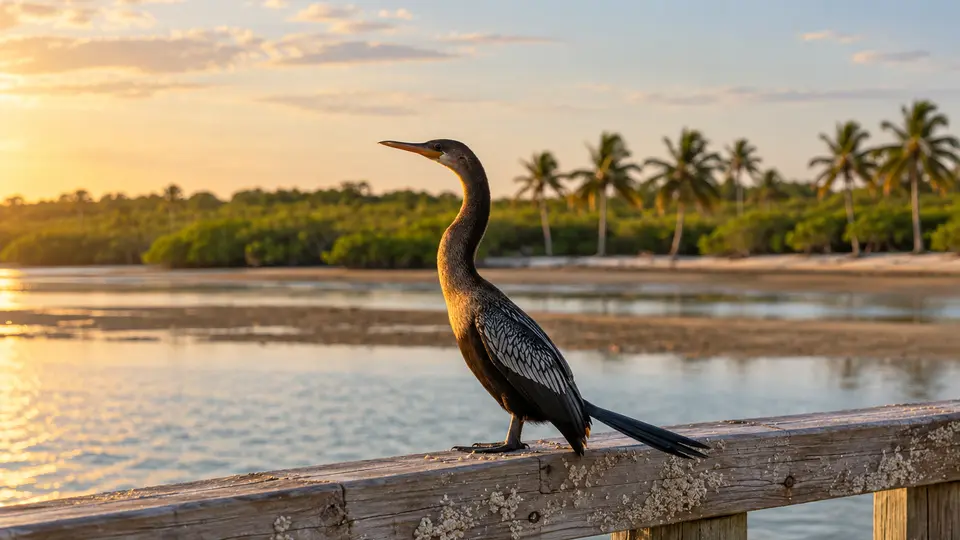
The Anhinga is a slender fish-eating waterbird with a long neck, pointed bill and extended tail. It hunts underwater but is often easiest to notice perched above the water with its wings open. The River registry associates it with a Peruvian Amazon cruise covering Iquitos and Nauta, the Ucayali and connected tributaries. In the original March 2017 report, two birds were recorded along the Zapote River, one flying and one perched in an overhanging tree. That precise account is more informative than a general statement that anhingas occur throughout tropical wetlands, but it remains a historical observation rather than a present-day abundance estimate. Cornell describes the species as favouring shallow, sheltered and slow-moving waters, usually freshwater. Its hunting method and need for nearby perches link the water to the bank vegetation. A quiet side-channel excursion therefore offers a better ecological setting for observation than an expectation of birds scattered across the main navigation channel.
व्यवहार और प्रजनन

आकार
Species-specific size not verified in the material read.
वजन
Species-specific weight not verified.
जीवनकाल
Species-specific lifespan not verified.
स्थिति
See sourced assessment

Anhingas swim underwater while hunting fish and commonly use nearby perches for drying and sunning. A bird may remain nearly motionless on a branch after a feeding session, making patient bank scanning worthwhile. Cornell describes slow underwater stalking around submerged vegetation, followed by a rapid thrust of the bill into the side of a fish. This differs from simply chasing prey continuously through open water. Nesting can occur in loose groups and alongside other colonial waterbirds. The male begins placing sticks and green material before pairing, collects most of the material, and the female completes the nest structure. These species-level details come from Cornell's account and are not evidence of breeding on the registered Peruvian itinerary. The original cruise observation included both a flying bird and a perched individual, illustrating how different activities create different viewing opportunities. Give perched birds room to remain settled rather than approaching until they leave the branch.

वन्यजीवों के प्रमुख स्थान

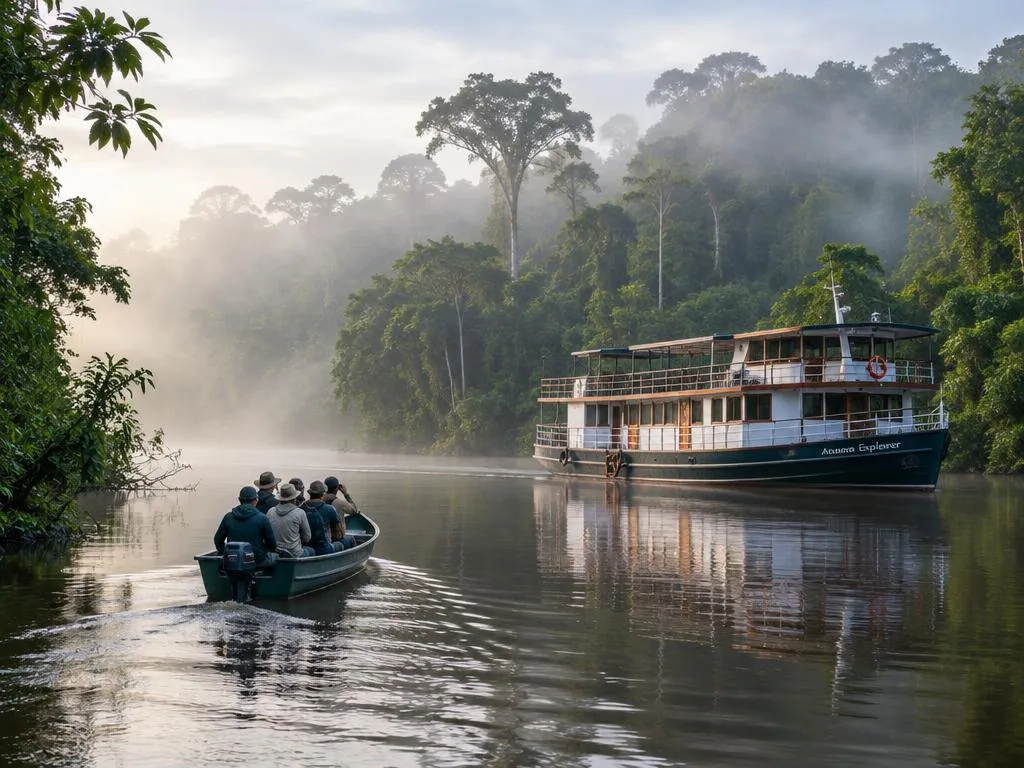
Amazon का नदी दृश्य — नदी क्रूज़ के वन्यजीवों का आवास

Amazon

Peru: Iquitos/Nauta, Ucayali and connected tributaries on the 2017 cruise; the original Anhinga observation was specifically along the Zapote River.
रिवर क्रूज एक्सप्लोर करें

गंतव्य प्रजातियों के प्राकृतिक आवास का वर्णन करते हैं, न कि क्रूज के निश्चित पड़ावों का। कुछ जानवरों को देखने के लिए वैकल्पिक अंतर्देशीय भ्रमण की आवश्यकता होती है या वे केवल प्रतिबंधित रिजर्व में पाए जाते हैं।

Anhinga के बारे में रोचक तथ्य

  • It hunts fish underwater.
  • The bill is straight and pointed rather than prominently hooked.
  • Cornell describes side-spearing of fish.
  • Nearby perches are used for drying and sunning.
  • Sheltered freshwater is characteristic habitat.
  • It can nest near other colonial waterbirds.
  • Males begin nest construction before pairing.
  • Females differ from males in head and neck colour.
  • The registered Zapote River observation dates to March 2017.

Anhinga को देखने का सबसे अच्छा समय

The original Peruvian Amazon species list is dated 18–26 March 2017 and records two Anhingas along the Zapote River. March is therefore a supported historical observation month for the registered Amazon association. It is not a verified annual peak, and the report does not establish the species' complete local calendar. Broad descriptions of tropical distribution or residency cannot fill the remaining months automatically. On a future excursion, access to quiet side channels, water conditions and the availability of exposed perches may influence what can be seen more directly than the month alone. Ask the operator for recent observations on the actual route and whether the planned skiff outing reaches suitable sheltered water. The original record should remain scoped to its place and date rather than being promoted to guaranteed viewing throughout the Amazon basin. A patient scan of overhanging trees can still be worthwhile whenever local guides consider the habitat appropriate.

Anhinga: गंतव्य के अनुसार सीजन मैट्रिक्स

Highlighted months reflect the stated local evidence, not guaranteed encounters. Neutral months mean no verified monthly viewing window, not absence. Observation records and recommended viewing windows are distinct.

Amazon

The 18–26 March 2017 species list reports two birds on the Zapote River. March indicates historical occurrence, not an established annual peak or full local calendar.

जन॰फ़र॰मार्चअप्रैलमईजूनजुल॰अग॰सित॰अक्टू॰नव॰दिस॰
रिवर क्रूज एक्सप्लोर करें

Anhinga कहाँ रहता है

Shallow, sheltered water with submerged structure and nearby perches is central to the Anhinga's ecology. Cornell emphasises slow-moving waters, banks and branches used for drying and sunning, and notes that extensive open-water areas are generally less characteristic habitat. Freshwater is especially important, although nesting and feeding environments need not always have identical salinity. The registered Peruvian evidence comes from the Zapote River within a broader Amazon cruise itinerary that included the Iquitos–Nauta corridor and Ucayali-connected waterways. Overhanging trees in quiet channels are therefore a useful habitat feature to examine. The presence of a large river alone is insufficient: water depth, shelter, underwater vegetation and accessible resting perches shape the places a bird can use. Retaining bankside vegetation benefits more than the visible perched bird, because the same river margin can support feeding cover and other wetland wildlife. Follow the guide's route instead of entering narrow vegetated areas to force a closer view.

Anhinga क्या खाता है

Fish make up the great majority of the Anhinga diet in Cornell's account, with much smaller amounts of crustaceans and other invertebrates. The bird hunts by swimming slowly underwater around submerged vegetation and striking with a rapid forward movement of its pointed bill. Fish are commonly pierced through the side, sometimes with both mandibles and sometimes with the upper mandible alone for smaller prey. This side-spearing method is consistent with stalking rather than prolonged high-speed pursuit. A capture may be difficult to see from a boat because the decisive movement occurs below the surface, while later handling can be more visible. No Zapote-specific prey species or dietary percentages were verified. Avoid supplying a local fish list from general Amazon biodiversity information. Never throw fish towards an anhinga or encourage a guide to bait it; naturally occurring hunting and subsequent resting provide the relevant ecological sequence without altering the bird's behaviour.

प्रजातियों पर एक नज़र

सामान्य नाम
Anhinga
Scientific name
Anhinga anhinga
पशु समूह
Birds
आकार
Species-specific size not verified in the material read.
वजन
Species-specific weight not verified.
जीवनकाल
Species-specific lifespan not verified.
स्थिति
A current formal global assessment was not verified. The Peruvian trip report is historical occurrence evidence only.
पहचान
The most useful structural combination is a very long, slender neck, a straight pointed bill and a long tail. Anhingas can resemble cormorants, especially when perched with their wings open, but cormorants have a more obviously hooked bill tip. Wing spreading alone is therefore not diagnostic. Adult males are predominantly dark, while females show paler brownish colouring on the head, neck and upper breast. Light patches and streaking on the wings can be visible on a settled bird, depending on distance and angle. A swimming individual may carry much of the body low in the water, leaving the neck especially conspicuous. Do not identify a distant dark bird solely from that posture, because visibility and water conditions can distort silhouettes. Wait for the bill profile or a clear perch view. In the registered Peruvian setting, compare all features with the guide's local knowledge rather than assuming that every wing-drying waterbird is an Anhinga.

Anhinga: अक्सर पूछे जाने वाले प्रश्न

तुम Anhinga कहाँ देख सकते हो?
Amazon. Scan branches projecting above sheltered water, paying particular attention to dark birds with long necks and tails. An open-wing posture can make an Anhinga conspicuous, but birds also perch with the wings folded, when the outline may be much narrower. Remain quiet while the skiff pauses and let the guide maintain an appropriate distance. If a swimming bird disappears, watch the surrounding water without moving directly over its last position. On resurfacing, a low body and prominent neck can be easier to notice than the rest of the bird. The registered historical sighting was on the Zapote River, not a promise of deck views throughout the main Amazon channel. Do not crowd a drying perch, cut branches for a better angle or approach a colonial nesting area. A settled bird provides time to study bill shape and plumage, whereas a disturbance-induced flight removes both the viewing opportunity and the animal's resting time.
Anhinga देखने का सबसे अच्छा समय कब है?
The original Peruvian Amazon species list is dated 18–26 March 2017 and records two Anhingas along the Zapote River. March is therefore a supported historical observation month for the registered Amazon association. It is not a verified annual peak, and the report does not establish the species' complete local calendar. Broad descriptions of tropical distribution or residency cannot fill the remaining months automatically. On a future excursion, access to quiet side channels, water conditions and the availability of exposed perches may influence what can be seen more directly than the month alone. Ask the operator for recent observations on the actual route and whether the planned skiff outing reaches suitable sheltered water. The original record should remain scoped to its place and date rather than being promoted to guaranteed viewing throughout the Amazon basin. A patient scan of overhanging trees can still be worthwhile whenever local guides consider the habitat appropriate.
Anhinga कितने बड़े होते हैं?
Species-specific size not verified in the material read.। वयस्क वजन: Species-specific weight not verified.। आकार उम्र, लिंग और आबादी के साथ बदलता रहता है।
Anhinga के आस-पास मुझे कैसा व्यवहार करना चाहिए?
Scan branches projecting above sheltered water, paying particular attention to dark birds with long necks and tails. An open-wing posture can make an Anhinga conspicuous, but birds also perch with the wings folded, when the outline may be much narrower. Remain quiet while the skiff pauses and let the guide maintain an appropriate distance. If a swimming bird disappears, watch the surrounding water without moving directly over its last position. On resurfacing, a low body and prominent neck can be easier to notice than the rest of the bird. The registered historical sighting was on the Zapote River, not a promise of deck views throughout the main Amazon channel. Do not crowd a drying perch, cut branches for a better angle or approach a colonial nesting area. A settled bird provides time to study bill shape and plumage, whereas a disturbance-induced flight removes both the viewing opportunity and the animal's resting time.
Anhinga क्या खाते हैं?
Fish make up the great majority of the Anhinga diet in Cornell's account, with much smaller amounts of crustaceans and other invertebrates. The bird hunts by swimming slowly underwater around submerged vegetation and striking with a rapid forward movement of its pointed bill. Fish are commonly pierced through the side, sometimes with both mandibles and sometimes with the upper mandible alone for smaller prey. This side-spearing method is consistent with stalking rather than prolonged high-speed pursuit. A capture may be difficult to see from a boat because the decisive movement occurs below the surface, while later handling can be more visible. No Zapote-specific prey species or dietary percentages were verified. Avoid supplying a local fish list from general Amazon biodiversity information. Never throw fish towards an anhinga or encourage a guide to bait it; naturally occurring hunting and subsequent resting provide the relevant ecological sequence without altering the bird's behaviour.
क्या रिवर क्रूज पर वन्यजीवों का दिखना निश्चित है?
नहीं। जानवर स्वतंत्र रूप से घूमते हैं और मार्ग, मौसम, पहुंच प्रतिबंध और स्थानीय स्थितियां हर यात्रा को प्रभावित करती हैं। बुकिंग से पहले वास्तविक यात्रा कार्यक्रम और तट कार्यक्रम की पुष्टि करें।

उन्हीं गंतव्यों में वन्यजीवों की तुलना करें

इन गंतव्यों में दर्ज अन्य birds को एक्सप्लोर करें। समान परिवेश का अर्थ यह नहीं है कि जानवरों की आदतें या देखने का सीजन भी एक जैसा होगा।

पशु समूह और गंतव्य के अनुसार प्रजातियों की तुलना
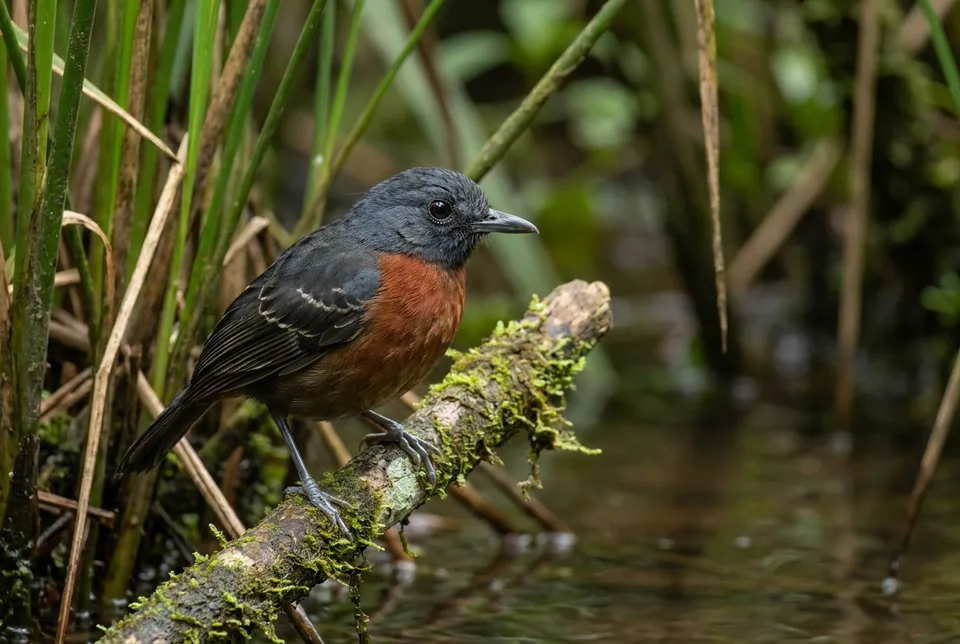
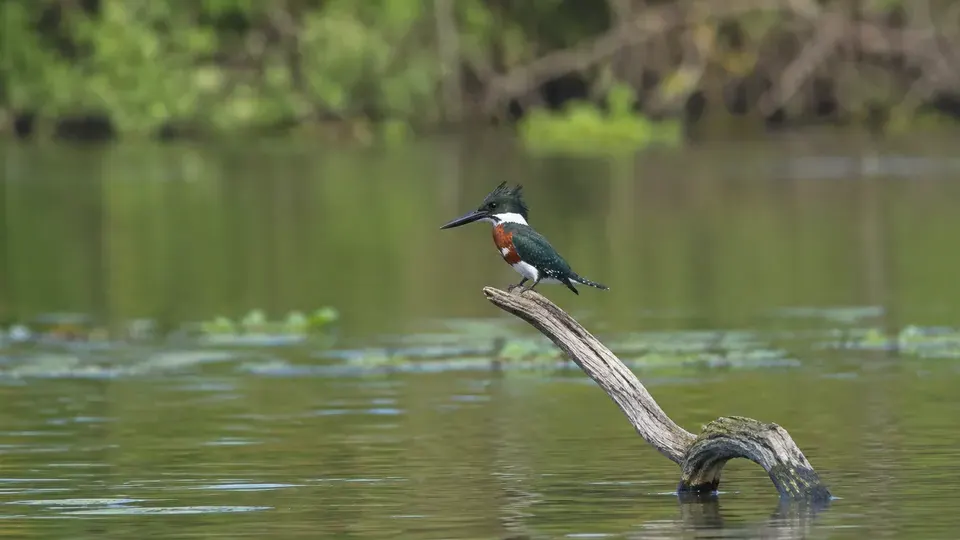
आर्द्रभूमि में Anhinga — Amazon, नदी क्रूज़ के वन्यजीवAnhingaआर्द्रभूमि में Amazon kingfisher — Amazon, नदी क्रूज़ के वन्यजीवAmazon Kingfisherआर्द्रभूमि में Ash-breasted Antbird — Amazon, नदी क्रूज़ के वन्यजीवAsh-breasted Antbird
पशु समूहBirdsपशु समूहBirdsपशु समूहBirds
डेस्टिनेशनAmazonडेस्टिनेशनAmazonडेस्टिनेशनAmazon
Scientific name
Anhinga anhinga

Anhinga anhinga

Scientific name
Scientific name
आकार
Species-specific size not verified in the material read.
आकार
आकार
वजन
Species-specific weight not verified.
वजन
वजन
जीवनकाल
Species-specific lifespan not verified.
जीवनकाल
जीवनकाल
स्थिति
See sourced assessment
स्थिति
स्थिति
पहचान
The most useful structural combination is a very long, slender neck, a straight pointed bill and a long tail.

The most useful structural combination is a very long, slender neck, a straight pointed bill and a long tail. Anhingas can resemble cormorants, especially when perched with their wings open, but cormorants have a more obviously hooked bill tip. Wing spreading alone is therefore not diagnostic. Adult males are predominantly dark, while females show paler brownish colouring on the head, neck and upper breast. Light patches and streaking on the wings can be visible on a settled bird, depending on distance and angle. A swimming individual may carry much of the body low in the water, leaving the neck especially conspicuous. Do not identify a distant dark bird solely from that posture, because visibility and water conditions can distort silhouettes. Wait for the bill profile or a clear perch view. In the registered Peruvian setting, compare all features with the guide's local knowledge rather than assuming that every wing-drying waterbird is an Anhinga.

पहचान
पहचान
आवास
Shallow, sheltered water with submerged structure and nearby perches is central to the Anhinga's ecology.

Shallow, sheltered water with submerged structure and nearby perches is central to the Anhinga's ecology. Cornell emphasises slow-moving waters, banks and branches used for drying and sunning, and notes that extensive open-water areas are generally less characteristic habitat. Freshwater is especially important, although nesting and feeding environments need not always have identical salinity. The registered Peruvian evidence comes from the Zapote River within a broader Amazon cruise itinerary that included the Iquitos–Nauta corridor and Ucayali-connected waterways. Overhanging trees in quiet channels are therefore a useful habitat feature to examine. The presence of a large river alone is insufficient: water depth, shelter, underwater vegetation and accessible resting perches shape the places a bird can use. Retaining bankside vegetation benefits more than the visible perched bird, because the same river margin can support feeding cover and other wetland wildlife. Follow the guide's route instead of entering narrow vegetated areas to force a closer view.

आवास
आवास
आहार
Fish make up the great majority of the Anhinga diet in Cornell's account, with much smaller amounts of crustaceans and other invertebrates.

Fish make up the great majority of the Anhinga diet in Cornell's account, with much smaller amounts of crustaceans and other invertebrates. The bird hunts by swimming slowly underwater around submerged vegetation and striking with a rapid forward movement of its pointed bill. Fish are commonly pierced through the side, sometimes with both mandibles and sometimes with the upper mandible alone for smaller prey. This side-spearing method is consistent with stalking rather than prolonged high-speed pursuit. A capture may be difficult to see from a boat because the decisive movement occurs below the surface, while later handling can be more visible. No Zapote-specific prey species or dietary percentages were verified. Avoid supplying a local fish list from general Amazon biodiversity information. Never throw fish towards an anhinga or encourage a guide to bait it; naturally occurring hunting and subsequent resting provide the relevant ecological sequence without altering the bird's behaviour.

आहार
आहार
सबसे अच्छा मौसम
The original Peruvian Amazon species list is dated 18–26 March 2017 and records two Anhingas along the Zapote River.

The original Peruvian Amazon species list is dated 18–26 March 2017 and records two Anhingas along the Zapote River. March is therefore a supported historical observation month for the registered Amazon association. It is not a verified annual peak, and the report does not establish the species' complete local calendar. Broad descriptions of tropical distribution or residency cannot fill the remaining months automatically. On a future excursion, access to quiet side channels, water conditions and the availability of exposed perches may influence what can be seen more directly than the month alone. Ask the operator for recent observations on the actual route and whether the planned skiff outing reaches suitable sheltered water. The original record should remain scoped to its place and date rather than being promoted to guaranteed viewing throughout the Amazon basin. A patient scan of overhanging trees can still be worthwhile whenever local guides consider the habitat appropriate.

सबसे अच्छा मौसम
सबसे अच्छा मौसम
गंतव्य के अनुसार सीजन मैट्रिक्स
AmazonNo verified monthly viewing evidence

The 18–26 March 2017 species list reports two birds on the Zapote River. March indicates historical occurrence, not an established annual peak or full local calendar.

गंतव्य के अनुसार सीजन मैट्रिक्सगंतव्य के अनुसार सीजन मैट्रिक्स
पिछली प्रजातिAmerican Wigeonअगली प्रजातिAsh-breasted Antbird
नदी के सभी वन्यजीव
On this page
  • 01लगभग
  • 02व्यवहार और प्रजनन
  • 03वन्यजीवों के प्रमुख स्थान
  • 04रोचक तथ्य
  • 05सबसे अच्छा मौसम
  • 06गंतव्य के अनुसार सीजन मैट्रिक्स
  • 07आवास
  • 08आहार
  • 09प्रजातियों पर एक नज़र
  • 10प्रश्न और उत्तर
  • 11तुलना करें

Find your river cruise

अपनी यात्रा की योजना बनाएं

अपना अगला रिवर क्रूज़ सफर खोजो

उन गंतव्यों, तटवर्ती कार्यक्रमों और तारीखों की तुलना करें जहाँ आप अपने पसंदीदा जानवरों और उनके प्राकृतिक आवासों को देख सकें।

  • दैनिक तटवर्ती भ्रमण
  • जिम्मेदारी के साथ वन्यजीव दर्शन
  • बुटीक रिवर शिप्स
रिवर क्रूज एक्सप्लोर करें