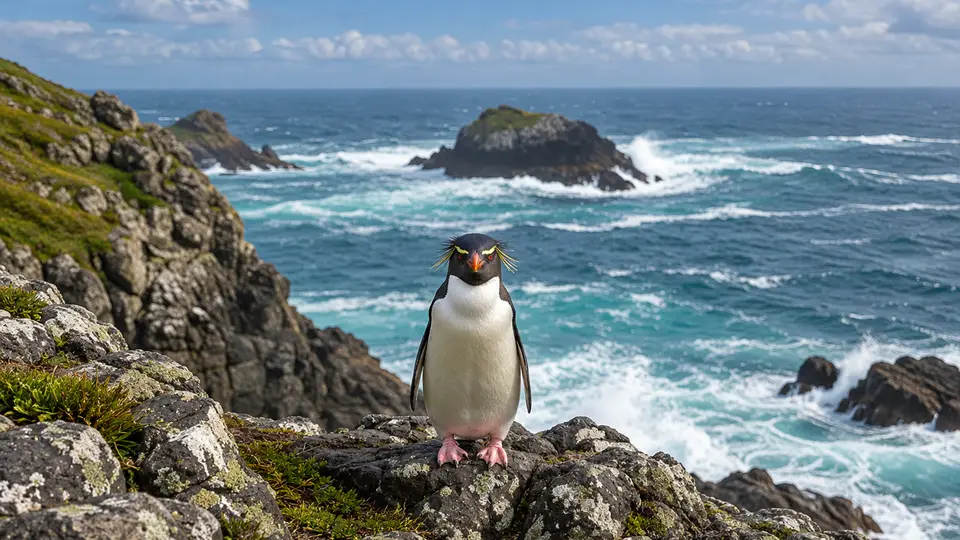
Snares penguin in its natural habitatAI-modified

Snares penguinEudyptes robustusWhere and when to see them

Snares penguin at a glance

The Snares penguin is a crested penguin whose breeding range is restricted to the Snares Islands south of New Zealand. Adults have sweeping yellow eyebrow plumes, dark cheeks and a robust reddish bill. Their colonies occupy a remarkably small geographic area, leaving the species vulnerable to major environmental events despite substantial local numbers. The islands receive strict protection, and ordinary visitors observe from offshore rather than entering colonies or walking across penguin routes.

Behaviour & reproduction

Size
50-60 cm (19.7-23.6 in) tall
Weight
2.5-4 kg (5.5-8.8 lb)
Lifespan
Not reliably established
Status
Vulnerable

During breeding, adults commute between the sea and crowded colonies, often following well-used paths through vegetation. Pairs defend small nest territories with calls and displays. Two eggs are usually laid, but the first is much smaller and normally does not produce a surviving chick. Parents alternate attendance and feeding responsibilities, and older chicks gather in groups while adults forage away from the colony. Courtship rituals include mutual preening and head-shaking displays between pair members. While the first laid egg is often infertile or fails to hatch, the second, larger egg typically produces the surviving chick. Fledgling chicks gather in crèches for protection before they gain independence and depart for the sea.

Top wildlife locations

New Zealand wildlife habitatAI-modified

New Zealand

Rocky shore approaches at the Snares may be viewed from permitted vessels when conditions allow. The breeding islands are restricted, inaccessible to ordinary visitors and not standard passenger landing sites.
Destinations describe the species' habitat, not guaranteed cruise stops. Some animals require an optional inland excursion or are found in restricted reserves.

Fun facts about the Snares penguin

  • The entire breeding population is confined to the Snares Islands.
  • Colonies can occur beneath dense tree-daisy forest.
  • The first egg is markedly smaller than the second.
  • Its scientific epithet robustus refers to its sturdy build.

Best time to see the Snares penguin

The austral spring and summer, broadly October to March, overlap colony attendance and the practical expedition season. Timing varies through courtship, incubation and chick rearing. Offshore viewing remains weather-dependent, and breeding activity never implies permission to land. Early in the season, adult pairs are establishing nests and performing courtship displays. Later, from December to February, chicks are most active and visible at the colonies before fledging. After fledging in late summer, adults undergo a pre-migratory molt, becoming flightless for several weeks.

Snares penguin: season matrix by destination

Travel and observation windows vary by region. Highlighted months are an orientation for planning, not confirmed sightings or a guarantee of access.

New Zealand

This window reflects common southern expedition conditions and breeding-season presence, not guaranteed offshore visibility; reserve restrictions prohibit routine tourist landings.

JanFebMarAprMayJunJulAugSepOctNovDec
Cruise ships in New Zealand

Where the Snares penguin lives

Breeding colonies occupy sheltered ground beneath tree-daisy forest and among tussock vegetation on the Snares Islands. Rocky shores provide access between nesting areas and the sea. Outside breeding, birds disperse through surrounding southern waters, where their distribution is less readily observed. These islands are the only known breeding grounds for the species. Beyond the breeding season, individuals are typically found in the waters around New Zealand's South Island, Stewart Island, and the subantarctic islands. They are pelagic outside the breeding season, ranging widely in oceanic waters.

What the Snares penguin eats

Krill and other small crustaceans are important foods, supplemented by squid and fish. The balance varies with prey availability and breeding stage. Adults returning to colonies deliver food to chicks, linking breeding success to productive marine feeding areas. Foraging dives are relatively shallow, typically less than 30 meters, lasting for a few minutes. These penguins are opportunistic predators, adapting their diet to local prey availability. Their diet provides essential energy for growth, reproduction, and maintaining body temperature in cold southern waters.

Species at a glance

Common name
Snares penguin
Scientific name
Eudyptes robustus
Animal group
Birds
Size
50-60 cm (19.7-23.6 in) tall
Weight
2.5-4 kg (5.5-8.8 lb)
Lifespan
Not reliably established
Status
Vulnerable
Identification
Unlike the similar Fiordland penguin, the Snares penguin has conspicuous bare pink skin at the bill base and generally lacks distinct white cheek streaks. The prominent yellow crest feathers extend from the base of the bill back over the eyes, often appearing somewhat bushy. Their dark plumage on the back and white underparts create a clear countershading, typical of many marine birds. The robust bill is a dark orange-brown, contrasting with the bare pink skin at its base.

Snares penguin: frequently asked questions

Where can I see the Snares penguin?
New Zealand. Observe only from a permitted vessel at an appropriate distance. Keep shore access routes clear, avoid loud calls or attempts to attract birds, and follow all reserve and vessel operating restrictions. Binoculars are highly recommended for observing these birds from a distance, allowing a closer view of their distinctive features and behaviors. During breeding, individuals can be seen actively moving along rocky pathways to and from the sea. Note that landing on the Snares Islands is strictly prohibited without special permits due to their protected status.
When is the best time to see the Snares penguin?
The austral spring and summer, broadly October to March, overlap colony attendance and the practical expedition season. Timing varies through courtship, incubation and chick rearing. Offshore viewing remains weather-dependent, and breeding activity never implies permission to land. Early in the season, adult pairs are establishing nests and performing courtship displays. Later, from December to February, chicks are most active and visible at the colonies before fledging. After fledging in late summer, adults undergo a pre-migratory molt, becoming flightless for several weeks.
How big does the Snares penguin get?
50-60 cm (19.7-23.6 in) tall. Adult weight: 2.5-4 kg (5.5-8.8 lb). Size varies with age, sex and population.
How should I behave around the Snares penguin?
Observe only from a permitted vessel at an appropriate distance. Keep shore access routes clear, avoid loud calls or attempts to attract birds, and follow all reserve and vessel operating restrictions. Binoculars are highly recommended for observing these birds from a distance, allowing a closer view of their distinctive features and behaviors. During breeding, individuals can be seen actively moving along rocky pathways to and from the sea. Note that landing on the Snares Islands is strictly prohibited without special permits due to their protected status.
What does the Snares penguin eat?
Krill and other small crustaceans are important foods, supplemented by squid and fish. The balance varies with prey availability and breeding stage. Adults returning to colonies deliver food to chicks, linking breeding success to productive marine feeding areas. Foraging dives are relatively shallow, typically less than 30 meters, lasting for a few minutes. These penguins are opportunistic predators, adapting their diet to local prey availability. Their diet provides essential energy for growth, reproduction, and maintaining body temperature in cold southern waters.
Are wildlife sightings guaranteed on an adventure cruise?
No. Animals move freely and routes, weather, access restrictions and local conditions influence every outing. Confirm the actual itinerary and shore program before booking.

Compare wildlife in the same destinations

Explore other birds recorded in these destinations. Similar surroundings do not mean the animals share the same habits or viewing season.

Species comparison by animal group and destination
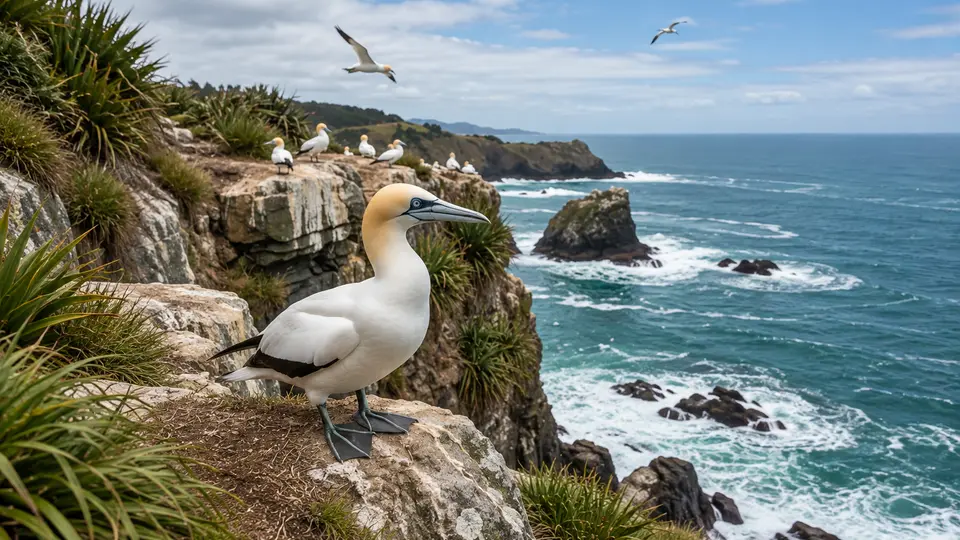
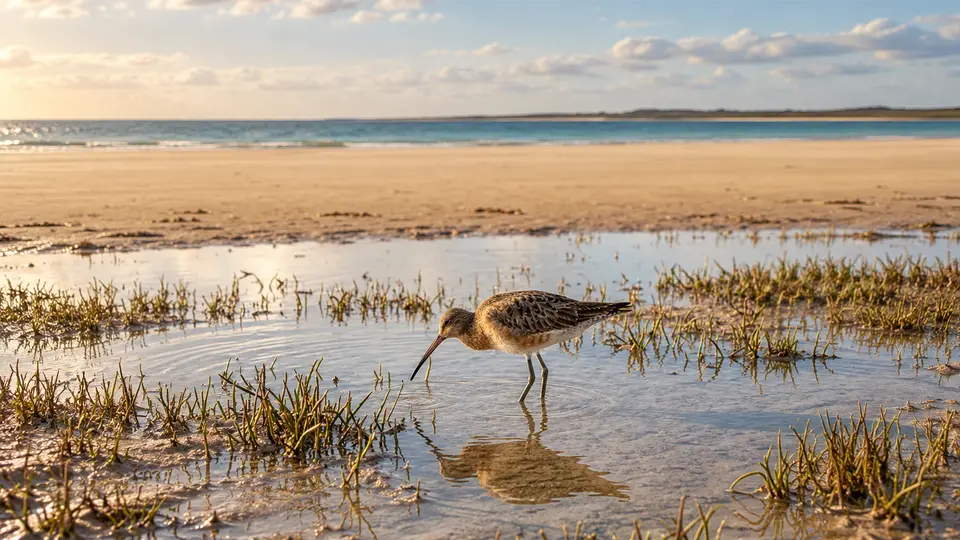
Snares penguinAI-modifiedSnares penguinAustralasian gannetAI-modifiedAustralasian gannetBar-tailed godwitAI-modifiedBar-tailed godwit
Animal groupBirdsAnimal groupBirdsAnimal groupBirds
DestinationsNew ZealandDestinationsNew ZealandDestinationsAustralia, New Zealand
Scientific nameEudyptes robustusScientific nameScientific name
All wildlife destinations
AI-modified
Plan your trip

Find your next wildlife adventure

Compare destinations, shore programs and dates with the animals and habitats you would love to see.

  • Naturalist-led shore excursions
  • Responsible wildlife watching
  • Small expedition ships