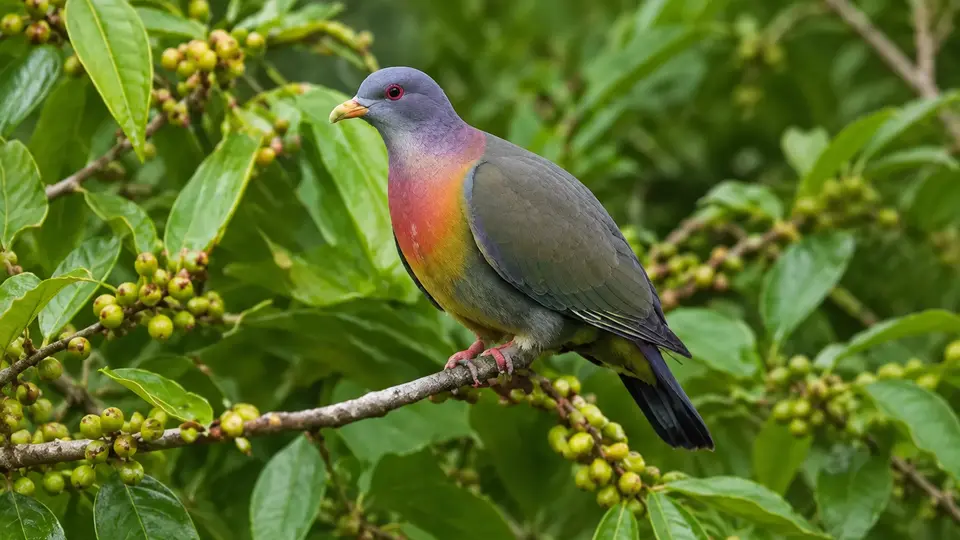
Rapa fruit dove in its natural habitat

Rapa fruit dovePtilinopus huttoniWhere and when to see them

Rapa fruit dove at a glance

The Rapa fruit dove is restricted to Rapa Iti in the Austral Islands of French Polynesia. This large fruit dove has predominantly green plumage with contrasting head and underpart markings, making it striking when seen well but surprisingly inconspicuous among leaves. Its entire natural distribution lies on one small, remote island. Loss and degradation of native forest, together with introduced animals and plants, leave the species vulnerable to changes affecting a very limited habitat.

Behaviour & reproduction

Size
About 31 cm (12.2 in) body length
Weight
Not reliably established
Lifespan
Not reliably established
Status
Endangered

Rapa fruit doves spend much of their time in forest trees, where they search for fruit and may remain hidden behind foliage. Calls can reveal a bird before its body becomes visible. They occur singly or in small associations around food rather than in large open-country flocks. Detailed information about nesting schedules and movements is limited, so firm claims about predictable display seasons or easily accessible gathering sites are not justified. They are known for their strong, clear, cooing calls, which are a primary indicator of their presence in the dense canopy. These doves typically move quietly through the forest, making them difficult to spot without prior acoustic detection. While generally solitary, small groups might gather at abundant fruiting trees, making these transient congregations a good target for observation.

Top wildlife locations

Polynesia wildlife habitat

Polynesia

Only Rapa Iti offers native habitat within Polynesia. Forested slopes above coastal settlements require a locally arranged inland excursion; this remote island is not a routine landing and sightings remain uncertain.
Destinations describe the species' habitat, not guaranteed cruise stops. Some animals require an optional inland excursion or are found in restricted reserves.

Fun facts about the Rapa fruit dove

  • Its natural range is confined to Rapa Iti.
  • Rapa Iti is distinct from Rapa Nui, or Easter Island.
  • The scientific name commemorates naturalist Frederick Hutton.
  • Its fruit-eating habits contribute to forest seed dispersal.

Best time to see the Rapa fruit dove

There is no well-established peak observation season for this rare island endemic. Access to remote Rapa Iti depends on transport, permissions and weather, while fruit availability can change bird movements. Travel timing should not be presented as a confirmed breeding calendar. While no peak season exists, the wet season (typically November to April) may offer better fruit availability, potentially influencing dove movements and visibility. However, high winds and heavy rainfall during this period can make forest access and observation difficult. Conversely, the drier months might concentrate birds around scarcer fruit resources.

Rapa fruit dove: season matrix by destination

Travel and observation windows vary by region. Highlighted months are an orientation for planning, not confirmed sightings or a guarantee of access.

Polynesia

Reliable species-specific seasonality and predictable visitor access are insufficiently established to recommend particular months.

JanFebMarAprMayJunJulAugSepOctNovDec
Cruise ships in Polynesia

Where the Rapa fruit dove lives

Remaining native forest on Rapa Iti is the essential habitat, particularly wooded slopes and valleys with suitable fruiting trees. Much of this terrain lies inland above the immediate coast. Open shorelines, settlement clearings and other Polynesian islands are not equivalent habitat. The species is strictly arboreal, rarely descending to the forest floor. Its survival is intrinsically linked to the health and extent of the remaining primary forest on the island. Fragmentation of these forests poses a significant threat to genetic exchange and resource access.

What the Rapa fruit dove eats

The dove feeds primarily on fruits from forest plants, swallowing suitable items and helping move seeds through the landscape. Its dependence on fruiting trees ties its prospects closely to native forest condition. Detailed seasonal dietary proportions are not reliably documented. Key food plants include species from the genera Ficus and Eugenia, whose fruits form a significant part of their diet. The doves often consume fruits larger than expected for their bill size, demonstrating their adapted feeding behavior. This specialized diet makes them important seed dispersers for several native tree species.

Species at a glance

Common name
Rapa fruit dove
Scientific name
Ptilinopus huttoni
Animal group
Birds
Size
About 31 cm (12.2 in) body length
Weight
Not reliably established
Lifespan
Not reliably established
Status
Endangered
Identification
On Rapa Iti, its large green body, pale head and contrasting yellow and pinkish underparts distinguish it from introduced pigeons and other local birds. The Rapa fruit dove's relatively short tail and robust build, typical of fruit doves, are good distinguishing features. The male's vibrant coloration is particularly striking, with a bright green back, a pale silvery head, and a contrasting yellow belly with a pinkish vent. Females are generally duller but retain the overall pattern, which is still distinct from other island birds.

Rapa fruit dove: frequently asked questions

Where can I see the Rapa fruit dove?
Polynesia. Use a locally authorized guide and remain on established routes through suitable forest. Avoid playback, nest searches and cutting vegetation for views; a small island population cannot absorb unnecessary disturbance. Focus on listening for their distinctive calls emanating from the canopy, as visual identification can be challenging. Patience and slow movement through suitable habitat greatly increase the chances of a sighting. Binoculars are essential for scanning dense foliage where they often feed.
When is the best time to see the Rapa fruit dove?
There is no well-established peak observation season for this rare island endemic. Access to remote Rapa Iti depends on transport, permissions and weather, while fruit availability can change bird movements. Travel timing should not be presented as a confirmed breeding calendar. While no peak season exists, the wet season (typically November to April) may offer better fruit availability, potentially influencing dove movements and visibility. However, high winds and heavy rainfall during this period can make forest access and observation difficult. Conversely, the drier months might concentrate birds around scarcer fruit resources.
How big does the Rapa fruit dove get?
About 31 cm (12.2 in) body length. Adult weight: Not reliably established. Size varies with age, sex and population.
How should I behave around the Rapa fruit dove?
Use a locally authorized guide and remain on established routes through suitable forest. Avoid playback, nest searches and cutting vegetation for views; a small island population cannot absorb unnecessary disturbance. Focus on listening for their distinctive calls emanating from the canopy, as visual identification can be challenging. Patience and slow movement through suitable habitat greatly increase the chances of a sighting. Binoculars are essential for scanning dense foliage where they often feed.
What does the Rapa fruit dove eat?
The dove feeds primarily on fruits from forest plants, swallowing suitable items and helping move seeds through the landscape. Its dependence on fruiting trees ties its prospects closely to native forest condition. Detailed seasonal dietary proportions are not reliably documented. Key food plants include species from the genera Ficus and Eugenia, whose fruits form a significant part of their diet. The doves often consume fruits larger than expected for their bill size, demonstrating their adapted feeding behavior. This specialized diet makes them important seed dispersers for several native tree species.
Are wildlife sightings guaranteed on an adventure cruise?
No. Animals move freely and routes, weather, access restrictions and local conditions influence every outing. Confirm the actual itinerary and shore program before booking.

Compare wildlife in the same destinations

Explore other birds recorded in these destinations. Similar surroundings do not mean the animals share the same habits or viewing season.

Species comparison by animal group and destination
Rapa fruit doveRapa fruit doveBlue lorikeetBlue lorikeetBristle-thighed curlewBristle-thighed curlew
Animal groupBirdsAnimal groupBirdsAnimal groupBirds
DestinationsPolynesiaDestinationsPolynesiaDestinationsPolynesia
Scientific namePtilinopus huttoniScientific nameScientific name
All wildlife destinations
Plan your trip

Find your next wildlife adventure

Compare destinations, shore programs and dates with the animals and habitats you would love to see.

  • Naturalist-led shore excursions
  • Responsible wildlife watching
  • Small expedition ships