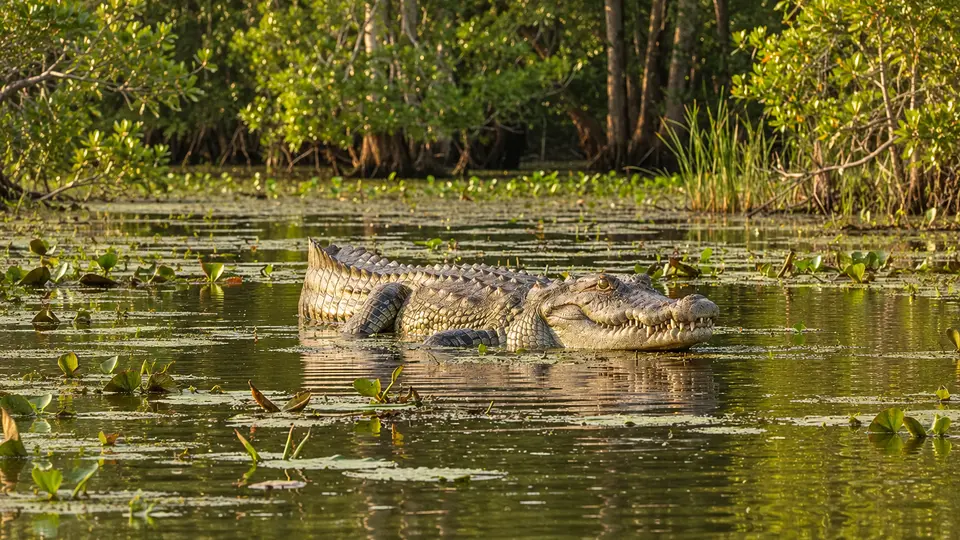
Morelet's Crocodile in its natural habitat

Morelet's CrocodileCrocodylus moreletiiWhere and when to see them

Morelet's Crocodile at a glance

Morelet's crocodile is a medium-sized crocodilian native to Atlantic-draining lowlands of Mexico, Belize and Guatemala. It is especially associated with freshwater wetlands, although it can occur in brackish settings. Its broad snout and dark, often mottled coloration suit a concealed life among shaded banks and vegetation. Recovery from historical hunting has benefited the species, but habitat loss, conflict with people and hybridization with American crocodiles complicate local conservation.

Behaviour & reproduction

Size
2-3 m total length
Weight
40-150 kg
Lifespan
Not reliably established
Status
Least Concern

Individuals bask on banks to regulate body temperature and retreat to water when disturbed. Much hunting occurs in low light, with crocodiles waiting near places where prey gathers. Females construct mound nests from vegetation and other material, guard the nest area and assist hatchlings at emergence. Adults may be difficult to detect even in occupied wetlands, so an apparently empty bank should never be treated as proof of safety. Individuals bask on banks to regulate body temperature and retreat to water when disturbed. Much hunting occurs in low light, with crocodiles waiting near places where prey gathers. Females construct mound nests from vegetation and other material, guard the nest area and assist hatchlings at emergence. Adults may be difficult to detect even in occupied wetlands, so an apparently empty bank should never be treated as proof of safety. During cooler periods, they may enter a state of dormancy or reduced activity. They are generally solitary but can congregate in favorable habitats, especially during dry seasons.

Top wildlife locations

Mexico wildlife habitat

Mexico

Freshwater lagoons and marshes in southeastern Mexico provide suitable habitat, including some coastal lowlands. Designated boardwalks are appropriate viewpoints; many wetlands require an inland excursion, and identification is complicated where American crocodiles also occur.
Destinations describe the species' habitat, not guaranteed cruise stops. Some animals require an optional inland excursion or are found in restricted reserves.

Fun facts about the Morelet's Crocodile

  • The species is named after French naturalist Pierre Marie Arthur Morelet.
  • Females build mound nests rather than simply burying eggs in bare sand.
  • Hatchlings call from within their eggs near hatching time.
  • Natural hybridization with American crocodiles occurs in parts of their overlapping range.

Best time to see the Morelet's Crocodile

Drier months can improve access to wetland boardwalks and make basking animals easier to notice in some Mexican regions. Conditions differ among wetlands, however. Nesting and rainfall patterns should be checked locally, and nesting areas should never become viewing targets. Drier months can improve access to wetland boardwalks and make basking animals easier to notice in some Mexican regions. Conditions differ among wetlands, however. Nesting and rainfall patterns should be checked locally, and nesting areas should never become viewing targets. The dry season can concentrate individuals in remaining water bodies, potentially increasing visibility. During the wet season, higher water levels may disperse crocodiles, making them harder to spot.

Morelet's Crocodile: season matrix by destination

Travel and observation windows vary by region. Highlighted months are an orientation for planning, not confirmed sightings or a guarantee of access.

Mexico

This broadly drier southeastern travel window can aid access, but water levels, closures and local species identification need confirmation.

JanFebMarAprMayJunJulAugSepOctNovDec
Cruise ships in Mexico

Where the Morelet's Crocodile lives

Freshwater marshes, swamps, lagoons, slow rivers and forested wetlands are characteristic habitats. Some animals also use brackish coastal systems. Dense bank vegetation and sheltered nesting ground are important, while altered waterways can bring crocodiles close to roads, farms and settlements. Freshwater marshes, swamps, lagoons, slow rivers and forested wetlands are characteristic habitats. Some animals also use brackish coastal systems. Dense bank vegetation and sheltered nesting ground are important, while altered waterways can bring crocodiles close to roads, farms and settlements. This species prefers warmer, shallower waters, often in areas with dense emergent vegetation providing cover. They are largely restricted to low-lying coastal plains and river basins across their range.

What the Morelet's Crocodile eats

Young crocodiles eat insects, crustaceans and small fish, progressing to larger prey as they grow. Adults take fish, turtles, birds and mammals when available. They are opportunistic predators, and feeding them encourages dangerous associations between people and food. Young crocodiles eat insects, crustaceans and small fish, progressing to larger prey as they grow. Adults take fish, turtles, birds and mammals when available. They are opportunistic predators, and feeding them encourages dangerous associations between people and food. Their powerful jaws allow them to crush shells and bones, enabling a diverse diet. They often ambush prey from the water's edge or underwater, using a sudden lunge.

Species at a glance

Common name
Morelet's Crocodile
Scientific name
Crocodylus moreletii
Animal group
Reptiles
Size
2-3 m total length
Weight
40-150 kg
Lifespan
Not reliably established
Status
Least Concern
Identification
It generally has a shorter, broader snout than the American crocodile, but overlap and hybridization mean distant identification may require expert confirmation. It generally has a shorter, broader snout than the American crocodile, but overlap and hybridization mean distant identification may require expert confirmation. Morelet's crocodiles typically have a series of dark bands or blotches on a gray to olive-brown body, which may fade with age. Unlike some other crocodilians, their fourth lower jaw tooth is not visible when the mouth is closed.

Morelet's Crocodile: frequently asked questions

Where can I see the Morelet's Crocodile?
Mexico. Observe only from designated raised platforms or protected paths, well back from water edges. Never feed crocodiles or approach nests and young. Keep children close, and follow local closures even when no animal is visible. Observe only from designated raised platforms or protected paths, well back from water edges. Never feed crocodiles or approach nests and young. Keep children close, and follow local closures even when no animal is visible. Use binoculars or a telephoto lens for detailed observation, ensuring a safe distance is maintained at all times. Look for characteristic eye shine at night if participating in guided nocturnal tours, but always under strict supervision.
When is the best time to see the Morelet's Crocodile?
Drier months can improve access to wetland boardwalks and make basking animals easier to notice in some Mexican regions. Conditions differ among wetlands, however. Nesting and rainfall patterns should be checked locally, and nesting areas should never become viewing targets. Drier months can improve access to wetland boardwalks and make basking animals easier to notice in some Mexican regions. Conditions differ among wetlands, however. Nesting and rainfall patterns should be checked locally, and nesting areas should never become viewing targets. The dry season can concentrate individuals in remaining water bodies, potentially increasing visibility. During the wet season, higher water levels may disperse crocodiles, making them harder to spot.
How big does the Morelet's Crocodile get?
2-3 m total length. Adult weight: 40-150 kg. Size varies with age, sex and population.
How should I behave around the Morelet's Crocodile?
Observe only from designated raised platforms or protected paths, well back from water edges. Never feed crocodiles or approach nests and young. Keep children close, and follow local closures even when no animal is visible. Observe only from designated raised platforms or protected paths, well back from water edges. Never feed crocodiles or approach nests and young. Keep children close, and follow local closures even when no animal is visible. Use binoculars or a telephoto lens for detailed observation, ensuring a safe distance is maintained at all times. Look for characteristic eye shine at night if participating in guided nocturnal tours, but always under strict supervision.
What does the Morelet's Crocodile eat?
Young crocodiles eat insects, crustaceans and small fish, progressing to larger prey as they grow. Adults take fish, turtles, birds and mammals when available. They are opportunistic predators, and feeding them encourages dangerous associations between people and food. Young crocodiles eat insects, crustaceans and small fish, progressing to larger prey as they grow. Adults take fish, turtles, birds and mammals when available. They are opportunistic predators, and feeding them encourages dangerous associations between people and food. Their powerful jaws allow them to crush shells and bones, enabling a diverse diet. They often ambush prey from the water's edge or underwater, using a sudden lunge.
Are wildlife sightings guaranteed on an adventure cruise?
No. Animals move freely and routes, weather, access restrictions and local conditions influence every outing. Confirm the actual itinerary and shore program before booking.

Compare wildlife in the same destinations

Explore other reptiles recorded in these destinations. Similar surroundings do not mean the animals share the same habits or viewing season.

Species comparison by animal group and destination
Morelet's CrocodileMorelet's CrocodileBlack Spiny-tailed IguanaBlack Spiny-tailed IguanaGreen Sea TurtleGreen Sea Turtle
Animal groupReptilesAnimal groupReptilesAnimal groupReptiles
DestinationsMexicoDestinationsMexicoDestinationsCosta Rica, Florida, Galapagos, Mexico, Cape Verde, Egypt, Greece, Seychelles, Turkey, Indonesia, Maldives, Thailand, Vietnam, Australia, Fiji, Polynesia
All wildlife destinations
Plan your trip

Find your next wildlife adventure

Compare destinations, shore programs and dates with the animals and habitats you would love to see.

  • Naturalist-led shore excursions
  • Responsible wildlife watching
  • Small expedition ships