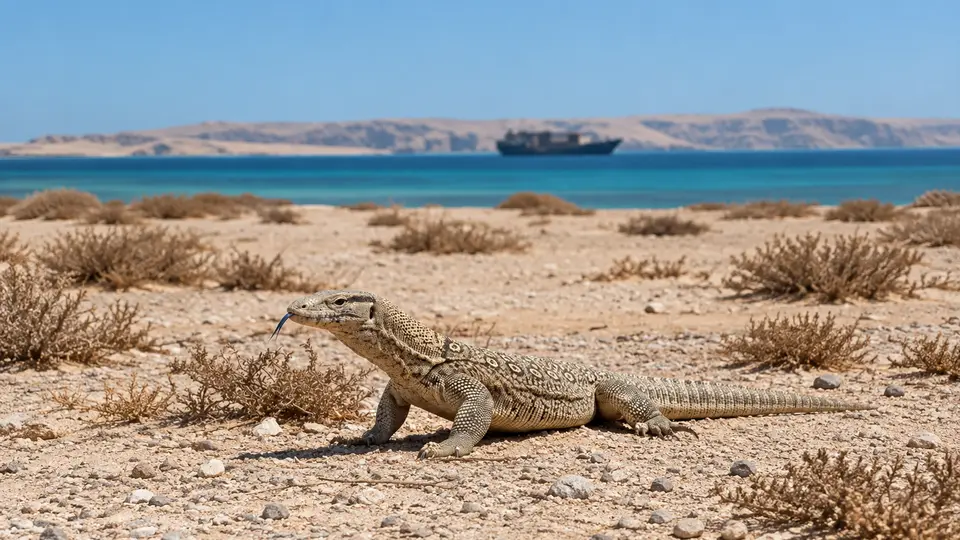
Desert Monitor in its natural habitatAI-modified

Desert MonitorVaranus griseusWhere and when to see them

Desert Monitor at a glance

The desert monitor is a large, alert lizard of arid North Africa and parts of Asia. In Egypt it inhabits suitable desert terrain, where its sandy colouring and dark bands provide camouflage against broken ground. A long neck, strong limbs and constantly sampling tongue suit an active hunter. Although widespread as a species, it can be difficult to find locally and is not a predictable feature of ordinary beach visits.

Behaviour & reproduction

Size
80–120 cm (31.5–47.2 in) total length
Weight
1–3 kg (2.2–6.6 lb)
Lifespan
Up to 17 years in captivity
Status
Least Concern

Desert monitors forage actively, investigating burrows, vegetation and ground cover with repeated tongue flicks. They shelter in burrows during unsuitable temperatures and adjust their daily activity to avoid extreme midday heat. When threatened, an animal may inflate its body, hiss, lash its tail or bite rather than simply flee. Seasonal inactivity occurs in colder parts of the range, but its timing varies substantially with local climate and geography. When cornered, a desert monitor may rear up on its hind legs and hiss loudly as a defensive display. They are known to dig extensive burrows, sometimes several meters long, which provide refuge from predators and temperature extremes.

Top wildlife locations

Egypt wildlife habitatAI-modified

Egypt

Dry wadis and desert scrub behind the coast offer plausible habitat, but a guided desert excursion is usually required. Sightings are uncommon and should never involve digging into burrows or leaving authorized routes.


Destinations describe the species' habitat, not guaranteed cruise stops. Some animals require an optional inland excursion or are found in restricted reserves.

Fun facts about the Desert Monitor

  • Its forked tongue carries chemical information to a sensory organ in the mouth.
  • Burrows provide refuge from both temperature extremes and predators.
  • Its range extends far beyond North Africa into parts of Asia.
  • The tail is both a balancing aid and a defensive weapon.

Best time to see the Desert Monitor

Spring and autumn offer more manageable temperatures for Egyptian desert excursions and plausible daytime activity. In very hot weather, activity can shift toward cooler hours. Local conditions matter more than a fixed calendar, and winter sightings may be less likely. Early mornings or late afternoons during spring and autumn maximize chances for observing them as they emerge from burrows to bask. During extreme summer heat, they may become almost entirely nocturnal to avoid dehydration.

Desert Monitor: season matrix by destination

Travel and observation windows vary by region. Highlighted months are an orientation for planning, not confirmed sightings or a guarantee of access.

Egypt

These shoulder-season months balance travel comfort with plausible reptile activity; local temperatures and access determine suitability, and occurrence is not assured.

JanFebMarAprMayJunJulAugSepOctNovDec
Cruise ships in Egypt

Where the Desert Monitor lives

Sandy and stony deserts, semi-desert scrub and dry wadis provide suitable habitat where shelter and prey are available. It is not restricted to open dunes. In Egypt, searches usually require a dedicated desert excursion away from developed coastal strips. They often prefer areas with sparse vegetation, such as acacia or tamarisk trees, which provide shade and cover. In Egypt, they can be found in a variety of desert environments from the northern coast southwards into the Nubian Desert.

What the Desert Monitor eats

An opportunistic predator, it eats rodents, lizards, snakes, eggs and large invertebrates, with occasional carrion. Its tongue helps locate chemical traces of prey. Strong claws assist in investigating shelters, although prey availability determines which foods dominate at any location. A significant portion of their diet includes beetles, scorpions, and other arthropods, especially juveniles. They have powerful jaws capable of crushing the shells of snails and hard exoskeletons of insects.

Species at a glance

Common name
Desert Monitor
Scientific name
Varanus griseus
Animal group
Reptiles
Size
80–120 cm (31.5–47.2 in) total length
Weight
1–3 kg (2.2–6.6 lb)
Lifespan
Up to 17 years in captivity
Status
Least Concern
Identification
Its sandy, dark-banded body and relatively rounded tail distinguish it from the more aquatic Nile monitor, which has a strongly compressed tail and yellow-spotted pattern. The species typically has small, bead-like scales over its entire body, lacking any keeled scales. Their overall coloration can vary from light yellow to grey depending on the substrate, providing excellent camouflage.

Desert Monitor: frequently asked questions

Where can I see the Desert Monitor?
Egypt. Watch from a respectful distance on established desert routes. Never corner a monitor, block its burrow or attempt handling; its bite and tail can cause injury. Carry water and avoid pursuing animals across exposed terrain. Binoculars are highly recommended for observing these wary lizards from a safe distance without disturbing their natural behavior. Look for their distinctive tracks in sandy areas, which can lead to their burrows or recent activity sites.
When is the best time to see the Desert Monitor?
Spring and autumn offer more manageable temperatures for Egyptian desert excursions and plausible daytime activity. In very hot weather, activity can shift toward cooler hours. Local conditions matter more than a fixed calendar, and winter sightings may be less likely. Early mornings or late afternoons during spring and autumn maximize chances for observing them as they emerge from burrows to bask. During extreme summer heat, they may become almost entirely nocturnal to avoid dehydration.
How big does the Desert Monitor get?
80–120 cm (31.5–47.2 in) total length. Adult weight: 1–3 kg (2.2–6.6 lb). Size varies with age, sex and population.
How should I behave around the Desert Monitor?
Watch from a respectful distance on established desert routes. Never corner a monitor, block its burrow or attempt handling; its bite and tail can cause injury. Carry water and avoid pursuing animals across exposed terrain. Binoculars are highly recommended for observing these wary lizards from a safe distance without disturbing their natural behavior. Look for their distinctive tracks in sandy areas, which can lead to their burrows or recent activity sites.
What does the Desert Monitor eat?
An opportunistic predator, it eats rodents, lizards, snakes, eggs and large invertebrates, with occasional carrion. Its tongue helps locate chemical traces of prey. Strong claws assist in investigating shelters, although prey availability determines which foods dominate at any location. A significant portion of their diet includes beetles, scorpions, and other arthropods, especially juveniles. They have powerful jaws capable of crushing the shells of snails and hard exoskeletons of insects.
Are wildlife sightings guaranteed on an adventure cruise?
No. Animals move freely and routes, weather, access restrictions and local conditions influence every outing. Confirm the actual itinerary and shore program before booking.

Compare wildlife in the same destinations

Explore other reptiles recorded in these destinations. Similar surroundings do not mean the animals share the same habits or viewing season.

Species comparison by animal group and destination
Desert MonitorAI-modifiedDesert MonitorGreen Sea TurtleAI-modifiedGreen Sea TurtleHawksbill Sea TurtleAI-modifiedHawksbill Sea Turtle
Animal groupReptilesAnimal groupReptilesAnimal groupReptiles
DestinationsEgyptDestinationsCosta Rica, Florida, Galapagos, Mexico, Cape Verde, Egypt, Greece, Seychelles, Turkey, Indonesia, Maldives, Thailand, Vietnam, Australia, Fiji, PolynesiaDestinationsEgypt, Seychelles, Indonesia, Maldives, Thailand, Vietnam, Fiji, Polynesia
Scientific nameVaranus griseusScientific nameScientific name
All wildlife destinations
AI-modified
Plan your trip

Find your next wildlife adventure

Compare destinations, shore programs and dates with the animals and habitats you would love to see.

  • Naturalist-led shore excursions
  • Responsible wildlife watching
  • Small expedition ships