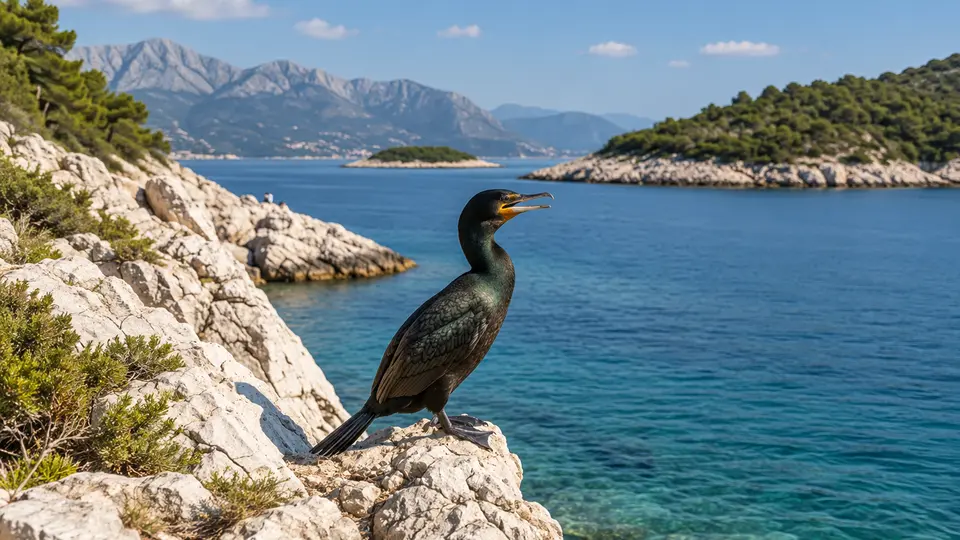
European Shag in its natural habitatAI-modified

European ShagGulosus aristotelisWhere and when to see them

European Shag at a glance

The European shag is a slender, predominantly marine member of the cormorant family, associated with rocky Atlantic and Mediterranean coasts. Adults appear black at a distance but show a green sheen in favourable light. Breeding birds develop a forward-curving crest that is absent for much of the year. Unlike the more versatile great cormorant, the shag is strongly tied to coastal waters, nesting on ledges, among boulders and in sheltered crevices close to the sea.

Behaviour & reproduction

Size
65-80 cm (25.6-31.5 in) long
Weight
1.5-2.5 kg (3.3-5.5 lb)
Lifespan
Over 14 years on average
Status
Least Concern

Shags rest on coastal rocks between feeding trips and often gather near nesting cliffs. They fly low over the sea with steady wingbeats, sometimes forming loose lines between feeding areas and colonies. Nesting pairs construct bulky platforms of plant material, with timing varying considerably between regions and years. Birds may spread their wings while resting. During rough weather, individuals can be concentrated in sheltered bays, but severe storms can also cause substantial mortality. Courtship displays involve bowing and head-shaking, particularly visible during the early breeding season. Shags are highly social at colonies but typically forage alone or in small, dispersed groups.

Top wildlife locations

Croatia wildlife habitatAI-modified

Croatia

Rocky Adriatic shores and offshore islets offer plausible distant views from coastal paths or decks. Nesting rocks may be inaccessible or protected, so observation should remain outside colony areas.

Greece wildlife habitatAI-modified

Greece

Rocky island coastlines, sheltered bays and sea cliffs provide suitable viewing habitat from established shore paths. Colonies are localized, and many nesting islets are inaccessible or unsuitable for public access.

Norway wildlife habitatAI-modified

Norway

Rocky outer coasts, sheltered coastal bays and seabird cliffs offer shore or deck viewing. Many colonies occupy remote islands, making some habitat inaccessible without authorized transport and appropriate local access arrangements.

Scotland wildlife habitatAI-modified

Scotland

Rock platforms, coastal headlands and sheltered sea-loch entrances offer plausible views from public paths. Some breeding cliffs and islands are inaccessible, and exposed viewpoints become hazardous during strong winds or swell.

Turkey wildlife habitatAI-modified

Turkey

Suitable rocky Black Sea, Marmara and Aegean coasts can support shags, with distant viewing from headlands or decks. Occurrence is localized, and nesting islands or cliffs may be inaccessible.

Destinations describe the species' habitat, not guaranteed cruise stops. Some animals require an optional inland excursion or are found in restricted reserves.

Fun facts about the European Shag

  • The green gloss becomes most apparent when light strikes adult feathers obliquely.
  • Its crest is a seasonal feature rather than a permanent identification mark.
  • Mediterranean juveniles can be much paler below than northern birds.
  • Modern classifications place the species in Gulosus rather than Phalacrocorax.

Best time to see the European Shag

Shags can be observed year-round across much of their coastal range, but accessibility and daylight differ strongly between destinations. Spring and summer generally suit northern shore watching. Mediterranean colonies may breed considerably earlier, so a summer holiday should not be assumed to coincide with nesting. In more northerly parts of its range, breeding can extend into late summer, offering opportunities to see fledglings. Optimal viewing from a ship often coincides with calmer seas, which are more common in late spring and early autumn in some regions.

European Shag: season matrix by destination

Travel and observation windows vary by region. Highlighted months are an orientation for planning, not confirmed sightings or a guarantee of access.

Croatia

These months provide a practical coastal travel window for a resident bird; Mediterranean nesting can occur earlier and is not defined by this window.

JanFebMarAprMayJunJulAugSepOctNovDec
Cruise ships in Croatia

Greece

This broad window reflects workable coastal observation conditions, not seasonal absence in winter or a uniform breeding calendar across Greek waters.

JanFebMarAprMayJunJulAugSepOctNovDec
Cruise ships in Greece

Norway

Longer daylight and generally more manageable coastal conditions favour these months; shags remain year-round in many areas, with local movements and variable nesting dates.

JanFebMarAprMayJunJulAugSepOctNovDec
Cruise ships in Norway

Scotland

Resident populations allow year-round observation, but spring and summer offer more daylight; weather and safe access should determine individual outings.

JanFebMarAprMayJunJulAugSepOctNovDec
Cruise ships in Scotland

Turkey

Resident occurrence is documented regionally, but a single reliable national shore-observation window is unsupported without a specific coast and current local information.

JanFebMarAprMayJunJulAugSepOctNovDec
Cruise ships in Turkey

Where the European Shag lives

Rocky coasts, islands, sheltered bays and nearshore waters form its core habitat. Cliffs and boulder fields provide nesting and resting places. It is much less associated with inland lakes than the great cormorant, although occasional individuals occur away from typical marine settings. They typically prefer clear, unpolluted waters for foraging, indicating a sensitivity to marine environmental quality. Breeding colonies are often found on remote offshore islands or inaccessible mainland cliffs, offering protection from terrestrial predators.

What the European Shag eats

Fish dominate the diet, including sandeels, gobies and other locally abundant coastal species. Prey selection varies with seabed habitat and region. From shore, feeding activity is usually seen as repeated disappearances and resurfacing, sometimes followed by a return to a nearby resting rock. Juvenile shags often consume smaller, more easily captured prey items, while adults target a wider size range. Their diet can also include crustaceans and cephalopods, though fish remain the primary food source.

Species at a glance

Common name
European Shag
Scientific name
Gulosus aristotelis
Animal group
Birds
Size
65-80 cm (25.6-31.5 in) long
Weight
1.5-2.5 kg (3.3-5.5 lb)
Lifespan
Over 14 years on average
Status
Least Concern
Identification
Compared with the great cormorant, it is slimmer with a finer bill, steeper forehead and no extensive white adult throat patch; breeding adults may show a curled crest. The deep green gloss on its black plumage is a key feature, often visible in good light. Juveniles are browner overall with a pale belly, gradually acquiring the adult's darker plumage over several years.

European Shag: frequently asked questions

Where can I see the European Shag?
Croatia, Greece, Norway, Scotland, Turkey. Watch resting rocks and feeding bays from secure coastal viewpoints or a deck. Stay back from cliff edges and nesting ledges, and never force resting birds to enter rough water. Binoculars are essential for detailed observation of plumage and behaviour from a distance, especially for identifying breeding crests. During boat excursions, scanning along the waterline and cliff bases can reveal birds resting or preening.
When is the best time to see the European Shag?
Shags can be observed year-round across much of their coastal range, but accessibility and daylight differ strongly between destinations. Spring and summer generally suit northern shore watching. Mediterranean colonies may breed considerably earlier, so a summer holiday should not be assumed to coincide with nesting. In more northerly parts of its range, breeding can extend into late summer, offering opportunities to see fledglings. Optimal viewing from a ship often coincides with calmer seas, which are more common in late spring and early autumn in some regions.
How big does the European Shag get?
65-80 cm (25.6-31.5 in) long. Adult weight: 1.5-2.5 kg (3.3-5.5 lb). Size varies with age, sex and population.
How should I behave around the European Shag?
Watch resting rocks and feeding bays from secure coastal viewpoints or a deck. Stay back from cliff edges and nesting ledges, and never force resting birds to enter rough water. Binoculars are essential for detailed observation of plumage and behaviour from a distance, especially for identifying breeding crests. During boat excursions, scanning along the waterline and cliff bases can reveal birds resting or preening.
What does the European Shag eat?
Fish dominate the diet, including sandeels, gobies and other locally abundant coastal species. Prey selection varies with seabed habitat and region. From shore, feeding activity is usually seen as repeated disappearances and resurfacing, sometimes followed by a return to a nearby resting rock. Juvenile shags often consume smaller, more easily captured prey items, while adults target a wider size range. Their diet can also include crustaceans and cephalopods, though fish remain the primary food source.
Are wildlife sightings guaranteed on an adventure cruise?
No. Animals move freely and routes, weather, access restrictions and local conditions influence every outing. Confirm the actual itinerary and shore program before booking.

Compare wildlife in the same destinations

Explore other birds recorded in these destinations. Similar surroundings do not mean the animals share the same habits or viewing season.

Species comparison by animal group and destination
European ShagAI-modifiedEuropean ShagArctic TernAI-modifiedArctic TernAtlantic PuffinAI-modifiedAtlantic Puffin
Animal groupBirdsAnimal groupBirdsAnimal groupBirds
DestinationsCroatia, Greece, Norway, Scotland, TurkeyDestinationsAlaska, Norway, ArcticDestinationsNew England, Norway, Scotland, Arctic
Scientific nameGulosus aristotelisScientific nameScientific name
All wildlife destinations
AI-modified
Plan your trip

Find your next wildlife adventure

Compare destinations, shore programs and dates with the animals and habitats you would love to see.

  • Naturalist-led shore excursions
  • Responsible wildlife watching
  • Small expedition ships