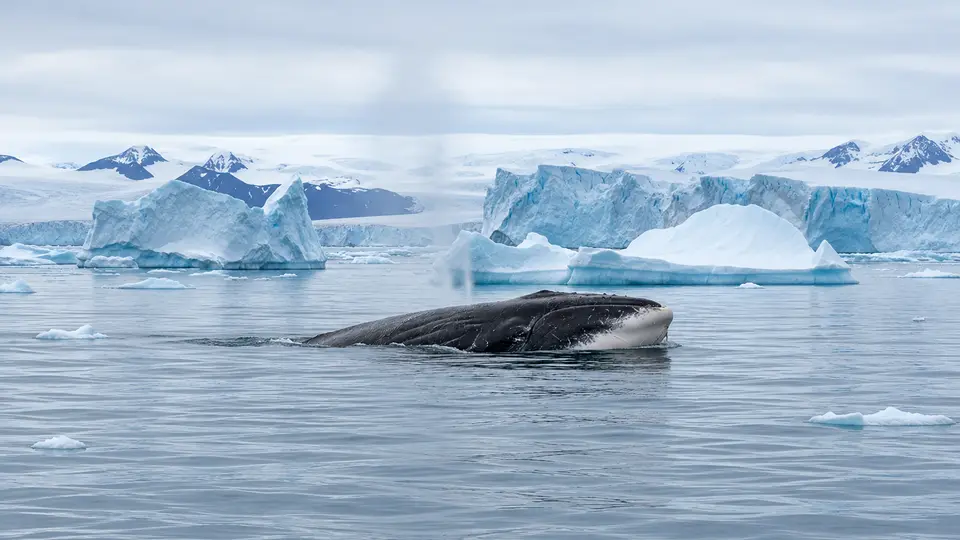
Bowhead Whale in its natural habitat

Bowhead WhaleBalaena mysticetusWhere and when to see them

Bowhead Whale at a glance

The bowhead whale is a heavily built Arctic marine mammal with an immense arched head, exceptionally long baleen and no dorsal fin. Thick blubber and specialized circulation help it function in icy seas. Its global assessment masks major differences among populations, some of which remain small after historical commercial whaling. Bowheads are also culturally and nutritionally important to Indigenous Arctic communities, whose knowledge has contributed substantially to understanding their movements, behaviour and long lives.

Behaviour & reproduction

Size
14–18 m (46–59 ft) long
Weight
60–100 tonnes (66–110 short tons)
Lifespan
100–200+ years
Status
Least Concern

Bowheads move through ice leads and seasonally open coastal waters, sometimes gathering where currents concentrate plankton. They can break relatively thin sea ice to breathe using the reinforced head. Feeding often involves slow swimming with the mouth open, filtering small prey continuously. Individuals produce varied calls and elaborate songs, especially during winter. Migration routes and timing differ among populations, with ice formation, breakup and food conditions shaping access to seasonal habitats. They are long lived, potentially reaching ages well over 100 years. Their strong social bonds are evident in coordinated feeding and traveling groups. Bowheads are known for their loud and diverse vocalizations, which play a role in communication, navigation, and possibly mate attraction, especially during the long dark winter months.

Top wildlife locations

Arctic wildlife habitat

Arctic

Selected bays, channels and ice-margin coasts within established population ranges offer possible distant views. Most habitat is remote or inaccessible, and shore access requires local permission, wildlife precautions and respect for subsistence use.
Destinations describe the species' habitat, not guaranteed cruise stops. Some animals require an optional inland excursion or are found in restricted reserves.

Fun facts about the Bowhead Whale

  • Some individuals can live for more than two centuries.
  • Its baleen plates can exceed four metres in length.
  • The head can account for roughly one-third of body length.
  • Winter recordings reveal diverse songs that can change between years.

Best time to see the Bowhead Whale

For visitors, Arctic summer usually provides the most practical coastal access and daylight. This is not a universal bowhead peak: some populations pass particular coasts during spring or autumn ice movements. Choose a region with current local guidance rather than assuming all Arctic waters are suitable. Late spring and early autumn also offer opportunities to see whales as they transition between seasonal areas, often coinciding with ice melt or freeze up. Specific travel times within the Arctic summer vary by region depending on ice conditions and whale movements. Consulting local indigenous knowledge and current ice charts provides the most accurate timing for viewing prospects.

Bowhead Whale: season matrix by destination

Travel and observation windows vary by region. Highlighted months are an orientation for planning, not confirmed sightings or a guarantee of access.

Arctic

A broad visitor-access window only; local whale movements may peak outside these months and differ greatly between Arctic populations.

JanFebMarAprMayJunJulAugSepOctNovDec
Cruise ships in Arctic

Where the Bowhead Whale lives

Arctic and subarctic shelf seas, ice margins, sheltered bays and channels provide habitat across separate regional populations. Unlike many large whales, bowheads remain associated with high latitudes throughout the year. Some coastal concentrations occur, but extensive habitat is remote, icebound or inaccessible to visitors. Historical whaling records and modern surveys indicate their range once extended further south, especially in the North Atlantic. Their robust blubber layer and unique circulatory adaptations allow them to thrive in waters that are often near or below freezing. Some regional populations demonstrate strong fidelity to specific summer feeding grounds and wintering areas.

What the Bowhead Whale eats

Copepods and other small crustaceans, including euphausiids, supply most food. Very long, fine baleen fringes retain tiny prey as water passes through the mouth. Feeding can occur near the surface or deeper, wherever currents and seasonal productivity create sufficiently dense plankton patches. Calanoid copepods are a particularly important food source for bowheads in many regions. They are filter feeders, consuming vast quantities of these tiny organisms, which are crucial to the Arctic food web. Their feeding efficiency is remarkable, allowing them to accumulate significant blubber reserves for winter.

Species at a glance

Common name
Bowhead Whale
Scientific name
Balaena mysticetus
Animal group
Mammals
Size
14–18 m (46–59 ft) long
Weight
60–100 tonnes (66–110 short tons)
Lifespan
100–200+ years
Status
Least Concern
Identification
Its huge arched head, pale lower jaw and complete absence of a dorsal fin distinguish it from most Arctic whales, including humpbacks and fin whales. Adults can grow over 18 meters long, making them among the largest whales. The distinctive white chin patch is more pronounced in some individuals and populations. Young whales are typically darker overall than adults, gradually lightening with age.

Bowhead Whale: frequently asked questions

Where can I see the Bowhead Whale?
Arctic. Use distant shore viewpoints or an existing vessel deck, following local wildlife and community guidance. Do not approach ice edges or enter polar-bear habitat independently; quiet observation should never interfere with whales or subsistence activities. Binoculars are essential for identifying key features and observing natural behaviors from a distance. Respect designated buffer zones around whales and avoid creating noise that could disturb them. Photography should be done with long lenses to maintain a respectful distance.
When is the best time to see the Bowhead Whale?
For visitors, Arctic summer usually provides the most practical coastal access and daylight. This is not a universal bowhead peak: some populations pass particular coasts during spring or autumn ice movements. Choose a region with current local guidance rather than assuming all Arctic waters are suitable. Late spring and early autumn also offer opportunities to see whales as they transition between seasonal areas, often coinciding with ice melt or freeze up. Specific travel times within the Arctic summer vary by region depending on ice conditions and whale movements. Consulting local indigenous knowledge and current ice charts provides the most accurate timing for viewing prospects.
How big does the Bowhead Whale get?
14–18 m (46–59 ft) long. Adult weight: 60–100 tonnes (66–110 short tons). Size varies with age, sex and population.
How should I behave around the Bowhead Whale?
Use distant shore viewpoints or an existing vessel deck, following local wildlife and community guidance. Do not approach ice edges or enter polar-bear habitat independently; quiet observation should never interfere with whales or subsistence activities. Binoculars are essential for identifying key features and observing natural behaviors from a distance. Respect designated buffer zones around whales and avoid creating noise that could disturb them. Photography should be done with long lenses to maintain a respectful distance.
What does the Bowhead Whale eat?
Copepods and other small crustaceans, including euphausiids, supply most food. Very long, fine baleen fringes retain tiny prey as water passes through the mouth. Feeding can occur near the surface or deeper, wherever currents and seasonal productivity create sufficiently dense plankton patches. Calanoid copepods are a particularly important food source for bowheads in many regions. They are filter feeders, consuming vast quantities of these tiny organisms, which are crucial to the Arctic food web. Their feeding efficiency is remarkable, allowing them to accumulate significant blubber reserves for winter.
Are wildlife sightings guaranteed on an adventure cruise?
No. Animals move freely and routes, weather, access restrictions and local conditions influence every outing. Confirm the actual itinerary and shore program before booking.

Compare wildlife in the same destinations

Explore other mammals recorded in these destinations. Similar surroundings do not mean the animals share the same habits or viewing season.

Species comparison by animal group and destination
Bowhead WhaleBowhead WhaleArctic FoxArctic FoxArctic HareArctic Hare
Animal groupMammalsAnimal groupMammalsAnimal groupMammals
DestinationsArcticDestinationsNorway, ArcticDestinationsArctic
Scientific nameBalaena mysticetusScientific nameScientific name
All wildlife destinations
Plan your trip

Find your next wildlife adventure

Compare destinations, shore programs and dates with the animals and habitats you would love to see.

  • Naturalist-led shore excursions
  • Responsible wildlife watching
  • Small expedition ships