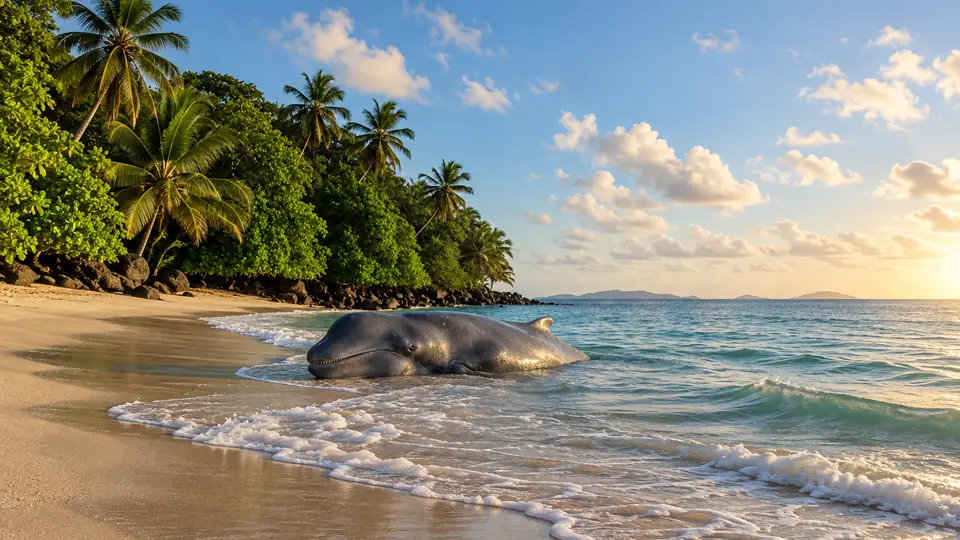
Blainville's Beaked Whale in its natural habitatAI-modified

Blainville's Beaked WhaleMesoplodon densirostrisWhere and when to see them

Blainville's Beaked Whale at a glance

Blainville's beaked whale is a rarely observed marine mammal of warm and temperate deep waters. Its modest size, low surfacing profile and long periods out of sight make it difficult to detect even where resident groups occur. Adult males develop dramatically arched lower jaws carrying exposed teeth, while females and younger animals are less distinctive. Knowledge comes disproportionately from a few intensively studied populations, so occurrence and seasonal patterns remain poorly understood across much of its range.

Behaviour & reproduction

Size
4.4–4.7 m (14.4–15.4 ft) long
Weight
800–1,000 kg (1,764–2,205 lb)
Lifespan
Longer than 21 years
Status
Least Concern

Small groups typically surface quietly, showing little splash and an inconspicuous blow. Brief sequences of breathing can be followed by prolonged absences while animals forage far below the surface. Sound is central to finding prey in darkness, and this species is sensitive to intense human-generated noise. Adult males often carry linear scars associated with interactions involving their exposed teeth. Social groups commonly include females and young, sometimes accompanied by a mature male. These whales produce a distinctive echolocation click train that is vital for navigation and prey location in deep, dark waters. They are known for their deep, prolonged dives, often reaching depths of over 1000 meters. Social cohesion is maintained through a combination of acoustic communication and group foraging strategies.

Top wildlife locations

Seychelles wildlife habitatAI-modified

Seychelles

Deep water beyond island slopes is plausible habitat, but shore identification is exceptionally unlikely. Distant deck views would be opportunistic; ordinary beaches and island landings should not be presented as reliable observation sites.
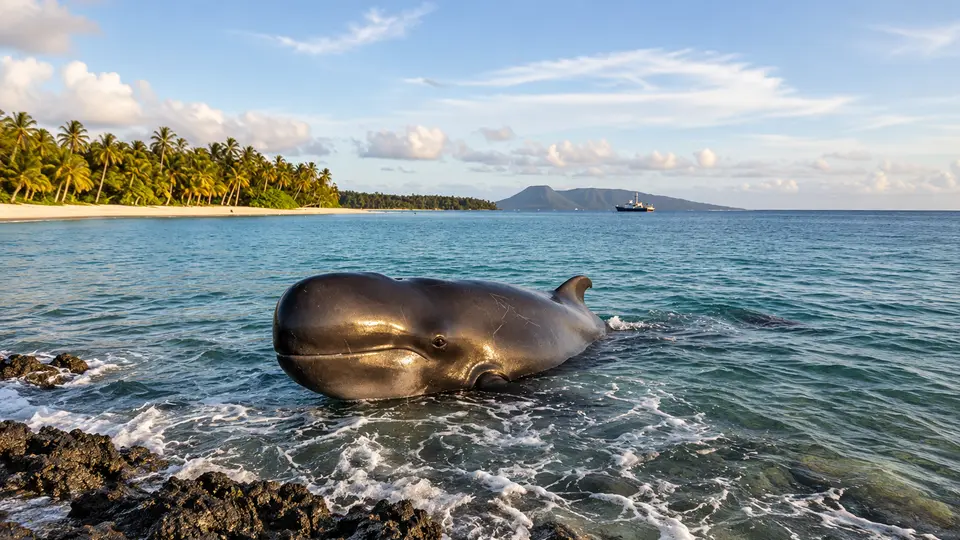
Destinations describe the species' habitat, not guaranteed cruise stops. Some animals require an optional inland excursion or are found in restricted reserves.

Fun facts about the Blainville's Beaked Whale

  • The species name densirostris refers to its unusually dense rostral bone.
  • Only adult males normally have erupted functional teeth.
  • Barnacles can attach to the exposed teeth of mature males.
  • Its understated surfacing often reveals less of the animal than observers expect.

Best time to see the Blainville's Beaked Whale

No dependable seasonal shore-observation window is established for Seychelles. Weather suitable for coastal travel does not demonstrate whale presence, and sparse reports cannot support a predictable calendar. Any distant deck observation should be treated as an unusual opportunity requiring cautious identification. While no specific season offers reliable sightings in the Seychelles, their presence is recorded year-round across their tropical range. Research efforts often focus on periods of calmer seas to facilitate acoustic monitoring rather than visual observation. Patience and luck are paramount for any sighting opportunity.

Blainville's Beaked Whale: season matrix by destination

Travel and observation windows vary by region. Highlighted months are an orientation for planning, not confirmed sightings or a guarantee of access.

Seychelles

There is insufficient support for a species-specific Seychelles shore or deck observation season.

JanFebMarAprMayJunJulAugSepOctNovDec
Cruise ships in Seychelles

Where the Blainville's Beaked Whale lives

Oceanic island slopes, submarine canyons and deep continental margins provide characteristic habitat. Suitable water can occur close to steep-sided islands, but the whales remain marine animals rather than coastal land wildlife. Their preferred depth and subtle surfacing usually place them beyond practical shore identification. This species exhibits a global distribution in tropical and warm temperate waters, usually in depths exceeding 200 meters. They prefer areas with complex seafloor topography such as seamounts and continental slopes. Blainville's beaked whales are not commonly found in shallow coastal waters or enclosed seas.

What the Blainville's Beaked Whale eats

Deep-water squid and fish are taken using suction rather than extensive biting or chewing. Most teeth remain unerupted, particularly in females. Feeding occurs far below ordinary surface visibility, so dietary knowledge relies heavily on biological samples and research rather than casual observation. This whale primarily consumes mesopelagic and bathypelagic squid and fish, including species like lanternfish. Their specialized feeding mechanism involves creating a vacuum in their mouths to rapidly ingest prey. They typically hunt solitary prey rather than schooling fish.

Species at a glance

Common name
Blainville's Beaked Whale
Scientific name
Mesoplodon densirostris
Animal group
Marine life
Size
4.4–4.7 m (14.4–15.4 ft) long
Weight
800–1,000 kg (1,764–2,205 lb)
Lifespan
Longer than 21 years
Status
Least Concern
Identification
A mature male's strongly arched lower jaw and projecting teeth distinguish it from most other beaked whales, but females are difficult to identify at distance. Beyond the unique jawline of adult males, the overall body is robust with a relatively small dorsal fin set far back on the body. Their coloration is typically dark gray to brown dorsally, fading to a lighter underside. The presence of male scars, though distinctive, is not always visible during brief surface encounters.

Blainville's Beaked Whale: frequently asked questions

Where can I see the Blainville's Beaked Whale?
Seychelles. From shore or an existing vessel deck, use binoculars and record distant features without pursuing the animal. Avoid requests for closer approaches or added engine noise; identification may remain uncertain even with photographs. Passive acoustic monitoring using hydrophones is often a more effective method for detecting their presence than visual surveys. When observed, their cryptic surfacing behavior means they are easily missed, even by experienced observers. Maintaining a respectful distance is crucial for minimizing disturbance to these sensitive marine mammals.
When is the best time to see the Blainville's Beaked Whale?
No dependable seasonal shore-observation window is established for Seychelles. Weather suitable for coastal travel does not demonstrate whale presence, and sparse reports cannot support a predictable calendar. Any distant deck observation should be treated as an unusual opportunity requiring cautious identification. While no specific season offers reliable sightings in the Seychelles, their presence is recorded year-round across their tropical range. Research efforts often focus on periods of calmer seas to facilitate acoustic monitoring rather than visual observation. Patience and luck are paramount for any sighting opportunity.
How big does the Blainville's Beaked Whale get?
4.4–4.7 m (14.4–15.4 ft) long. Adult weight: 800–1,000 kg (1,764–2,205 lb). Size varies with age, sex and population.
How should I behave around the Blainville's Beaked Whale?
From shore or an existing vessel deck, use binoculars and record distant features without pursuing the animal. Avoid requests for closer approaches or added engine noise; identification may remain uncertain even with photographs. Passive acoustic monitoring using hydrophones is often a more effective method for detecting their presence than visual surveys. When observed, their cryptic surfacing behavior means they are easily missed, even by experienced observers. Maintaining a respectful distance is crucial for minimizing disturbance to these sensitive marine mammals.
What does the Blainville's Beaked Whale eat?
Deep-water squid and fish are taken using suction rather than extensive biting or chewing. Most teeth remain unerupted, particularly in females. Feeding occurs far below ordinary surface visibility, so dietary knowledge relies heavily on biological samples and research rather than casual observation. This whale primarily consumes mesopelagic and bathypelagic squid and fish, including species like lanternfish. Their specialized feeding mechanism involves creating a vacuum in their mouths to rapidly ingest prey. They typically hunt solitary prey rather than schooling fish.
Are wildlife sightings guaranteed on an adventure cruise?
No. Animals move freely and routes, weather, access restrictions and local conditions influence every outing. Confirm the actual itinerary and shore program before booking.

Compare wildlife in the same destinations

Explore other marine life recorded in these destinations. Similar surroundings do not mean the animals share the same habits or viewing season.

Species comparison by animal group and destination
Blainville's Beaked WhaleAI-modifiedBlainville's Beaked WhaleShort-finned Pilot WhaleAI-modifiedShort-finned Pilot Whale
Animal groupMarine lifeAnimal groupMarine life
DestinationsSeychellesDestinationsCape Verde, Seychelles, Maldives, Fiji, Polynesia
Scientific nameMesoplodon densirostrisScientific name
All wildlife destinations
AI-modified
Plan your trip

Find your next wildlife adventure

Compare destinations, shore programs and dates with the animals and habitats you would love to see.

  • Naturalist-led shore excursions
  • Responsible wildlife watching
  • Small expedition ships