Bluerides – Blue Rides - Book Liveaboards worldwideOCEAN ADVENTURES
River CruisesRiversNature & WildlifeOur Promise
River CruisesRiversNature & WildlifeOur PromiseSign In

River destinations

  • River destinations
  • Amazon
  • Danube
  • Rhine
  • Mekong
  • Nile

Ships & departures

  • River Cruise Search
  • Deals

Nature & Wildlife

  • Nature & Wildlife

Travel support

  • Our Promise
  • Contact

Contact

Get in Touch

Get in touch anytime, we're happy to help you find the right trip or sort out any question.

EmailWrite us, we usually reply within a few hours.
contact@bluerides.com
WhatsAppChat with us on WhatsApp, Mon–Fri 10:00–16:00 (CET).
Start WhatsApp Chat
PhoneCall us, we're happy to help.
Free call, Mon–Fri 10 AM – 8 PM (CET).
Europe+49 800 1144 990USA+1 888 557 7735UK+44 800 707 4152Australia+61 2 8599 6113Canada+1 888 557 7735
Which river journey is yours?Answer 8 quick questions and find the river cruise that fits you.
8 questions, 1 minute·Plus Gift
Secure Payment MethodsYour payments are fully secured with AES-256 encryption.
Powered byStripeWiseAMEXPayGoogle PaySEPABank
Imprint·Terms & Conditions·Privacy Policy·About·Contact·Liability Waiver·Affiliate Program·Cruise·
Visit us here

© 2026 Blue Rides. All rights reserved.·

Bluerides – Blue Rides - Book Liveaboards worldwideOCEAN ADVENTURES
River CruisesRiversNature & WildlifeOur Promise
River CruisesRiversNature & WildlifeOur PromiseSign In
European fire-bellied toad in wetland habitat — Danube, River Cruises wildlife
Home›River Cruises›River Wildlife›European Fire-bellied Toad

European Fire-bellied ToadBombina bombinaWhere and when to see them

Previous speciesEurasian WryneckNext speciesEuropean Golden Plover

European Fire-bellied Toad at a glance

The European fire-bellied toad is a small floodplain amphibian whose quiet appearance contrasts with its far-carrying, melodic call. In the Donau-Auen, it uses ponds and can rapidly occupy newly flooded fields and meadows. This makes the floodplain's changing water mosaic central to its biology, rather than the deep Danube channel itself. Its upper surface is often dark and inconspicuous, while bright patches underneath function as a warning associated with defensive skin secretions. Calling males float at the surface and generate small waves as air moves between lungs and vocal structures. The registry reach is the Austrian floodplain east of Vienna towards Hainburg, on the Vienna–Bratislava section, with a shore or backwater excursion required. The park's detailed original account supports this local context and reproductive ecology; it does not establish an equivalent opportunity at Passau, Budapest or every Danube landing.

Behaviour & reproduction

Size
Seldom reaches 50 mm (1.97 in) body length (Donau-Auen National Park)
Weight
Species-specific weight not verified
Lifespan
Species-specific lifespan not verified
Status
See sourced assessment

A calling male first inflates its lungs, then lies flattened at the water surface while moving air internally; its mouth and nostrils stay closed. The resulting small waves can be visible around the body. The park describes calling territories commonly around two to three metres across, with vegetation affecting how those waves travel. In mating, the male grips the female in front of her hind legs. Eggs are laid in small clumps containing up to around fifty eggs rather than one enormous exposed string. They hatch within days, and tadpoles generally require two to three months to reach metamorphosis under the conditions described by the park. Breeding activity can occur in pulses as weather and water availability change. These details make a chorus or newly occupied flood pool more informative than a single silent animal: they reveal how the population uses temporary reproductive opportunities within the floodplain.

Top wildlife locations

Danube river landscape — River Cruises wildlife habitat

Danube

Austria: Donau-Auen floodplains east of Vienna towards Hainburg, on Vienna–Bratislava reach; optional shore/backwater excursion, not Passau or Budapest.
Explore river cruises

Destinations describe the species' habitat, not guaranteed cruise stops. Some animals require an optional inland excursion or are found in restricted reserves.

Fun facts about the European Fire-bellied Toad

  • Calling males keep mouth and nostrils closed while moving air internally.
  • Calling produces visible small waves around the body.
  • Aquatic vegetation influences territorial spacing.
  • Males grip females in front of the hind legs.
  • Eggs occur in clumps of up to around fifty.
  • Tadpoles may take two to three months to metamorphose.
  • Newly flooded fields can be colonised rapidly.
  • Defensive skin secretions accompany warning colours.
  • Hybridisation with yellow-bellied toad occurs in the Vienna contact zone.

Best time to see the European Fire-bellied Toad

The Donau-Auen source gives locally relevant qualitative timing: breeding normally starts in spring and can continue into late summer, depending on weather. Reproductive activity occurs in stronger phases rather than at a constant rate, and newly flooded ground can create fresh opportunities. That supports a warm-season listening emphasis for the Austrian floodplain, but not a guarantee of a chorus on any particular excursion. The existing numerical month array is retained unchanged; no calendar is generated from general statements or transferred to other Danube reaches. Water persistence matters because larval development takes two to three months in the park account. A newly filled pool may attract adults quickly yet still face drying risk before metamorphosis. Ask park staff about current water conditions and authorised observation points. Seasonal advice should remain attached to Donau-Auen east of Vienna, not to a broad river label spanning very different floodplain systems.

European Fire-bellied Toad: season matrix by destination

Highlighted months reflect the stated local evidence, not guaranteed encounters. Neutral months mean no verified monthly viewing window, not absence. Observation records and recommended viewing windows are distinct.

Danube

Exact local species-specific monthly viewing evidence has not been verified; no monthly calendar is inferred.

JanFebMarAprMayJunJulAugSepOctNovDec
Explore river cruises

Where the European Fire-bellied Toad lives

The park associates fire-bellied toads with wetland ponds and, after high water, flooded meadows and fields. The important habitat is shallow, relatively still floodplain water, not the strong flow of the main navigation channel. Aquatic vegetation helps shape the calling environment by interrupting the small waves generated around males; densely vegetated water can therefore alter territorial spacing. Newly formed pools may be colonised rapidly, but they must persist long enough for larvae to develop. The surrounding terrestrial landscape also matters because amphibians do not spend every life stage permanently at one visible pool. In the registered Donau-Auen reach east of Vienna, use authorised access to backwaters and floodplain habitats rather than treating a deck view of the Danube as an equivalent search. The park's description of a dynamic water mosaic explains why yesterday's productive pool and today's accessible viewpoint may not coincide after changing water levels.

What the European Fire-bellied Toad eats

The Donau-Auen account identifies insects and insect larvae as principal foods and specifically notes a substantial contribution from mosquitoes. This is a more useful dietary description than calling the animal a generic pond predator. Adults exploit small animal prey associated with the wetland, while the larval stage has a different body form and feeding ecology; adult food statements should not automatically be applied to tadpoles. A floating toad may be calling rather than feeding, so time at the surface does not itself demonstrate a capture. Watch for a distinct prey-taking movement before recording hunting behaviour. The park source does not provide a quantified prey table or identify every insect consumed, and its qualitative mosquito statement should not be converted into a numerical percentage. Nor does mosquito consumption justify introducing toads elsewhere: their occurrence reflects an established native floodplain community, not a visitor-managed pest-control service.

Species at a glance

Common name
European Fire-bellied Toad
Scientific name
Bombina bombina
Animal group
Amphibians
Size
Seldom reaches 50 mm (1.97 in) body length (Donau-Auen National Park)
Weight
Species-specific weight not verified
Lifespan
Species-specific lifespan not verified
Status
Current global category not independently verified; regional conservation statements must not be presented as a global assessment.
Identification
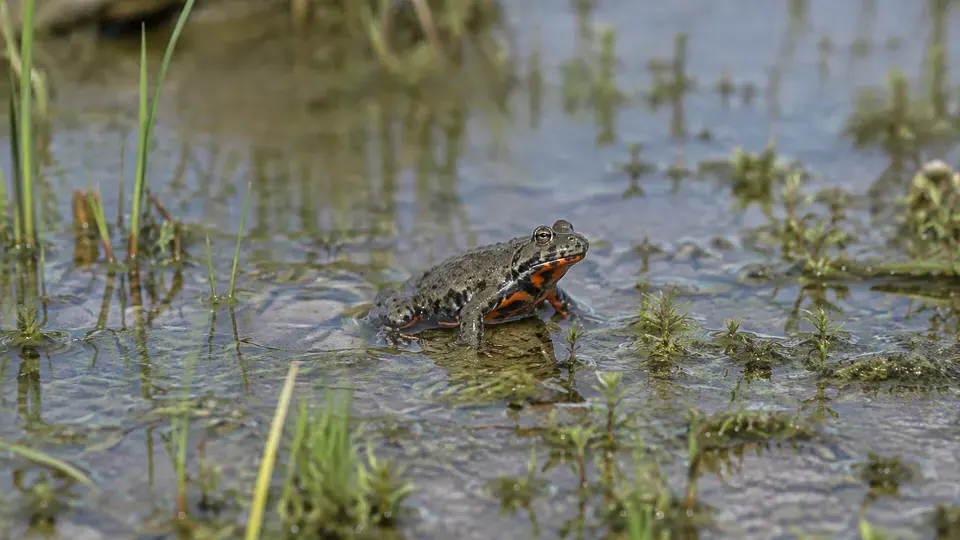
The park describes a very small toad, only rarely reaching fifty millimetres, with heart-shaped pupils and a rough, warty upper surface. The back is often dark with larger dark spots, although greenish individuals occur. Underneath, red, orange or sometimes yellowish patches interrupt a grey-to-black background. Colour alone is therefore insufficient to separate it from yellow-bellied toad. The park highlights the dark underside of the thumb in fire-bellied toad, contrasting with the yellow underside in yellow-bellied toad, but this is not a reason to capture or turn an animal over. Where the species meet near Vienna, hybrids may show intermediate features and intermediate call characteristics. Males are most readily recognised through calling behaviour during breeding activity; quiet individuals should not be sexed by guesswork. Use natural posture, photographs and local expertise, especially in a contact zone where a simple belly-colour rule can fail.

European Fire-bellied Toad: frequently asked questions

Where can I see the European Fire-bellied Toad?
Danube. On an authorised Donau-Auen backwater outing, listen first for the repeated soft “ooh” notes from ponds or flooded meadow margins. Locate the sound without entering the water or trampling the edge. Through binoculars, a calling male may appear as a small inflated body at the surface, with fine ripples around it. That wave pattern is a particularly rewarding observation because it connects directly to the park's account of calling and territorial spacing. Do not provoke the defensive arching posture to expose the belly: the warning display is a stress response, not a photographic target. The park also rejects the familiar story that these toads routinely throw themselves onto their backs. Avoid handling, especially because defensive secretions can irritate eyes and mucous membranes. Record the actual pond or excursion area and water conditions, while treating possible hybrid identification cautiously in the Vienna contact zone.
When is the best time to see the European Fire-bellied Toad?
The Donau-Auen source gives locally relevant qualitative timing: breeding normally starts in spring and can continue into late summer, depending on weather. Reproductive activity occurs in stronger phases rather than at a constant rate, and newly flooded ground can create fresh opportunities. That supports a warm-season listening emphasis for the Austrian floodplain, but not a guarantee of a chorus on any particular excursion. The existing numerical month array is retained unchanged; no calendar is generated from general statements or transferred to other Danube reaches. Water persistence matters because larval development takes two to three months in the park account. A newly filled pool may attract adults quickly yet still face drying risk before metamorphosis. Ask park staff about current water conditions and authorised observation points. Seasonal advice should remain attached to Donau-Auen east of Vienna, not to a broad river label spanning very different floodplain systems.
How big does the European Fire-bellied Toad get?
Seldom reaches 50 mm (1.97 in) body length (Donau-Auen National Park). Adult weight: Species-specific weight not verified. Size varies with age, sex and population.
How should I behave around the European Fire-bellied Toad?
On an authorised Donau-Auen backwater outing, listen first for the repeated soft “ooh” notes from ponds or flooded meadow margins. Locate the sound without entering the water or trampling the edge. Through binoculars, a calling male may appear as a small inflated body at the surface, with fine ripples around it. That wave pattern is a particularly rewarding observation because it connects directly to the park's account of calling and territorial spacing. Do not provoke the defensive arching posture to expose the belly: the warning display is a stress response, not a photographic target. The park also rejects the familiar story that these toads routinely throw themselves onto their backs. Avoid handling, especially because defensive secretions can irritate eyes and mucous membranes. Record the actual pond or excursion area and water conditions, while treating possible hybrid identification cautiously in the Vienna contact zone.
What does the European Fire-bellied Toad eat?
The Donau-Auen account identifies insects and insect larvae as principal foods and specifically notes a substantial contribution from mosquitoes. This is a more useful dietary description than calling the animal a generic pond predator. Adults exploit small animal prey associated with the wetland, while the larval stage has a different body form and feeding ecology; adult food statements should not automatically be applied to tadpoles. A floating toad may be calling rather than feeding, so time at the surface does not itself demonstrate a capture. Watch for a distinct prey-taking movement before recording hunting behaviour. The park source does not provide a quantified prey table or identify every insect consumed, and its qualitative mosquito statement should not be converted into a numerical percentage. Nor does mosquito consumption justify introducing toads elsewhere: their occurrence reflects an established native floodplain community, not a visitor-managed pest-control service.
Are wildlife sightings guaranteed on a river cruise?
No. Animals move freely and routes, weather, access restrictions and local conditions influence every outing. Confirm the actual itinerary and shore program before booking.

Compare wildlife in the same destinations

Explore other amphibians recorded in these destinations. Similar surroundings do not mean the animals share the same habits or viewing season.

Species comparison by animal group and destination
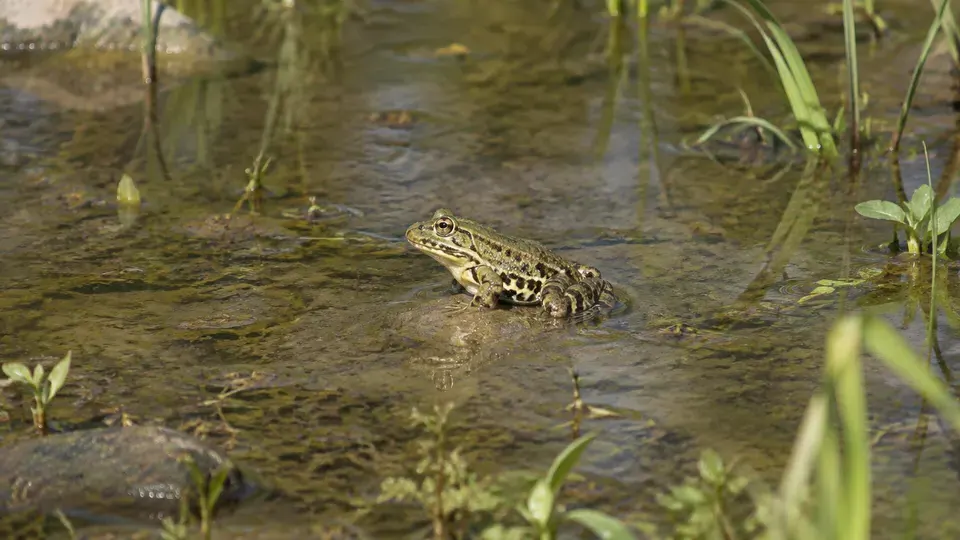
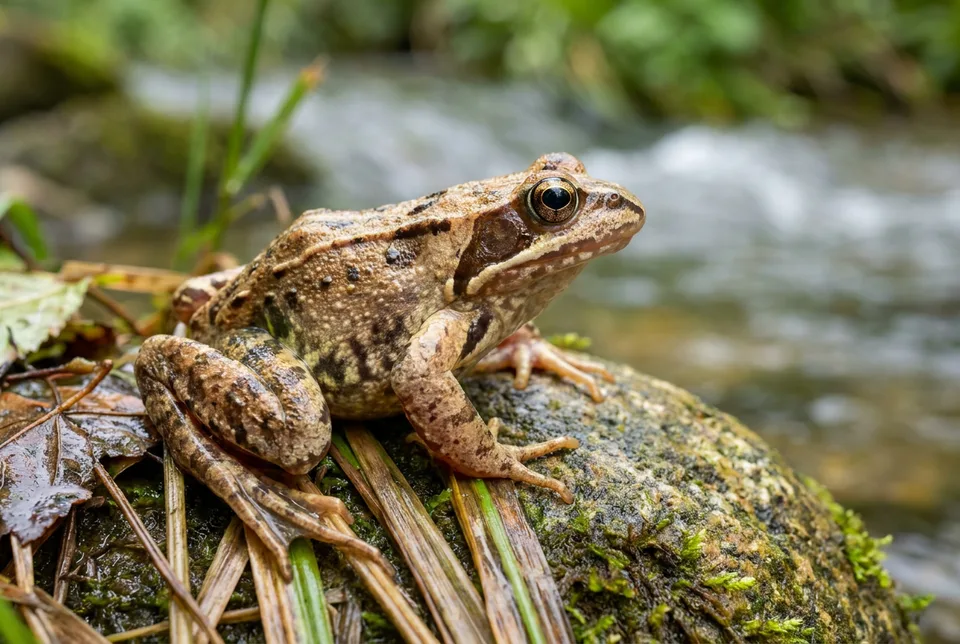
European fire-bellied toad in wetland habitat — Danube, River Cruises wildlifeEuropean Fire-bellied ToadAgile Frog in wetland habitat — Danube, River Cruises wildlifeAgile FrogEdible frog in wetland habitat — Danube, River Cruises wildlifeEdible Frog
Animal groupAmphibiansAnimal groupAmphibiansAnimal groupAmphibians
DestinationsDanubeDestinationsDanubeDestinationsDanube
Scientific name
Bombina bombina
Scientific name
Scientific name
Previous speciesEurasian WryneckNext speciesEuropean Golden Plover
All river wildlife
On this page
  • 01About
  • 02Behaviour & reproduction
  • 03Top wildlife locations
  • 04Fun facts
  • 05Best season
  • 06Season matrix by destination
  • 07Habitat
  • 08Diet
  • 09Species at a glance
  • 10Questions & answers
  • 11Compare

Find your river cruise

Plan your trip

Find your next river journey

Compare destinations, shore programs and dates with the animals and habitats you would love to see.

  • Daily shore excursions
  • Responsible wildlife watching
  • Boutique river ships
Explore river cruises