Bluerides – Blue Rides - Book Liveaboards worldwideOCEAN ADVENTURES
River CruisesRiversNature & WildlifeOur Promise
River CruisesRiversNature & WildlifeOur PromiseSign In

River destinations

  • River destinations
  • Amazon
  • Danube
  • Rhine
  • Mekong
  • Nile

Ships & departures

  • River Cruise Search
  • Deals

Nature & Wildlife

  • Nature & Wildlife

Travel support

  • Our Promise
  • Contact

Contact

Get in Touch

Get in touch anytime, we're happy to help you find the right trip or sort out any question.

EmailWrite us, we usually reply within a few hours.
contact@bluerides.com
WhatsAppChat with us on WhatsApp, Mon–Fri 10:00–16:00 (CET).
Start WhatsApp Chat
PhoneCall us, we're happy to help.
Free call, Mon–Fri 10 AM – 8 PM (CET).
Europe+49 800 1144 990USA+1 888 557 7735UK+44 800 707 4152Australia+61 2 8599 6113Canada+1 888 557 7735
Which river journey is yours?Answer 8 quick questions and find the river cruise that fits you.
8 questions, 1 minute·Plus Gift
Secure Payment MethodsYour payments are fully secured with AES-256 encryption.
Powered byStripeWiseAMEXPayGoogle PaySEPABank
Imprint·Terms & Conditions·Privacy Policy·About·Contact·Liability Waiver·Affiliate Program·Cruise·Blog·
Visit us here

© 2026 Blue Rides. All rights reserved.

Bluerides – Blue Rides - Book Liveaboards worldwideOCEAN ADVENTURES
River CruisesRiversNature & WildlifeOur Promise
River CruisesRiversNature & WildlifeOur PromiseSign In
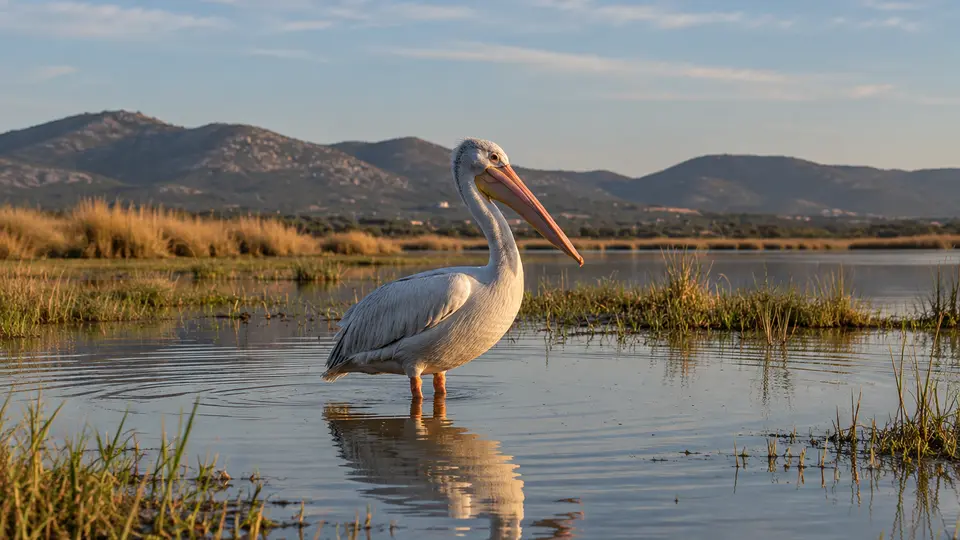
Dalmatian pelican in wetland habitat — Danube, River Cruises wildlifeAI-modified
Home›River Cruises›River Wildlife›Dalmatian Pelican

Dalmatian PelicanPelecanus crispusWhere and when to see them

Previous speciesCoypuNext speciesDice Snake

Dalmatian Pelican at a glance

The Dalmatian Pelican is an exceptionally large fish-eating waterbird associated with extensive wetlands. Pelican Way of LIFE describes a wingspan of almost three metres and a weight exceeding ten kilograms, useful scale indicators rather than a complete measurement range. Its Romanian stronghold includes the Danube Delta, where a dedicated network of lakes, channels and other wetland habitats provides feeding, resting and breeding opportunities. The cruise registry places it around Mahmudia and delta excursion waters. This is a separate lower-Danube or delta itinerary, not evidence for the upper and middle Danube route through Passau, Vienna, Bratislava and Budapest. The registered checklist establishes occurrence, while conservation-project research adds evidence of Romanian breeding, dispersal and winter presence. These different kinds of evidence should remain separate. None identifies a pelican flock waiting at a particular landing or guarantees that a normal navigation passage will encounter birds.

Behaviour & reproduction

Size
Approximately 3 m (9.8 ft) wingspan, as described by Pelican Way of LIFE
Weight
Not verified
Lifespan
Species-specific lifespan not verified
Status
See sourced assessment

Dalmatian Pelicans gather at suitable feeding and resting waters, and breeding birds use colonies that can vary greatly in size. Pelican Way of LIFE describes nests as heaps of vegetation on islands or dense vegetation mats, with birds often returning to traditional breeding sites. Its species account reports young fledging at around 85 days; that is a developmental interval, not a Danube Delta sightseeing season. In Romania, the project describes a resident and partially migratory population. Adults outside the breeding season and immature birds disperse along the Lower Danube, using large lakes and wetlands to feed and roost. Movement can therefore change where concentrations occur without implying that all birds arrive or leave together. Watch feeding and resting groups from a distance. Do not approach a colony or try to make a resting flock take flight, because those behaviours are more important than obtaining an airborne photograph.

Top wildlife locations

Danube river landscape — River Cruises wildlife habitatAI-modified

Danube

Romania: Danube Delta around Mahmudia and delta lakes/channels; a separate lower-Danube or delta itinerary, not Passau–Vienna–Bratislava–Budapest. The registered checklist establishes occurrence. Pelican Way of LIFE independently documents delta breeding and a December 2023 reserve-wide winter count, neither of which guarantees birds on a particular lake excursion. A permitted lake/channel programme is more relevant than generic river transit.

Explore river cruises

Destinations describe the species' habitat, not guaranteed cruise stops. Some animals require an optional inland excursion or are found in restricted reserves.

Fun facts about the Dalmatian Pelican

  • Pelican Way of LIFE describes a wingspan of almost three metres.
  • The same project describes the species as weighing over ten kilograms.
  • Its scientific name is Pelecanus crispus.
  • Curled nape feathers are a useful identification feature.
  • Its grey legs help distinguish it from other pelicans when clearly visible.
  • Fish are the central food category documented by the conservation sources.
  • Nests can be built on islands or dense vegetation mats.
  • Romanian birds include residents and partial migrants rather than one uniform arrival wave.
  • A December 2023 census counted 404 individuals within the Danube Delta Biosphere Reserve.

Best time to see the Dalmatian Pelican

Romanian Danube Delta only: local specialist Ibis Tours identifies May as viewing recommendations for this species. This is operator guidance, not a statistical sighting forecast; it does not extend to Passau, Vienna or Budapest. Colonies must be watched from permitted routes without close nest approaches. Other registered reaches retain their separate evidence and unknown months. These highlighted windows are recommendations, not the only months when the species may occur. Ask the guide about recent observations, current water access and local restrictions before choosing an excursion. Historical records and breeding dates elsewhere are not used to fill gaps in the local calendar.

Dalmatian Pelican: season matrix by destination

Highlighted months reflect the stated local evidence, not guaranteed encounters. Neutral months mean no verified monthly viewing window, not absence. Observation records and recommended viewing windows are distinct.

Danube

Romanian Danube Delta only: local specialist Ibis Tours identifies May as viewing recommendations for this species. This is operator guidance, not a statistical sighting forecast; it does not extend to Passau, Vienna or Budapest. Colonies must be watched from permitted routes without close nest approaches.

JanFebMarAprMayJunJulAugSepOctNovDec
Explore river cruises

Where the Dalmatian Pelican lives

The conservation project emphasises still waters containing fish, extensive shallow or flooded areas and freedom from human disturbance as requirements for breeding. Islands and dense mats of vegetation can support nests. Feeding and roosting also occur across a broader network of large lakes and wetlands, including the Danube Delta and other Lower Danube sites. A main river channel may connect these habitats without itself being the place where a visitor encounters pelicans. For the registered Mahmudia context, check whether the programme actually includes a permitted lake or channel excursion rather than assuming that a ship’s transit provides equivalent access. Breeding habitat and visitor viewing habitat should not be treated as the same destination. Protecting undisturbed resting places and maintaining connected wetlands are central conservation concerns. A site suitable for pelicans may be closed or inappropriate for close approach, particularly where birds are nesting.

What the Dalmatian Pelican eats

Fish form the central dietary category supported by the conservation sources read. Pelican Way of LIFE repeatedly describes the species as a fish eater and links its conservation to healthy fish populations and functioning wetland systems. This supports a clear feeding summary without inventing a locally measured daily ration or a list of preferred fish for a particular delta lake. Feeding opportunities help determine where birds disperse, so yesterday’s flock location is not necessarily tomorrow’s observation point. A group resting on an island should not automatically be described as actively feeding, and a bird flying over a channel may simply be moving between sites. Watch what the birds are actually doing and keep those observations distinct from general ecology. Never throw fish to attract pelicans or ask a boat operator to bait them for photographs. Natural feeding is more informative and avoids drawing large birds towards people and boats.

Species at a glance

Common name
Dalmatian Pelican
Scientific name
Pelecanus crispus
Animal group
Birds
Size
Approximately 3 m (9.8 ft) wingspan, as described by Pelican Way of LIFE
Weight
Over 10 kg (22 lb), as described by Pelican Way of LIFE; not a full species weight range
Lifespan
Species-specific lifespan not verified
Status
Pelican Way of LIFE identifies the species as Near Threatened on the IUCN Red List. This is an attributed project statement, not a newly checked assessment. The project identifies power-line collisions, habitat loss or decline, disturbance and direct persecution among major threats.
Identification
Dalmatian Pelicans require separation from Great White Pelicans, which also occur in the Danube Delta. The Romanian Ornithological Society’s account describes grey-white plumage, curled feathers on the nape and grey legs. It highlights the paler appearance of the underside of the flight feathers compared with the strong black-and-white contrast of Great White Pelicans. Adult throat pouches can be orange-red, but colour should be interpreted with age, season, light and viewing distance in mind rather than used alone. Look for several features together, especially in mixed or distant groups. A very large pelican is not automatically a Dalmatian Pelican, and a silhouette may remain unresolved. Use photographs taken without approaching the birds to check details afterwards with a guide. The scientific name Pelecanus crispus matches the registered species; generic pelican records or photographs should not be silently assigned to it.

Dalmatian Pelican: frequently asked questions

Where can I see the Dalmatian Pelican?
Danube. Use binoculars or a long lens to watch pelicans on open water or at distant resting sites from permitted routes. Large size makes the species conspicuous when visible, but extensive reedbeds, islands and the scale of the delta can conceal birds completely from an ordinary passenger vessel. A guided lake-and-channel excursion may provide the relevant habitat access; it still cannot promise a flock. Keep a steady, respectful distance and avoid separating birds from their resting place or repeatedly altering course to follow them. Do not land on nesting islands, enter dense colony vegetation or request a closer approach to chicks. Conservation sources identify disturbance as a threat, so photographing relaxed feeding or resting behaviour is preferable to causing take-off. Note the actual location, date and behaviour of any encounter. A passing bird, a feeding flock and a breeding colony are different observations and should be recorded as such.
When is the best time to see the Dalmatian Pelican?
Romanian Danube Delta only: local specialist Ibis Tours identifies May as viewing recommendations for this species. This is operator guidance, not a statistical sighting forecast; it does not extend to Passau, Vienna or Budapest. Colonies must be watched from permitted routes without close nest approaches. Other registered reaches retain their separate evidence and unknown months. These highlighted windows are recommendations, not the only months when the species may occur. Ask the guide about recent observations, current water access and local restrictions before choosing an excursion. Historical records and breeding dates elsewhere are not used to fill gaps in the local calendar.
How big does the Dalmatian Pelican get?
Approximately 3 m (9.8 ft) wingspan, as described by Pelican Way of LIFE. Adult weight: Over 10 kg (22 lb), as described by Pelican Way of LIFE; not a full species weight range. Size varies with age, sex and population.
How should I behave around the Dalmatian Pelican?
Use binoculars or a long lens to watch pelicans on open water or at distant resting sites from permitted routes. Large size makes the species conspicuous when visible, but extensive reedbeds, islands and the scale of the delta can conceal birds completely from an ordinary passenger vessel. A guided lake-and-channel excursion may provide the relevant habitat access; it still cannot promise a flock. Keep a steady, respectful distance and avoid separating birds from their resting place or repeatedly altering course to follow them. Do not land on nesting islands, enter dense colony vegetation or request a closer approach to chicks. Conservation sources identify disturbance as a threat, so photographing relaxed feeding or resting behaviour is preferable to causing take-off. Note the actual location, date and behaviour of any encounter. A passing bird, a feeding flock and a breeding colony are different observations and should be recorded as such.
What does the Dalmatian Pelican eat?
Fish form the central dietary category supported by the conservation sources read. Pelican Way of LIFE repeatedly describes the species as a fish eater and links its conservation to healthy fish populations and functioning wetland systems. This supports a clear feeding summary without inventing a locally measured daily ration or a list of preferred fish for a particular delta lake. Feeding opportunities help determine where birds disperse, so yesterday’s flock location is not necessarily tomorrow’s observation point. A group resting on an island should not automatically be described as actively feeding, and a bird flying over a channel may simply be moving between sites. Watch what the birds are actually doing and keep those observations distinct from general ecology. Never throw fish to attract pelicans or ask a boat operator to bait them for photographs. Natural feeding is more informative and avoids drawing large birds towards people and boats.
Are wildlife sightings guaranteed on a river cruise?
No. Animals move freely and routes, weather, access restrictions and local conditions influence every outing. Confirm the actual itinerary and shore program before booking.

Compare wildlife in the same destinations

Explore other birds recorded in these destinations. Similar surroundings do not mean the animals share the same habits or viewing season.

Species comparison by animal group and destination
Dalmatian pelican in wetland habitat — Danube, River Cruises wildlifeAI-modifiedDalmatian PelicanBlack kite in wetland habitat — Danube, Rhine, River Cruises wildlifeAI-modifiedBlack KiteBlack stork in wetland habitat — Danube, River Cruises wildlifeAI-modifiedBlack Stork
Animal groupBirdsAnimal groupBirdsAnimal groupBirds
DestinationsDanubeDestinationsDanube, RhineDestinationsDanube
Scientific name
Pelecanus crispus
Scientific name
Scientific name
Previous speciesCoypuNext speciesDice Snake
All river wildlife
On this page
  • 01About
  • 02Behaviour & reproduction
  • 03Top wildlife locations
  • 04Fun facts
  • 05Best season
  • 06Season matrix by destination
  • 07Habitat
  • 08Diet
  • 09Species at a glance
  • 10Questions & answers
  • 11Compare

Find your river cruise

AI-modified
Plan your trip

Find your next river journey

Compare destinations, shore programs and dates with the animals and habitats you would love to see.

  • Daily shore excursions
  • Responsible wildlife watching
  • Boutique river ships
Explore river cruises