
Spoon-billed sandpiper in its natural habitatAI-modified

Spoon-billed sandpiperCalidris pygmaeaWhere and when to see them

Spoon-billed sandpiper at a glance

The spoon-billed sandpiper is a tiny migratory shorebird with an extraordinary flattened bill tip. It breeds in coastal northeastern Russia and travels along the East Asian–Australasian Flyway to Asian nonbreeding grounds. Its global population is extremely small, making every surviving tidal feeding area important. Coastal reclamation, habitat degradation and accidental capture in nets have contributed to its decline. Finding one requires patience, expertise and especially careful avoidance of disturbance.

Behaviour & reproduction

Size
Length 14–16 cm (5.5–6.3 in)
Weight
25–40 g (0.88–1.41 oz)
Lifespan
Not reliably established
Status
Critically Endangered

On nonbreeding grounds, spoon-billed sandpipers usually mingle with other small waders rather than forming conspicuous separate flocks. They feed with quick steps, pecks and sideways movements of the bill through wet sediment or shallow water. Tides govern movements between feeding flats and roosts. During the short Arctic breeding season, males display and sing, and chicks leave the nest soon after hatching to forage for themselves. Outside of the breeding season, these sandpipers are typically seen singly or in small groups within larger aggregations of other shorebirds. Their feeding behavior is quite distinctive, involving rapid head movements and bill sweeps while foraging. They are highly migratory, undertaking long journeys between their Arctic breeding grounds and Southeast Asian wintering areas, often making stopovers at critical refuelling sites.

Top wildlife locations

Thailand wildlife habitatAI-modified

Thailand

Gulf coast mudflats and salt pans provide important nonbreeding habitat, with viewing from public embankments where permitted. A dedicated coastal excursion and expert guide are usually needed; this critically endangered bird remains rare.

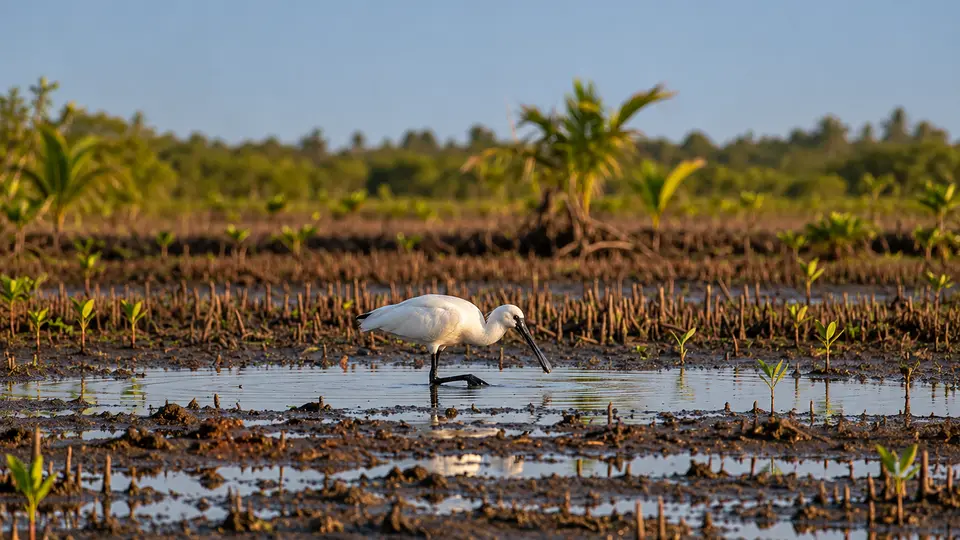
Vietnam wildlife habitatAI-modified

Vietnam

Selected estuarine mudflats and coastal wetland margins offer possible nonbreeding habitat. Sightings are very rare, access may require a dedicated excursion, and local conservation advice is essential before approaching feeding or roosting areas.

Destinations describe the species' habitat, not guaranteed cruise stops. Some animals require an optional inland excursion or are found in restricted reserves.

Fun facts about the Spoon-billed sandpiper

  • Even newly hatched chicks have a recognisably spoon-shaped bill.
  • Its breeding range is concentrated in coastal northeastern Russia.
  • Nonbreeding birds lose the rich reddish tones of breeding plumage.
  • Conservation programs have used head-starting to improve survival through the earliest life stages.

Best time to see the Spoon-billed sandpiper

Thailand and Vietnam are nonbreeding destinations, with the most plausible search period broadly from November to March. Passage can extend beyond that window, but numbers and site use vary. Tide timing and current conservation guidance are more important than choosing a particular winter month. In Southeast Asia, the species is an infrequent but regular winter visitor, with peak numbers observed from December to February. Its presence is highly dependent on suitable intertidal habitats and local weather conditions. Early migrants can arrive in October, and some individuals may linger into April before departing for breeding grounds.

Spoon-billed sandpiper: season matrix by destination

Travel and observation windows vary by region. Highlighted months are an orientation for planning, not confirmed sightings or a guarantee of access.

Thailand

A credible nonbreeding search window, subject to current site reports, tides and conservation access restrictions.

JanFebMarAprMayJunJulAugSepOctNovDec
Cruise ships in Thailand

Vietnam

These months cover the broad nonbreeding period, not confirmed annual occupancy of any particular accessible shoreline.

JanFebMarAprMayJunJulAugSepOctNovDec
Cruise ships in Vietnam

Where the Spoon-billed sandpiper lives

Breeding habitat consists of coastal tundra with sparse vegetation, pools and nearby shorelines. Outside the breeding season, the species depends on intertidal mudflats, estuarine margins and suitable roosts, sometimes using salt-production landscapes. Fine-scale sediment conditions can make only small sections of extensive wetlands suitable. Its restricted Arctic breeding grounds are predominantly found on the Chukotka and Kamchatka Peninsulas in far eastern Russia. These unique coastal areas are characterized by low-lying, often boggy, tundra near the sea. During migration and winter, it can be found in a range of coastal wetlands, often favoring sheltered areas.

What the Spoon-billed sandpiper eats

It takes small invertebrates from wet mud, shallow water and tundra surfaces, including insects and aquatic larvae. The spatulate bill helps manipulate and detect prey near the surface. Food availability changes with season, tidal exposure and the characteristics of individual feeding flats. Prey items like polychaete worms, gastropods, and bivalves are commonly targeted in intertidal zones. The spoon-shaped bill is particularly effective at 'scything' or sweeping through the surface layer of mud or water, detecting small invertebrates by touch. Energy demands are high during migration, requiring access to rich feeding grounds.

Species at a glance

Common name
Spoon-billed sandpiper
Scientific name
Calidris pygmaea
Animal group
Birds
Size
Length 14–16 cm (5.5–6.3 in)
Weight
25–40 g (0.88–1.41 oz)
Lifespan
Not reliably established
Status
Critically Endangered
Identification
The distinctly widened, spoon-shaped bill tip separates it from similarly sized stints and other small sandpipers when viewed clearly. Beyond the unique bill, adults in breeding plumage develop a reddish-brown head, breast, and neck with dark streaking. Non-breeding adults and juveniles are plainer, often greyish-brown above and white below, making the bill the primary identification feature. Look for its small size, similar to a Little Stint, but with a more robust body and shorter legs.

Spoon-billed sandpiper: frequently asked questions

Where can I see the Spoon-billed sandpiper?
Thailand, Vietnam. Use a telescope from established viewing points and follow local conservation guides. Never flush mixed shorebird flocks, approach roosts for photographs or publish precise locations where disclosure could increase disturbance. When viewing, maintain a respectful distance to avoid causing stress to these sensitive birds, especially in mixed flocks. Binoculars are essential for initial spotting, but a powerful telescope will reveal the distinct bill shape. Always prioritize the welfare of the birds over obtaining a photograph.
When is the best time to see the Spoon-billed sandpiper?
Thailand and Vietnam are nonbreeding destinations, with the most plausible search period broadly from November to March. Passage can extend beyond that window, but numbers and site use vary. Tide timing and current conservation guidance are more important than choosing a particular winter month. In Southeast Asia, the species is an infrequent but regular winter visitor, with peak numbers observed from December to February. Its presence is highly dependent on suitable intertidal habitats and local weather conditions. Early migrants can arrive in October, and some individuals may linger into April before departing for breeding grounds.
How big does the Spoon-billed sandpiper get?
Length 14–16 cm (5.5–6.3 in). Adult weight: 25–40 g (0.88–1.41 oz). Size varies with age, sex and population.
How should I behave around the Spoon-billed sandpiper?
Use a telescope from established viewing points and follow local conservation guides. Never flush mixed shorebird flocks, approach roosts for photographs or publish precise locations where disclosure could increase disturbance. When viewing, maintain a respectful distance to avoid causing stress to these sensitive birds, especially in mixed flocks. Binoculars are essential for initial spotting, but a powerful telescope will reveal the distinct bill shape. Always prioritize the welfare of the birds over obtaining a photograph.
What does the Spoon-billed sandpiper eat?
It takes small invertebrates from wet mud, shallow water and tundra surfaces, including insects and aquatic larvae. The spatulate bill helps manipulate and detect prey near the surface. Food availability changes with season, tidal exposure and the characteristics of individual feeding flats. Prey items like polychaete worms, gastropods, and bivalves are commonly targeted in intertidal zones. The spoon-shaped bill is particularly effective at 'scything' or sweeping through the surface layer of mud or water, detecting small invertebrates by touch. Energy demands are high during migration, requiring access to rich feeding grounds.
Are wildlife sightings guaranteed on an adventure cruise?
No. Animals move freely and routes, weather, access restrictions and local conditions influence every outing. Confirm the actual itinerary and shore program before booking.

Compare wildlife in the same destinations

Explore other birds recorded in these destinations. Similar surroundings do not mean the animals share the same habits or viewing season.

Species comparison by animal group and destination
Spoon-billed sandpiperAI-modifiedSpoon-billed sandpiperBlack-faced spoonbillAI-modifiedBlack-faced spoonbillBrahminy kiteAI-modifiedBrahminy kite
Animal groupBirdsAnimal groupBirdsAnimal groupBirds
DestinationsThailand, VietnamDestinationsVietnamDestinationsIndonesia, Thailand, Vietnam
Scientific nameCalidris pygmaeaScientific nameScientific name
All wildlife destinations
AI-modified
Plan your trip

Find your next wildlife adventure

Compare destinations, shore programs and dates with the animals and habitats you would love to see.

  • Naturalist-led shore excursions
  • Responsible wildlife watching
  • Small expedition ships