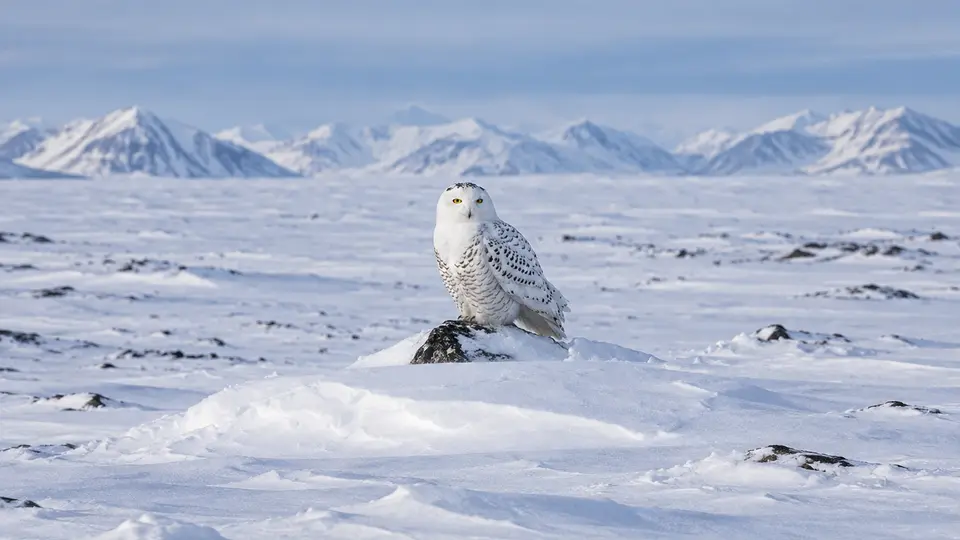
Snowy Owl in its natural habitat

Snowy OwlBubo scandiacusWhere and when to see them

Snowy Owl at a glance

The snowy owl is a powerful owl of open Arctic landscapes, adapted to hunting across treeless ground in prolonged summer daylight. Adult males can become nearly white, whereas females and younger birds usually carry heavier dark markings. Its movements are strongly influenced by prey availability, and winter appearances far south are irregular. Climate-related changes to tundra ecosystems and uncertainty surrounding population trends make careful monitoring particularly important for this widely admired but vulnerable predator.

Behaviour & reproduction

Size
52-71 cm (20-28 in) long; 126-145 cm (50-57 in) wingspan
Weight
1.2-2.5 kg (2.6-5.5 lb)
Lifespan
Not reliably established
Status
Vulnerable

Snowy owls hunt from low perches or by flying over open terrain, using both vision and hearing to locate prey. They are active in daylight as well as at other times. Breeding pairs defend extensive areas around ground nests, sometimes vigorously attacking intruders. Where food is abundant, females can lay large clutches, but breeding may be absent or sparse when prey populations are low. Snowy owls are largely nomadic, with their movements often tied to fluctuations in prey populations, particularly lemmings. They have excellent eyesight and hearing, allowing them to detect prey beneath dense vegetation or snow.

Top wildlife locations

Arctic wildlife habitat

Arctic

Open coastal tundra and raised gravelly ground can provide distant viewing opportunities from permitted trails. Owls are often rare or absent locally, and remote nesting areas may be inaccessible.
Destinations describe the species' habitat, not guaranteed cruise stops. Some animals require an optional inland excursion or are found in restricted reserves.

Fun facts about the Snowy Owl

  • Females are usually larger and more heavily marked than males.
  • It nests on the ground rather than in trees.
  • Arctic summer daylight does not prevent it from hunting.
  • Winter movements can include prolonged use of sea ice.

Best time to see the Snowy Owl

June through August is the most practical Arctic observation window for many travelers, overlapping potential breeding activity. Owls are unevenly distributed and may shift areas between years. Winter movements elsewhere are irregular and cannot be predicted from summer abundance alone. In some years, particularly during lemming population crashes, owls may not breed at all, making observations less likely. Arctic summer offers the best chance to see these impressive predators actively hunting and potentially nesting.

Snowy Owl: season matrix by destination

Travel and observation windows vary by region. Highlighted months are an orientation for planning, not confirmed sightings or a guarantee of access.

Arctic

These months reflect practical summer access, not assured nesting or presence; prey cycles, region and annual movements create large differences between visits.

JanFebMarAprMayJunJulAugSepOctNovDec
Cruise ships in Arctic

Where the Snowy Owl lives

Breeding habitat is open Arctic tundra with good visibility and raised ground for nest placement. Outside breeding, birds may use coastal flats, grasslands, agricultural fields and sea ice. Trees are unnecessary, but broad, open hunting areas are essential. They are circumpolar, found throughout the Arctic regions of North America and Eurasia. During irruption years, large numbers can move south into more temperate latitudes, even reaching agricultural areas in the US and Europe.

What the Snowy Owl eats

Lemmings and other small mammals are central to breeding-season diets in many regions. Birds, including shorebirds and waterfowl, can also be important. The balance varies geographically and seasonally, and access to prey strongly affects nesting effort and movements. Owls swallow small prey whole and later regurgitate indigestible parts as a pellet. These pellets can be analyzed to understand their feeding habits.

Species at a glance

Common name
Snowy Owl
Scientific name
Bubo scandiacus
Animal group
Birds
Size
52-71 cm (20-28 in) long; 126-145 cm (50-57 in) wingspan
Weight
1.2-2.5 kg (2.6-5.5 lb)
Lifespan
Not reliably established
Status
Vulnerable
Identification
Unlike other large northern owls, the snowy owl combines predominantly white plumage, yellow eyes and an almost earless rounded head, with females generally more heavily barred than adult males. Juveniles are heavily barred, often appearing almost entirely dark brown. Males tend to become whiter with age, while adult females retain more barring.

Snowy Owl: frequently asked questions

Where can I see the Snowy Owl?
Arctic. Scan tundra from a considerable distance and never approach a nest or bait an owl. Retreat if a bird watches persistently, calls in alarm or flies toward you in defensive passes. Their cryptic plumage provides excellent camouflage against snow and ice, making them surprisingly difficult to spot despite their size. Using binoculars to scan for a white 'bump' or an upright form on a low hummock or rock can be effective.
When is the best time to see the Snowy Owl?
June through August is the most practical Arctic observation window for many travelers, overlapping potential breeding activity. Owls are unevenly distributed and may shift areas between years. Winter movements elsewhere are irregular and cannot be predicted from summer abundance alone. In some years, particularly during lemming population crashes, owls may not breed at all, making observations less likely. Arctic summer offers the best chance to see these impressive predators actively hunting and potentially nesting.
How big does the Snowy Owl get?
52-71 cm (20-28 in) long; 126-145 cm (50-57 in) wingspan. Adult weight: 1.2-2.5 kg (2.6-5.5 lb). Size varies with age, sex and population.
How should I behave around the Snowy Owl?
Scan tundra from a considerable distance and never approach a nest or bait an owl. Retreat if a bird watches persistently, calls in alarm or flies toward you in defensive passes. Their cryptic plumage provides excellent camouflage against snow and ice, making them surprisingly difficult to spot despite their size. Using binoculars to scan for a white 'bump' or an upright form on a low hummock or rock can be effective.
What does the Snowy Owl eat?
Lemmings and other small mammals are central to breeding-season diets in many regions. Birds, including shorebirds and waterfowl, can also be important. The balance varies geographically and seasonally, and access to prey strongly affects nesting effort and movements. Owls swallow small prey whole and later regurgitate indigestible parts as a pellet. These pellets can be analyzed to understand their feeding habits.
Are wildlife sightings guaranteed on an adventure cruise?
No. Animals move freely and routes, weather, access restrictions and local conditions influence every outing. Confirm the actual itinerary and shore program before booking.

Compare wildlife in the same destinations

Explore other birds recorded in these destinations. Similar surroundings do not mean the animals share the same habits or viewing season.

Species comparison by animal group and destination
Snowy OwlSnowy OwlArctic TernArctic TernAtlantic PuffinAtlantic Puffin
Animal groupBirdsAnimal groupBirdsAnimal groupBirds
DestinationsArcticDestinationsAlaska, Norway, ArcticDestinationsNew England, Norway, Scotland, Arctic
Scientific nameBubo scandiacusScientific nameScientific name
All wildlife destinations
Plan your trip

Find your next wildlife adventure

Compare destinations, shore programs and dates with the animals and habitats you would love to see.

  • Naturalist-led shore excursions
  • Responsible wildlife watching
  • Small expedition ships