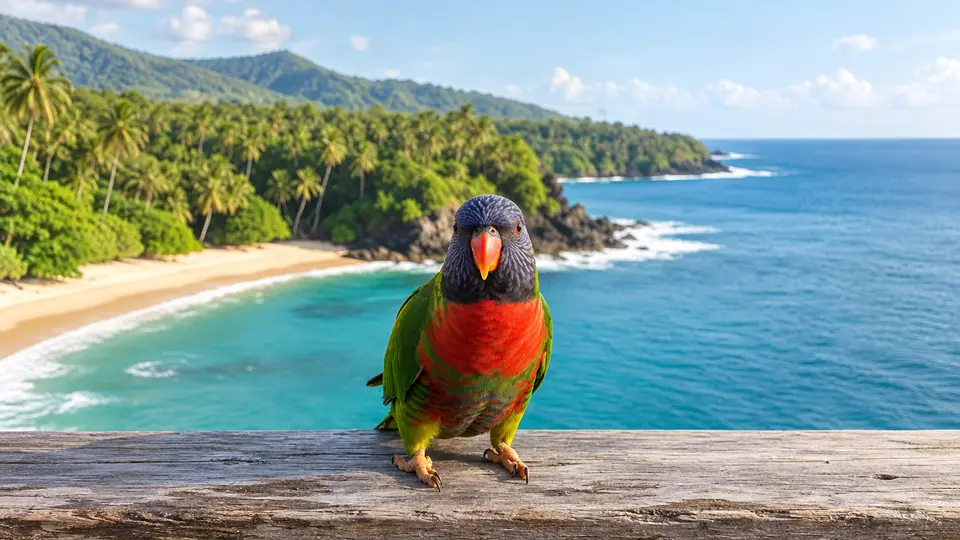
Red-throated lorikeet in its natural habitatAI-modified

Red-throated lorikeetVini amabilisWhere and when to see them

Red-throated lorikeet at a glance

The red-throated lorikeet is an exceptionally rare Fijian parrot whose present status remains deeply uncertain. Historical records describe a small green lorikeet with a red throat and facial markings, associated mainly with forested islands. Confirmed modern evidence is extremely scarce, and reports require careful verification because other Fijian parrots can cause confusion. It should not be presented as a realistic routine wildlife encounter, and any credible observation would have substantial conservation significance.

Behaviour & reproduction

Size
Length approximately 18 cm (7.1 in)
Weight
Not reliably established
Lifespan
Not reliably established
Status
Critically Endangered

Historical accounts suggest an active canopy bird that visited flowering trees, sometimes in small groups, and may have moved locally as nectar sources changed. However, its breeding behaviour, daily movements and social organization are poorly documented. Detailed claims about nesting schedules or dependable feeding routes would exceed the evidence. The absence of recent confirmed observations makes it especially important to distinguish historical descriptions from demonstrated behaviour of any surviving population. Its presumed arboreal lifestyle would have involved agile movements through the canopy, typical of lorikeets foraging for nectar. Little is known about its social structure, but lorikeets often forage in pairs or small flocks, suggesting a similar historical pattern.

Top wildlife locations

Fiji wildlife habitatAI-modified

Fiji

Historical habitat lies in native upland forest, not accessible beach habitat or standard shore landings. An inland forest excursion would be required, but even there no reliable viewing site or current population is established.
Destinations describe the species' habitat, not guaranteed cruise stops. Some animals require an optional inland excursion or are found in restricted reserves.

Fun facts about the Red-throated lorikeet

  • Older references often place it in the genus Charmosyna.
  • The species is endemic to Fiji.
  • Its current persistence has not been securely demonstrated by recent confirmed records.
  • Reliable photographs or sound recordings would be important evidence for evaluating a suspected sighting.

Best time to see the Red-throated lorikeet

No reliable observation season is known, and no month should be advertised as offering a credible chance of finding this bird. Fiji's drier travel season may ease forest access for general birdwatching, but it provides no evidence of red-throated lorikeet presence or breeding. The Red-throated lorikeet's presumed historical range includes areas that experience distinct wet and dry seasons, but there is no evidence linking these seasonal changes to observation likelihood. Any potential discovery would be exceptional, irrespective of the time of year.

Red-throated lorikeet: season matrix by destination

Travel and observation windows vary by region. Highlighted months are an orientation for planning, not confirmed sightings or a guarantee of access.

Fiji

No supported observation window exists; general Fiji travel seasons cannot establish presence, detectability or breeding timing for this exceptionally rare bird.

JanFebMarAprMayJunJulAugSepOctNovDec
Cruise ships in Fiji

Where the Red-throated lorikeet lives

Historical habitat associations include humid native forest, particularly upland and montane areas, with flowering canopy trees. Precise current habitat use is unknown because surviving populations have not been reliably located. Coastal resorts, beaches and standard shore landings are not credible routine viewing settings. Historical records indicate it inhabited dense, often inaccessible, humid forests of Viti Levu and possibly other islands in the Lau Group. It is considered Critically Endangered, possibly extinct, with a conservation focus on identifying any remaining suitable forest fragments.

What the Red-throated lorikeet eats

Nectar and pollen are considered important, consistent with lorikeet feeding anatomy and historical observations at blossoms. Other soft plant foods may have been taken, but species-specific evidence is limited. A detailed modern diet or dependable list of feeding trees is not established. Like other lorikeets, it likely possessed a specialized brush-tipped tongue for efficient nectar and pollen collection from native flowering plants. Its diet would have been crucial for the pollination of specific forest flora, highlighting its ecological role.

Species at a glance

Common name
Red-throated lorikeet
Scientific name
Vini amabilis
Animal group
Birds
Size
Length approximately 18 cm (7.1 in)
Weight
Not reliably established
Lifespan
Not reliably established
Status
Critically Endangered
Identification
Historical descriptions distinguish it from the larger collared lory by its predominantly green body and restricted red throat and facial markings rather than extensive red underparts. Distinguishing features include a bright green body, a distinct red throat, and a short, stout bill adapted for its nectarivorous diet. Its smaller size and overall green plumage readily separate it from more common, larger lory species found in the region.

Red-throated lorikeet: frequently asked questions

Where can I see the Red-throated lorikeet?
Fiji. Treat this as a conservation-sensitive possibility, not a target promised by tours. Remain on permitted forest routes, avoid playback and report any well-documented suspected observation privately to qualified Fijian conservation specialists rather than publicizing a precise location. Because of its extreme rarity, any unconfirmed sighting should be thoroughly documented with clear photographs or video for scientific validation. Responsible ecotourism prioritizes conservation and avoids any activity that could disturb a sensitive species or its potential habitat.
When is the best time to see the Red-throated lorikeet?
No reliable observation season is known, and no month should be advertised as offering a credible chance of finding this bird. Fiji's drier travel season may ease forest access for general birdwatching, but it provides no evidence of red-throated lorikeet presence or breeding. The Red-throated lorikeet's presumed historical range includes areas that experience distinct wet and dry seasons, but there is no evidence linking these seasonal changes to observation likelihood. Any potential discovery would be exceptional, irrespective of the time of year.
How big does the Red-throated lorikeet get?
Length approximately 18 cm (7.1 in). Adult weight: Not reliably established. Size varies with age, sex and population.
How should I behave around the Red-throated lorikeet?
Treat this as a conservation-sensitive possibility, not a target promised by tours. Remain on permitted forest routes, avoid playback and report any well-documented suspected observation privately to qualified Fijian conservation specialists rather than publicizing a precise location. Because of its extreme rarity, any unconfirmed sighting should be thoroughly documented with clear photographs or video for scientific validation. Responsible ecotourism prioritizes conservation and avoids any activity that could disturb a sensitive species or its potential habitat.
What does the Red-throated lorikeet eat?
Nectar and pollen are considered important, consistent with lorikeet feeding anatomy and historical observations at blossoms. Other soft plant foods may have been taken, but species-specific evidence is limited. A detailed modern diet or dependable list of feeding trees is not established. Like other lorikeets, it likely possessed a specialized brush-tipped tongue for efficient nectar and pollen collection from native flowering plants. Its diet would have been crucial for the pollination of specific forest flora, highlighting its ecological role.
Are wildlife sightings guaranteed on an adventure cruise?
No. Animals move freely and routes, weather, access restrictions and local conditions influence every outing. Confirm the actual itinerary and shore program before booking.

Compare wildlife in the same destinations

Explore other birds recorded in these destinations. Similar surroundings do not mean the animals share the same habits or viewing season.

Species comparison by animal group and destination
Red-throated lorikeetAI-modifiedRed-throated lorikeetBarking imperial pigeonAI-modifiedBarking imperial pigeonBrown BoobyAI-modifiedBrown Booby
Animal groupBirdsAnimal groupBirdsAnimal groupBirds
DestinationsFijiDestinationsFijiDestinationsCosta Rica, Cape Verde, Egypt, Fiji, Polynesia
Scientific nameVini amabilisScientific nameScientific name
All wildlife destinations
AI-modified
Plan your trip

Find your next wildlife adventure

Compare destinations, shore programs and dates with the animals and habitats you would love to see.

  • Naturalist-led shore excursions
  • Responsible wildlife watching
  • Small expedition ships