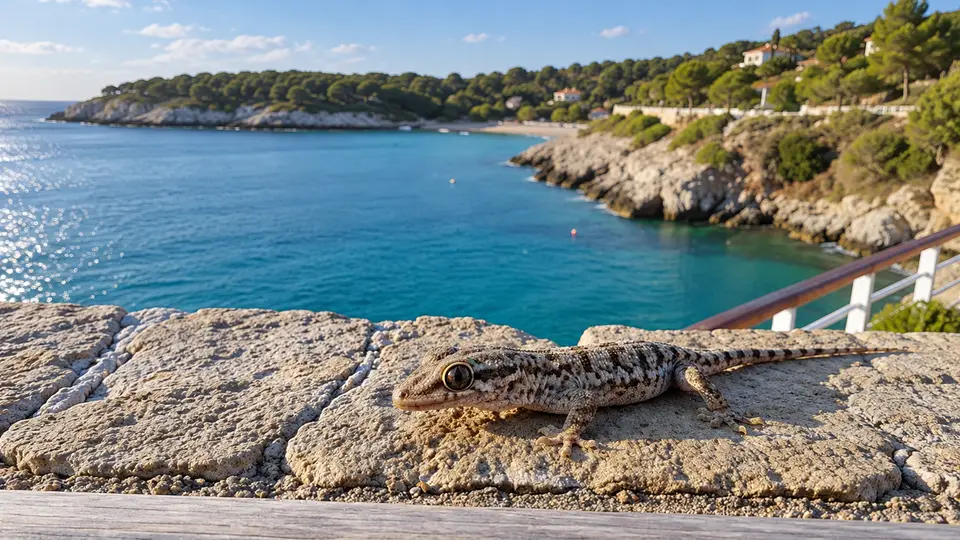
Mediterranean House Gecko in its natural habitatAI-modified

Mediterranean House GeckoHemidactylus turcicusWhere and when to see them

Mediterranean House Gecko at a glance

The Mediterranean house gecko is a small, largely nocturnal lizard native to the Mediterranean region and neighboring lands. Its pale, somewhat translucent skin, scattered raised tubercles and broad toe pads suit a life on rough rock and buildings. In Greece it often shares human settlements without attracting much attention. Individuals emerge from narrow daytime refuges after dusk, sometimes becoming conspicuous where exterior lights concentrate small insects.

Behaviour & reproduction

Size
8-15 cm (3.1-5.9 in) total length
Weight
Not reliably established
Lifespan
Not reliably established
Status
Least Concern

After sunset, this gecko moves between crevices and feeding positions on walls, ceilings and rocky surfaces. It often waits motionless before making a short dash at passing prey. Males can give small squeaks or clicks during social encounters, unusual sounds for a lizard. Retreating into cracks is its first defense, but a seized individual may shed its tail, which later regrows with a different appearance. They are notably vocal for a gecko, with males producing a series of soft clicks or chirps to establish territory or attract mates. Their ability to climb smooth vertical surfaces is due to specialized lamellae on their toes, equipped with microscopic hairs.

Top wildlife locations

Greece wildlife habitatAI-modified

Greece

Old coastal town walls, sheltered courtyards and rocky village margins offer plausible evening habitat. An inland excursion is unnecessary where suitable coastal buildings occur, but geckos can remain hidden even on warm nights.
Destinations describe the species' habitat, not guaranteed cruise stops. Some animals require an optional inland excursion or are found in restricted reserves.

Fun facts about the Mediterranean House Gecko

  • Its adhesive toe pads contain microscopic structures that help it grip vertical surfaces.
  • Females commonly lay two hard-shelled eggs per clutch.
  • Individuals can communicate with audible clicks or squeaks.
  • The species has established introduced populations far beyond the Mediterranean, including parts of North America.

Best time to see the Mediterranean House Gecko

Late spring through early autumn generally offers the best conditions for evening observation in Greece. Warm, still nights favor surface activity, while cold or windy weather can keep geckos hidden. This is an activity window rather than a guarantee of local presence. In Greece, high summer temperatures sometimes lead to reduced daytime activity, making cooler evening hours the primary window. Even during peak season, a sudden drop in temperature or strong winds can significantly decrease their visibility.

Mediterranean House Gecko: season matrix by destination

Travel and observation windows vary by region. Highlighted months are an orientation for planning, not confirmed sightings or a guarantee of access.

Greece

These months usually provide warm evening conditions for observation, with activity varying by island, elevation and weather.

JanFebMarAprMayJunJulAugSepOctNovDec
Cruise ships in Greece

Where the Mediterranean House Gecko lives

Natural habitats include rocky slopes, cliffs, caves and scrub with abundant crevices. Around people, old masonry, garden walls and sheltered buildings provide similar refuges. Warm coastal settlements are suitable places to look, although the species is not restricted to the immediate shoreline. In urban areas, they are frequently found on the exterior walls of houses, churches, and ruins, particularly those with rough surfaces that offer good grip. They are highly adaptable and can thrive in various Mediterranean and even subtropical environments where human structures provide warmth and shelter.

What the Mediterranean House Gecko eats

It eats small arthropods, including moths, flies, mosquitoes, beetles, spiders and other manageable prey. Artificial lighting can create concentrated feeding opportunities, but these geckos also hunt away from buildings. Their small size limits them mainly to relatively small invertebrates. This nocturnal hunter primarily uses its large eyes to spot prey under ambient light or by detecting movement. Their diet can also include smaller geckos or their own shed skin, demonstrating opportunistic feeding behavior.

Species at a glance

Common name
Mediterranean House Gecko
Scientific name
Hemidactylus turcicus
Animal group
Reptiles
Size
8-15 cm (3.1-5.9 in) total length
Weight
Not reliably established
Lifespan
Not reliably established
Status
Least Concern
Identification
Compared with the broader, more heavily armored Moorish gecko, it has a slimmer body, relatively translucent skin and conspicuous raised tubercles. Unlike many native European lizards, Mediterranean house geckos have vertical pupils and lack eyelids, instead possessing a clear spectacle over each eye. Their coloration varies from pale grey to brownish-yellow, often mottled, which aids in camouflage against stone or plaster.

Mediterranean House Gecko: frequently asked questions

Where can I see the Mediterranean House Gecko?
Greece. Look at exterior walls from public paths after dusk, using a dim light briefly. Do not pull geckos from cracks or grasp their tails, which can detach. Respect occupied buildings and avoid insect sprays. When viewing from a distance, look for their characteristic jerky movements or a motionless silhouette against a lit wall. Using a red-light flashlight can minimize disturbance while still allowing for good observation.
When is the best time to see the Mediterranean House Gecko?
Late spring through early autumn generally offers the best conditions for evening observation in Greece. Warm, still nights favor surface activity, while cold or windy weather can keep geckos hidden. This is an activity window rather than a guarantee of local presence. In Greece, high summer temperatures sometimes lead to reduced daytime activity, making cooler evening hours the primary window. Even during peak season, a sudden drop in temperature or strong winds can significantly decrease their visibility.
How big does the Mediterranean House Gecko get?
8-15 cm (3.1-5.9 in) total length. Adult weight: Not reliably established. Size varies with age, sex and population.
How should I behave around the Mediterranean House Gecko?
Look at exterior walls from public paths after dusk, using a dim light briefly. Do not pull geckos from cracks or grasp their tails, which can detach. Respect occupied buildings and avoid insect sprays. When viewing from a distance, look for their characteristic jerky movements or a motionless silhouette against a lit wall. Using a red-light flashlight can minimize disturbance while still allowing for good observation.
What does the Mediterranean House Gecko eat?
It eats small arthropods, including moths, flies, mosquitoes, beetles, spiders and other manageable prey. Artificial lighting can create concentrated feeding opportunities, but these geckos also hunt away from buildings. Their small size limits them mainly to relatively small invertebrates. This nocturnal hunter primarily uses its large eyes to spot prey under ambient light or by detecting movement. Their diet can also include smaller geckos or their own shed skin, demonstrating opportunistic feeding behavior.
Are wildlife sightings guaranteed on an adventure cruise?
No. Animals move freely and routes, weather, access restrictions and local conditions influence every outing. Confirm the actual itinerary and shore program before booking.

Compare wildlife in the same destinations

Explore other reptiles recorded in these destinations. Similar surroundings do not mean the animals share the same habits or viewing season.

Species comparison by animal group and destination
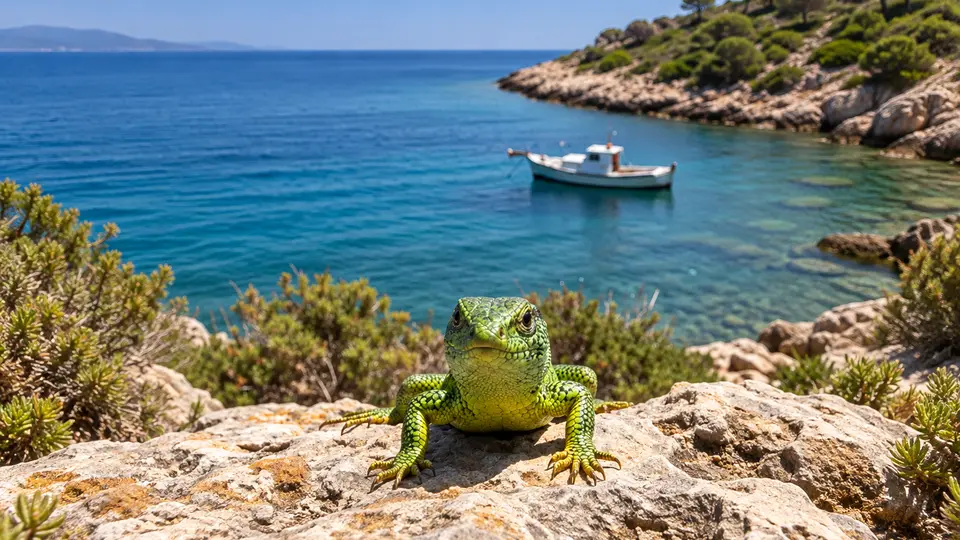
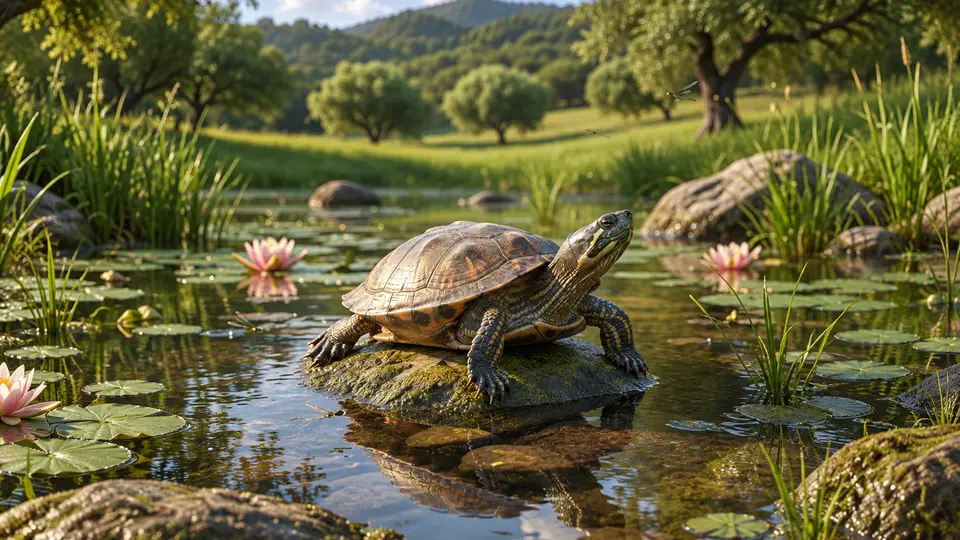
Mediterranean House GeckoAI-modifiedMediterranean House GeckoBalkan Green LizardAI-modifiedBalkan Green LizardBalkan Pond TurtleAI-modifiedBalkan Pond Turtle
Animal groupReptilesAnimal groupReptilesAnimal groupReptiles
DestinationsGreeceDestinationsGreeceDestinationsGreece
Scientific nameHemidactylus turcicusScientific nameScientific name
All wildlife destinations
AI-modified
Plan your trip

Find your next wildlife adventure

Compare destinations, shore programs and dates with the animals and habitats you would love to see.

  • Naturalist-led shore excursions
  • Responsible wildlife watching
  • Small expedition ships