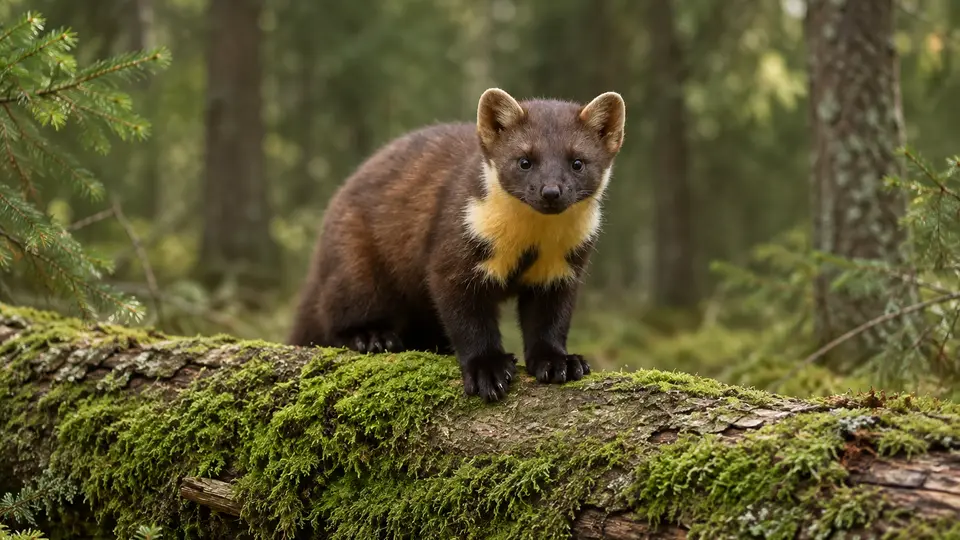
European Pine Marten in its natural habitatAI-modified

European Pine MartenMartes martesWhere and when to see them

European Pine Marten at a glance

The European pine marten is a slender woodland carnivore with rounded ears, a bushy tail and a pale throat bib. Despite its name, it uses broadleaved and mixed woods as well as conifer forest. Scotland holds an important part of its British population, following historical persecution and habitat loss elsewhere. Agile in trees but equally capable on the ground, it is usually difficult to see casually because much activity occurs around twilight or after dark.

Behaviour & reproduction

Size
40-55 cm (15.7-21.7 in) head-body length
Weight
0.8-2.2 kg (1.8-4.9 lb)
Lifespan
Up to 18.2 years in captivity
Status
Least Concern

Pine martens are mostly solitary and maintain overlapping ranges marked with scent. They climb confidently, using tree cavities and other sheltered places for resting or raising young, but often search for food at ground level. Activity can extend into daylight, particularly when females provision kits. Reproduction involves delayed implantation, separating summer mating from spring births. Individuals may investigate buildings or food sources, yet deliberate feeding can create dependence and undesirable contact with people. They are known for their agility, easily navigating complex arboreal environments, and can often be seen bounding across open ground between patches of cover. Although often solitary, family groups remain together until the young are independent, typically around autumn.

Top wildlife locations

Scotland wildlife habitatAI-modified

Scotland

Coastal woodland edges and mature Highland forests provide suitable habitat, but sightings are uncommon. An inland woodland excursion or responsibly managed hide is generally more realistic than watching from exposed shore paths.


Destinations describe the species' habitat, not guaranteed cruise stops. Some animals require an optional inland excursion or are found in restricted reserves.

Fun facts about the European Pine Marten

  • Delayed implantation postpones embryo development after summer mating.
  • Its bushy tail helps balance during climbing and leaping.
  • Seasonal berries can form a large share of its food.
  • Den boxes can supplement scarce natural cavities where conservation programs install them appropriately.

Best time to see the European Pine Marten

Late spring through summer provides long Scottish evenings and occasional daylight activity by adults feeding young. Autumn fruiting can influence movements, but no season ensures an encounter. Weather, woodland structure and locally responsible observation arrangements matter more than broad tourism seasons. While no season guarantees a sighting, summer shore excursions into well-managed forest reserves offer increased opportunities due to longer daylight hours and juvenile activity. Observing from deck is not a typical method for spotting this terrestrial and arboreal species.

European Pine Marten: season matrix by destination

Travel and observation windows vary by region. Highlighted months are an orientation for planning, not confirmed sightings or a guarantee of access.

Scotland

These months offer long evenings and possible daylight foraging, not a fixed viewing season; pine martens are resident and can remain unseen even at occupied sites.

JanFebMarAprMayJunJulAugSepOctNovDec
Cruise ships in Scotland

Where the European Pine Marten lives

Structurally varied woodland with cover, mature trees and sheltered den sites is especially valuable. Martens also cross scrub, rocky ground and forest edges. Coastal woods may be occupied, but open shores are not typical viewing habitat and inland forest excursions are usually necessary. In Scotland, they commonly occupy both coniferous and broadleaf forests, showing a preference for ancient and semi-natural woodlands. Their presence can also extend into moorlands and rocky areas adjacent to woodland, especially where good cover and food resources are available.

What the European Pine Marten eats

Small mammals, birds, eggs, insects and carrion are eaten alongside substantial seasonal fruit. Berries can become particularly important in late summer and autumn. This flexible diet means pine martens are not exclusively predators of squirrels or other tree-dwelling animals. Their opportunistic diet includes a significant proportion of voles, mice, and other small rodents, alongside occasional birds and their eggs. Seasonal availability greatly influences their diet, with fungi and insects also consumed when abundant.

Species at a glance

Common name
European Pine Marten
Scientific name
Martes martes
Animal group
Mammals
Size
40-55 cm (15.7-21.7 in) head-body length
Weight
0.8-2.2 kg (1.8-4.9 lb)
Lifespan
Up to 18.2 years in captivity
Status
Least Concern
Identification
Compared with the related beech marten, it typically has a creamy-yellow rather than white bib, a darker nose and proportionately larger ears, although bib colour alone is not definitive. Beyond the bib, look for their slender body, short legs, and long bushy tail which is often as long as their head and body combined. Their dark brown fur is generally uniform across the body, with the lighter bib providing the main contrasting feature.

European Pine Marten: frequently asked questions

Where can I see the European Pine Marten?
Scotland. Use quiet woodland paths or professionally managed hides without approaching dens. Never handle or corner a marten, and avoid improvised feeding stations, which can encourage biting risks, road crossings and dependence. Focus on observing from a distance with binoculars, particularly at dawn or dusk when they are most active. Always respect their space and minimize disturbance to avoid stressing the animals.
When is the best time to see the European Pine Marten?
Late spring through summer provides long Scottish evenings and occasional daylight activity by adults feeding young. Autumn fruiting can influence movements, but no season ensures an encounter. Weather, woodland structure and locally responsible observation arrangements matter more than broad tourism seasons. While no season guarantees a sighting, summer shore excursions into well-managed forest reserves offer increased opportunities due to longer daylight hours and juvenile activity. Observing from deck is not a typical method for spotting this terrestrial and arboreal species.
How big does the European Pine Marten get?
40-55 cm (15.7-21.7 in) head-body length. Adult weight: 0.8-2.2 kg (1.8-4.9 lb). Size varies with age, sex and population.
How should I behave around the European Pine Marten?
Use quiet woodland paths or professionally managed hides without approaching dens. Never handle or corner a marten, and avoid improvised feeding stations, which can encourage biting risks, road crossings and dependence. Focus on observing from a distance with binoculars, particularly at dawn or dusk when they are most active. Always respect their space and minimize disturbance to avoid stressing the animals.
What does the European Pine Marten eat?
Small mammals, birds, eggs, insects and carrion are eaten alongside substantial seasonal fruit. Berries can become particularly important in late summer and autumn. This flexible diet means pine martens are not exclusively predators of squirrels or other tree-dwelling animals. Their opportunistic diet includes a significant proportion of voles, mice, and other small rodents, alongside occasional birds and their eggs. Seasonal availability greatly influences their diet, with fungi and insects also consumed when abundant.
Are wildlife sightings guaranteed on an adventure cruise?
No. Animals move freely and routes, weather, access restrictions and local conditions influence every outing. Confirm the actual itinerary and shore program before booking.

Compare wildlife in the same destinations

Explore other mammals recorded in these destinations. Similar surroundings do not mean the animals share the same habits or viewing season.

Species comparison by animal group and destination
European Pine MartenAI-modifiedEuropean Pine MartenCommon Bottlenose DolphinAI-modifiedCommon Bottlenose DolphinEurasian OtterAI-modifiedEurasian Otter
Animal groupMammalsAnimal groupMammalsAnimal groupMammals
DestinationsScotlandDestinationsCosta Rica, Florida, Galapagos, Mexico, Cape Verde, Croatia, Greece, Portugal, Scotland, Seychelles, Turkey, Maldives, Australia, New ZealandDestinationsScotland, Turkey
Scientific nameMartes martesScientific nameScientific name
All wildlife destinations
AI-modified
Plan your trip

Find your next wildlife adventure

Compare destinations, shore programs and dates with the animals and habitats you would love to see.

  • Naturalist-led shore excursions
  • Responsible wildlife watching
  • Small expedition ships