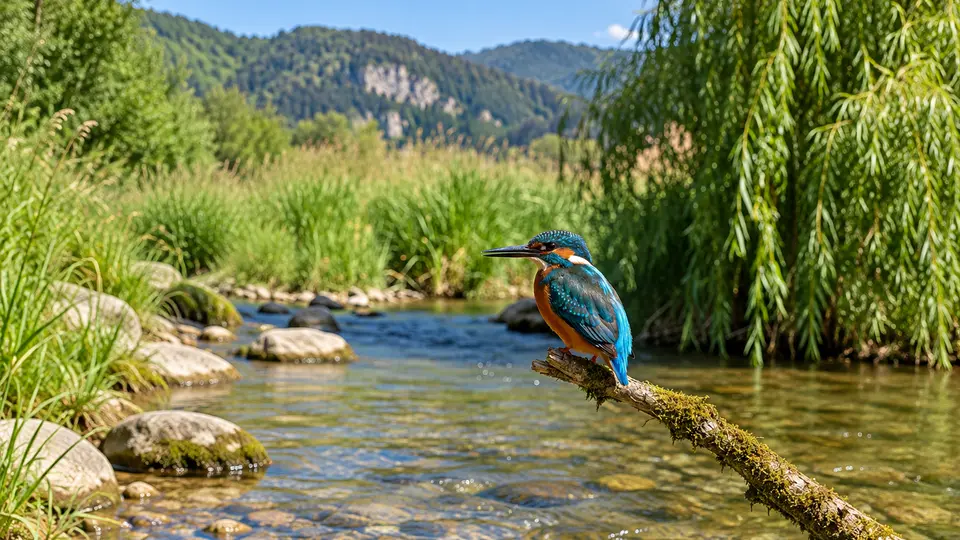
Common Kingfisher in its natural habitat

Common KingfisherAlcedo atthisWhere and when to see them

Common Kingfisher at a glance

The common kingfisher is a small, vividly coloured bird whose blue back often registers as a brief flash above water. Despite its brilliance, a motionless individual can be surprisingly difficult to notice on a shaded perch. It occurs widely across Europe and Asia, using freshwater and some sheltered coastal habitats. Clean-looking water alone does not guarantee its presence, since prey accessibility, suitable perches and nesting banks are also important.

Behaviour & reproduction

Size
16-18 cm (6.3-7.1 in) long
Weight
30-45 g (1.1-1.6 oz)
Lifespan
Up to 21 years in the wild (record)
Status
Least Concern

Kingfishers usually hunt alone, watching from a low perch before plunging after small prey. Captured fish are brought back to a perch, subdued and positioned for swallowing. Adults defend feeding stretches, particularly where suitable habitat is limited. Pairs excavate nesting tunnels in banks, ending in a chamber. Their fast, low flights often follow the watercourse, and a sharp, high call may reveal a passing bird before its colours do. Courtship involves the male offering fish to the female, a crucial bonding and feeding ritual before egg-laying. Parents are highly territorial around their nest sites, often chasing off intruders with aggressive calls and displays.

Top wildlife locations

Greece wildlife habitat

Greece

Coastal lagoons, estuary channels and sheltered wetland margins offer plausible autumn and winter viewing. Inland excursions may be needed for breeding rivers; suitable waters can still hold few or no birds.
Destinations describe the species' habitat, not guaranteed cruise stops. Some animals require an optional inland excursion or are found in restricted reserves.

Fun facts about the Common Kingfisher

  • Females typically show orange-red on the lower mandible.
  • The nest lies at the end of an excavated bank tunnel.
  • Blue plumage is produced largely by feather structure rather than blue pigment.
  • A sharp flight call often reveals a bird before it is seen.

Best time to see the Common Kingfisher

Autumn and winter are often useful for Greek coastal wetlands, when birds may spread into estuaries and sheltered saline margins. Spring and summer observations are possible around breeding waters, frequently inland. Local water levels and disturbance matter more than a single nationwide viewing season. Breeding season typically runs from March to September, allowing for observations of active pairs and fledglings around suitable nesting sites. During autumn and winter migrations, birds from colder northern regions may augment local populations in Greece, increasing viewing opportunities.

Common Kingfisher: season matrix by destination

Travel and observation windows vary by region. Highlighted months are an orientation for planning, not confirmed sightings or a guarantee of access.

Greece

This window reflects wider coastal use outside breeding, not guaranteed presence or the timing of all Greek populations.

JanFebMarAprMayJunJulAugSepOctNovDec
Cruise ships in Greece

Where the Common Kingfisher lives

Slow rivers, streams, canals, ponds and lake margins provide core habitat when small fish are accessible. In Greece, sheltered lagoons, estuaries and coastal wetlands may also be used, especially outside breeding. Nesting generally requires an appropriate exposed earthen bank nearby. While predominantly a freshwater species, Greek populations show adaptability, sometimes utilising brackish waters near river mouths. They require clear water to hunt effectively and soft, sandy banks for nesting tunnels, often along quiet stretches of water.

What the Common Kingfisher eats

Small fish make up most of the diet, with aquatic insects, crustaceans and other small prey taken opportunistically. Hunting success depends on seeing prey clearly and reaching it in shallow water. Fish are generally swallowed head first after being repositioned on a perch. Kingfishers can adjust their hunting techniques to local conditions, sometimes hovering briefly before a dive in open water. They may also consume tadpoles or aquatic invertebrates if fish are scarce, demonstrating dietary flexibility.

Species at a glance

Common name
Common Kingfisher
Scientific name
Alcedo atthis
Animal group
Birds
Size
16-18 cm (6.3-7.1 in) long
Weight
30-45 g (1.1-1.6 oz)
Lifespan
Up to 21 years in the wild (record)
Status
Least Concern
Identification
Its tiny size, orange underparts and electric-blue back distinguish it from the much larger, differently patterned kingfishers occasionally encountered around the eastern Mediterranean. The deep rufous-orange underparts extend from the breast to the belly, contrasting sharply with the white chin and small white patch on the neck. Juveniles have duller plumage, greenish-black legs, and a darker bill compared to the brighter orange legs and red-tipped lower mandible of adults.

Common Kingfisher: frequently asked questions

Where can I see the Common Kingfisher?
Greece. Wait quietly beside an established wetland path and scan low branches or posts. Never approach a nest tunnel or trim vegetation for photographs; repeated disturbance can prevent adults from feeding their young. Their rapid flight often appears as a blur of iridescent blue low over the water, making them challenging to follow. Binoculars are essential for close examination of their subtle feather details and hunting actions from a distance.
When is the best time to see the Common Kingfisher?
Autumn and winter are often useful for Greek coastal wetlands, when birds may spread into estuaries and sheltered saline margins. Spring and summer observations are possible around breeding waters, frequently inland. Local water levels and disturbance matter more than a single nationwide viewing season. Breeding season typically runs from March to September, allowing for observations of active pairs and fledglings around suitable nesting sites. During autumn and winter migrations, birds from colder northern regions may augment local populations in Greece, increasing viewing opportunities.
How big does the Common Kingfisher get?
16-18 cm (6.3-7.1 in) long. Adult weight: 30-45 g (1.1-1.6 oz). Size varies with age, sex and population.
How should I behave around the Common Kingfisher?
Wait quietly beside an established wetland path and scan low branches or posts. Never approach a nest tunnel or trim vegetation for photographs; repeated disturbance can prevent adults from feeding their young. Their rapid flight often appears as a blur of iridescent blue low over the water, making them challenging to follow. Binoculars are essential for close examination of their subtle feather details and hunting actions from a distance.
What does the Common Kingfisher eat?
Small fish make up most of the diet, with aquatic insects, crustaceans and other small prey taken opportunistically. Hunting success depends on seeing prey clearly and reaching it in shallow water. Fish are generally swallowed head first after being repositioned on a perch. Kingfishers can adjust their hunting techniques to local conditions, sometimes hovering briefly before a dive in open water. They may also consume tadpoles or aquatic invertebrates if fish are scarce, demonstrating dietary flexibility.
Are wildlife sightings guaranteed on an adventure cruise?
No. Animals move freely and routes, weather, access restrictions and local conditions influence every outing. Confirm the actual itinerary and shore program before booking.

Compare wildlife in the same destinations

Explore other birds recorded in these destinations. Similar surroundings do not mean the animals share the same habits or viewing season.

Species comparison by animal group and destination
Common KingfisherCommon KingfisherAudouin's GullAudouin's GullBlack-winged StiltBlack-winged Stilt
Animal groupBirdsAnimal groupBirdsAnimal groupBirds
DestinationsGreeceDestinationsCroatia, Greece, Portugal, TurkeyDestinationsCroatia, Greece
Scientific nameAlcedo atthisScientific nameScientific name
All wildlife destinations
Plan your trip

Find your next wildlife adventure

Compare destinations, shore programs and dates with the animals and habitats you would love to see.

  • Naturalist-led shore excursions
  • Responsible wildlife watching
  • Small expedition ships