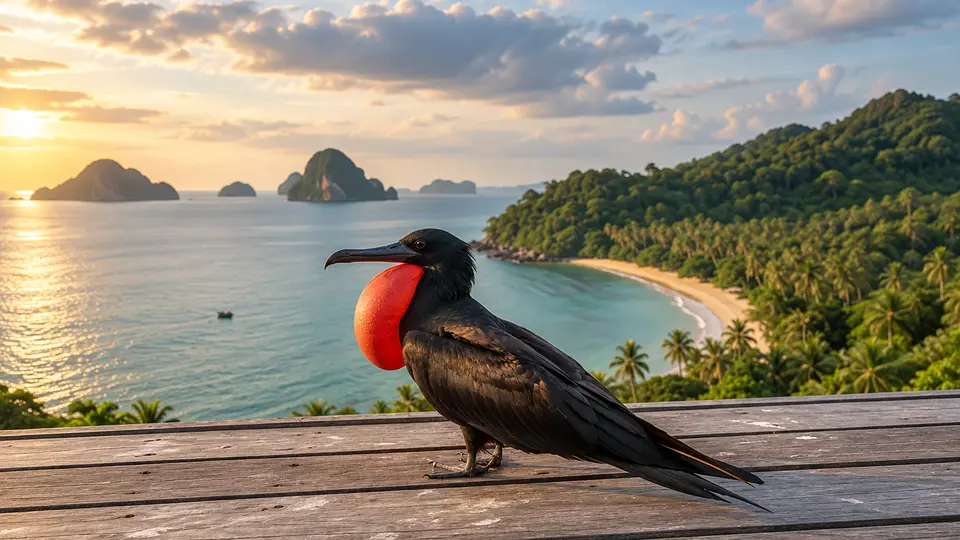
Christmas Island frigatebird in its natural habitatAI-modified

Christmas Island frigatebirdFregata andrewsiWhere and when to see them

Christmas Island frigatebird at a glance

The Christmas frigatebird is a large tropical seabird whose breeding population is confined to Christmas Island in the eastern Indian Ocean. Its immense wings and deeply forked tail support prolonged soaring, while its relatively weak legs make it awkward on land. Birds disperse into Southeast Asian seas outside the breeding area. In Thailand it is an uncommon and identification-sensitive visitor, not a nesting resident or a predictable attraction at coastal stops.

Behaviour & reproduction

Size
89-100 cm (35-39 in) long; 205-230 cm (81-91 in) wingspan
Weight
1.2-1.6 kg (2.6-3.5 lb)
Lifespan
Up to 25.6 years in the wild (record)
Status
Check current assessment

Frigatebirds use rising air to remain aloft with little flapping, scanning the surface for food or following feeding predators. They seize prey without settling on the sea and sometimes harass other seabirds into surrendering meals. On Christmas Island they nest in trees, with males displaying inflated red throat pouches. Parental care is prolonged. Away from the breeding island, birds may use communal coastal roosts, but movements are variable and incompletely understood. Their aerial prowess allows them to cover vast distances with minimal effort, often soaring on thermal currents high above the ocean. Kleptoparasitism, the act of stealing food from other birds, is a well-known and often spectacular feeding strategy. Outside the breeding season, they do not settle on water and must rely on coastal roosts for rest.

Top wildlife locations

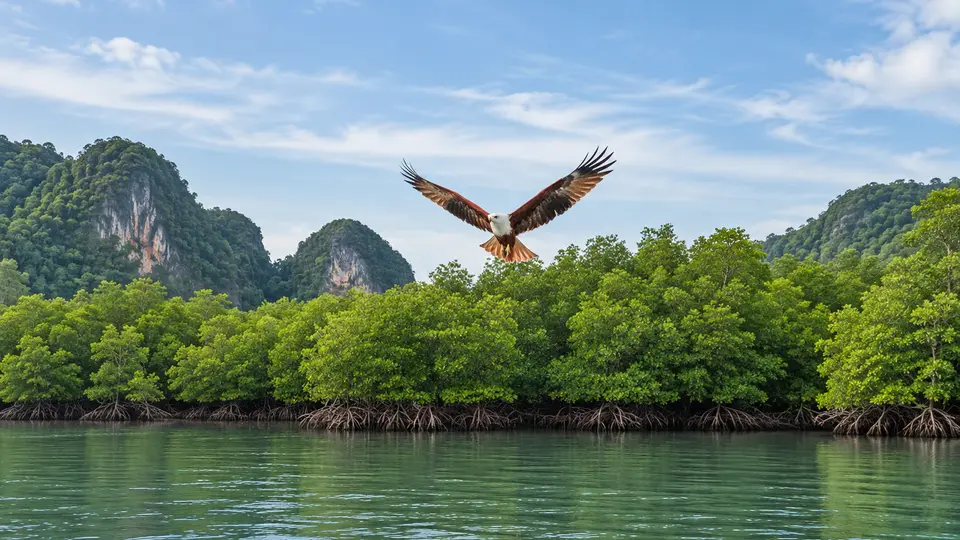
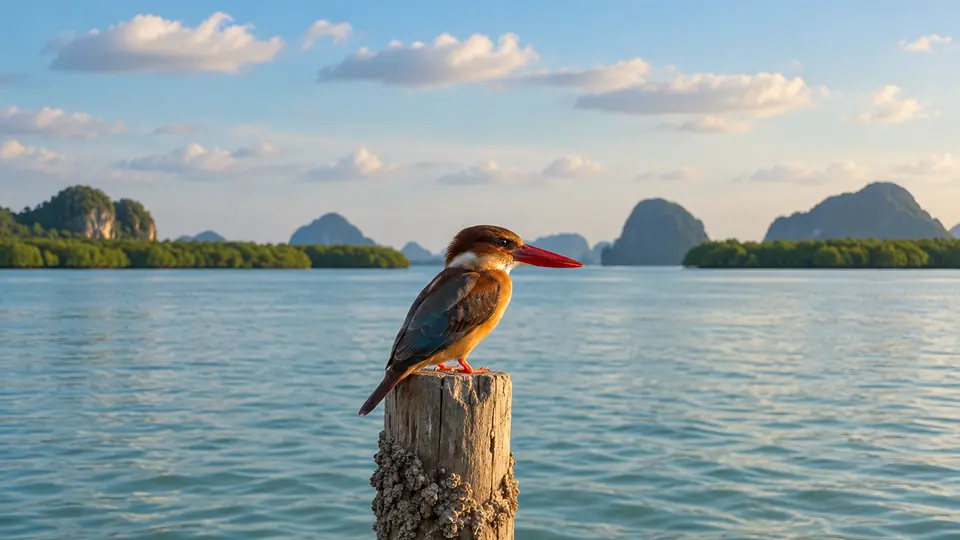
Thailand wildlife habitatAI-modified

Thailand

Andaman coastal headlands and vessel decks near offshore islands provide plausible distant observation settings. This is an uncommon visitor, not a Thai breeding species; roosts may be inaccessible and identification requires care.
Destinations describe the species' habitat, not guaranteed cruise stops. Some animals require an optional inland excursion or are found in restricted reserves.

Fun facts about the Christmas Island frigatebird

  • All known breeding occurs on Christmas Island.
  • Males inflate a red throat pouch during courtship.
  • Its scientific name honours palaeontologist Charles William Andrews.
  • Young frigatebirds remain dependent on parental feeding for an unusually long period.

Best time to see the Christmas Island frigatebird

No sufficiently dependable species-specific viewing season can be assigned across Thailand. Coastal access is often easier during the Andaman dry season, but that is a travel consideration rather than evidence of frigatebird presence. Recent, carefully verified local records are essential. While records exist year-round, occasional sightings may be more frequent during periods of oceanographic upwelling or specific migration pathways in the Andaman Sea. Data on their non-breeding distribution in Southeast Asia, particularly Thailand, remains sparse and opportunistic. Any sighting should be carefully documented with location, date, and time.

Christmas Island frigatebird: season matrix by destination

Travel and observation windows vary by region. Highlighted months are an orientation for planning, not confirmed sightings or a guarantee of access.

Thailand

A reliable Thailand-wide occurrence window is unsupported; November to April may ease Andaman travel but does not establish seasonal species presence.

JanFebMarAprMayJunJulAugSepOctNovDec
Cruise ships in Thailand

Where the Christmas Island frigatebird lives

Breeding depends on suitable tall forest on Christmas Island. Nonbreeding birds range over tropical seas and may rest on offshore islands or coastal trees. Thai observations are associated with marine airspace and island coasts rather than inland forest or local breeding colonies. This critically endangered species breeds exclusively on Christmas Island, making its presence in Thailand a record of non-breeding dispersal from this single population. Their occurrence in Thai waters is usually tied to significant oceanographic features or passages between island groups. They are pelagic in non-breeding periods, spending most of their time over open ocean far from land.

What the Christmas Island frigatebird eats

Flying fish, squid and other surface-accessible marine prey form the diet. Birds also obtain food through opportunistic scavenging and theft from other seabirds. Their feeding depends on prey reaching the surface, sometimes through the activity of larger marine predators. Despite their large size, their feet are not adapted for swimming or diving, restricting them to surface feeding. They are also known to scavenge from fishing boats and will exploit any opportunity to obtain food without expending significant energy. The hooked bill is perfectly suited for snatching prey from the water's surface or mid-air.

Species at a glance

Common name
Christmas Island frigatebird
Scientific name
Fregata andrewsi
Animal group
Birds
Size
89-100 cm (35-39 in) long; 205-230 cm (81-91 in) wingspan
Weight
1.2-1.6 kg (2.6-3.5 lb)
Lifespan
Up to 25.6 years in the wild (record)
Status
Check current assessment
Identification
Adult males show a diagnostic white belly patch, but females and immature birds require careful comparison of belly and underwing patterns with great and lesser frigatebirds. The adult female has a white head and throat, while the immature bird shows a rusty-red or orange wash on the head and neck. Look for the exceptionally long, deeply forked tail, which is a common feature across frigatebird species but distinct in length. Their dark plumage often appears black, but can show a green or purple sheen in good light.

Christmas Island frigatebird: frequently asked questions

Where can I see the Christmas Island frigatebird?
Thailand. Use binoculars from shore or a stable deck and photograph distant birds for later identification. Do not approach roosts by climbing or pursuing birds, and avoid exposed viewpoints during tropical storms. Focus particular attention on their distinctive silhouette and flight pattern when spotting them against the sky. A high quality spotting scope can also be very useful for detailed identification from a distance. Consider using a field guide specific to Asian seabirds to help differentiate frigatebird species in flight.
When is the best time to see the Christmas Island frigatebird?
No sufficiently dependable species-specific viewing season can be assigned across Thailand. Coastal access is often easier during the Andaman dry season, but that is a travel consideration rather than evidence of frigatebird presence. Recent, carefully verified local records are essential. While records exist year-round, occasional sightings may be more frequent during periods of oceanographic upwelling or specific migration pathways in the Andaman Sea. Data on their non-breeding distribution in Southeast Asia, particularly Thailand, remains sparse and opportunistic. Any sighting should be carefully documented with location, date, and time.
How big does the Christmas Island frigatebird get?
89-100 cm (35-39 in) long; 205-230 cm (81-91 in) wingspan. Adult weight: 1.2-1.6 kg (2.6-3.5 lb). Size varies with age, sex and population.
How should I behave around the Christmas Island frigatebird?
Use binoculars from shore or a stable deck and photograph distant birds for later identification. Do not approach roosts by climbing or pursuing birds, and avoid exposed viewpoints during tropical storms. Focus particular attention on their distinctive silhouette and flight pattern when spotting them against the sky. A high quality spotting scope can also be very useful for detailed identification from a distance. Consider using a field guide specific to Asian seabirds to help differentiate frigatebird species in flight.
What does the Christmas Island frigatebird eat?
Flying fish, squid and other surface-accessible marine prey form the diet. Birds also obtain food through opportunistic scavenging and theft from other seabirds. Their feeding depends on prey reaching the surface, sometimes through the activity of larger marine predators. Despite their large size, their feet are not adapted for swimming or diving, restricting them to surface feeding. They are also known to scavenge from fishing boats and will exploit any opportunity to obtain food without expending significant energy. The hooked bill is perfectly suited for snatching prey from the water's surface or mid-air.
Are wildlife sightings guaranteed on an adventure cruise?
No. Animals move freely and routes, weather, access restrictions and local conditions influence every outing. Confirm the actual itinerary and shore program before booking.

Compare wildlife in the same destinations

Explore other birds recorded in these destinations. Similar surroundings do not mean the animals share the same habits or viewing season.

Species comparison by animal group and destination
Christmas Island frigatebirdAI-modifiedChristmas Island frigatebirdBrahminy kiteAI-modifiedBrahminy kiteBrown-winged kingfisherAI-modifiedBrown-winged kingfisher
Animal groupBirdsAnimal groupBirdsAnimal groupBirds
DestinationsThailandDestinationsIndonesia, Thailand, VietnamDestinationsThailand
Scientific nameFregata andrewsiScientific nameScientific name
All wildlife destinations
AI-modified
Plan your trip

Find your next wildlife adventure

Compare destinations, shore programs and dates with the animals and habitats you would love to see.

  • Naturalist-led shore excursions
  • Responsible wildlife watching
  • Small expedition ships