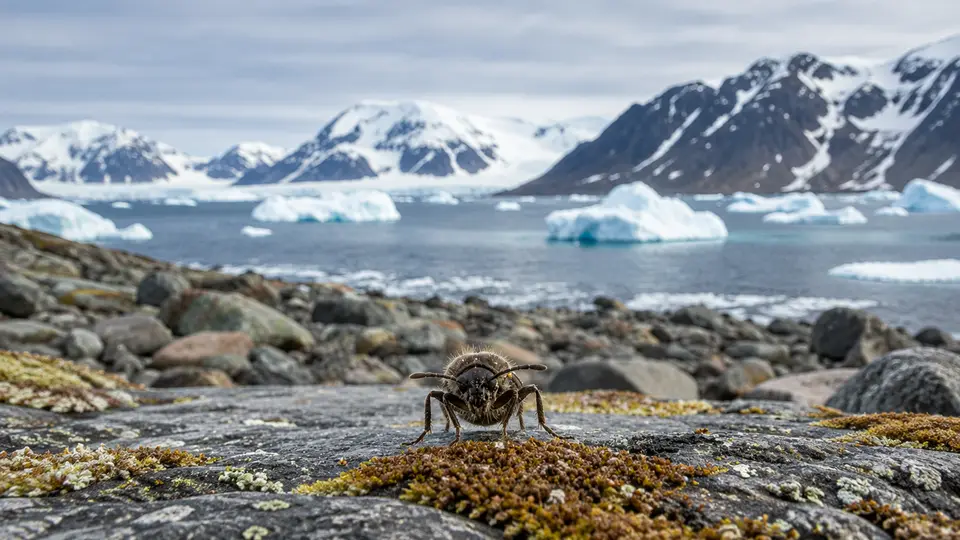
Belgica antarctica in its natural habitatAI-modified

Belgica antarcticaBelgica antarcticaWhere and when to see them

Belgica antarctica at a glance

Belgica antarctica is a tiny, flightless Antarctic midge, not a marine animal despite its catalog grouping. It lives in small patches of ice-free terrestrial habitat in the Antarctic Peninsula region and nearby islands. Most of its life is spent as a larva among moist organic material. Its ability to endure freezing and severe dehydration has made it an important subject for understanding how animals survive exceptionally harsh land environments.

Behaviour & reproduction

Size
2–6 mm (0.08–0.24 in) long
Weight
Not reliably established
Lifespan
7–14 days as an adult
Status
Check current assessment

Larvae remain within sheltered, moist microhabitats and pass through a life cycle usually lasting about two years. They survive winter using physiological responses that tolerate freezing and water loss. Adults emerge during the brief summer, cannot fly and live only long enough to mate and lay eggs. They are easily overlooked because of their minute size and limited movement, and their colonies can occupy very small suitable patches. The larvae exhibit remarkable physiological adaptations, including the ability to survive complete dehydration and rehydration, crucial for surviving freeze-thaw cycles. They produce cryoprotectants like trehalose and glycerol, which prevent ice crystal formation within their cells during freezing temperatures. The flightless adults are poor dispersers, which limits genetic exchange between isolated populations and contributes to their localized distribution.

Top wildlife locations

Antarctica wildlife habitatAI-modified

Antarctica

Moist moss and algal patches in the Antarctic Peninsula region provide habitat, but colonies are minute and often inaccessible. Standard permitted shore visits do not ensure access to occupied patches.
Destinations describe the species' habitat, not guaranteed cruise stops. Some animals require an optional inland excursion or are found in restricted reserves.

Fun facts about the Belgica antarctica

  • Both male and female adults lack functional wings.
  • The larval phase usually spans two Antarctic winters.
  • Adults live for roughly one to two weeks and do not feed.
  • Its compact genome has attracted attention from researchers studying extreme-environment adaptation.

Best time to see the Belgica antarctica

The Antarctic summer, broadly December through February, is the relevant period for accessible ice-free ground and possible adult activity. Emergence varies with local microclimate. Even during this window, visitors should not expect to locate these minute insects on ordinary permitted shore visits. While adults are most active during the peak of summer, larval development occurs over multiple years, including overwintering. The duration of their life cycle, from egg to adult, is often two years but can extend to three depending on local conditions. Summer conditions are critical for adult emergence, mating, and subsequent egg-laying.

Belgica antarctica: season matrix by destination

Travel and observation windows vary by region. Highlighted months are an orientation for planning, not confirmed sightings or a guarantee of access.

Antarctica

These months correspond to summer access and possible emergence, not confirmed availability at visitor sites; local colonies and adult timing remain uncertain.

JanFebMarAprMayJunJulAugSepOctNovDec
Cruise ships in Antarctica

Where the Belgica antarctica lives

This species occupies moist terrestrial sites with mosses, algae, soil and decomposing organic matter in the maritime Antarctic. It depends on sheltered, ice-free microhabitats rather than open snowfields. Suitable patches may occur near seabird colonies but are highly localised. Despite its small size, its restricted habitat makes Belgica antarctica a key component of the terrestrial ecosystem in the maritime Antarctic. This species is found on several Antarctic Peninsula islands and scattered sites along the mainland coast, making it the southernmost insect on Earth. Its ability to tolerate extreme environmental conditions allows it to thrive in these specialized niches.

What the Belgica antarctica eats

Larvae feed on algae, microorganisms and decaying organic material within their damp surroundings. This links them to the recycling of nutrients in Antarctic terrestrial ecosystems. Adults do not feed, relying instead on resources accumulated during the much longer larval stage. Larval feeding activity contributes to the decomposition of organic matter, facilitating nutrient cycling in an environment with slow decomposition rates. They consume a variety of organic debris, including plant detritus and microbial films that form on surfaces. This detritivorous diet highlights their role as primary decomposers in their localized habitats.

Species at a glance

Common name
Belgica antarctica
Scientific name
Belgica antarctica
Animal group
Marine life
Size
2–6 mm (0.08–0.24 in) long
Weight
Not reliably established
Lifespan
7–14 days as an adult
Status
Check current assessment
Identification
This minute, dark, wingless midge differs from winged Antarctic-region midges, but reliable species identification may require expert examination rather than a casual field view. While the lack of wings is a key identifying feature, other tiny invertebrates like mites or springtails may superficially resemble them to the untrained eye. Positive identification usually requires examination under magnification to observe specific morphological characteristics. Genetic analysis can definitively confirm the species where visual identification is ambiguous.

Belgica antarctica: frequently asked questions

Where can I see the Belgica antarctica?
Antarctica. Look only from authorised routes if a guide identifies suitable habitat. Never lift moss, collect insects or step into vegetation patches; preventing trampling and biological contamination matters more than obtaining a close view. Due to their minute size, adults measure only 2-6 mm in length, making them extremely difficult to spot without close inspection. Their dark coloration also helps them absorb solar radiation, but makes them blend in with the dark substrate. Even in areas where they are abundant, their presence is easily overlooked by casual observers.
When is the best time to see the Belgica antarctica?
The Antarctic summer, broadly December through February, is the relevant period for accessible ice-free ground and possible adult activity. Emergence varies with local microclimate. Even during this window, visitors should not expect to locate these minute insects on ordinary permitted shore visits. While adults are most active during the peak of summer, larval development occurs over multiple years, including overwintering. The duration of their life cycle, from egg to adult, is often two years but can extend to three depending on local conditions. Summer conditions are critical for adult emergence, mating, and subsequent egg-laying.
How big does the Belgica antarctica get?
2–6 mm (0.08–0.24 in) long. Adult weight: Not reliably established. Size varies with age, sex and population.
How should I behave around the Belgica antarctica?
Look only from authorised routes if a guide identifies suitable habitat. Never lift moss, collect insects or step into vegetation patches; preventing trampling and biological contamination matters more than obtaining a close view. Due to their minute size, adults measure only 2-6 mm in length, making them extremely difficult to spot without close inspection. Their dark coloration also helps them absorb solar radiation, but makes them blend in with the dark substrate. Even in areas where they are abundant, their presence is easily overlooked by casual observers.
What does the Belgica antarctica eat?
Larvae feed on algae, microorganisms and decaying organic material within their damp surroundings. This links them to the recycling of nutrients in Antarctic terrestrial ecosystems. Adults do not feed, relying instead on resources accumulated during the much longer larval stage. Larval feeding activity contributes to the decomposition of organic matter, facilitating nutrient cycling in an environment with slow decomposition rates. They consume a variety of organic debris, including plant detritus and microbial films that form on surfaces. This detritivorous diet highlights their role as primary decomposers in their localized habitats.
Are wildlife sightings guaranteed on an adventure cruise?
No. Animals move freely and routes, weather, access restrictions and local conditions influence every outing. Confirm the actual itinerary and shore program before booking.

Compare wildlife in the same destinations

Explore other marine life recorded in these destinations. Similar surroundings do not mean the animals share the same habits or viewing season.

Species comparison by animal group and destination
Belgica antarcticaAI-modifiedBelgica antarcticaFin WhaleAI-modifiedFin Whale
Animal groupMarine lifeAnimal groupMarine life
DestinationsAntarcticaDestinationsMexico, New England, Croatia, Greece, Norway, Portugal, Antarctica, Arctic
Scientific nameBelgica antarcticaScientific name
All wildlife destinations
AI-modified
Plan your trip

Find your next wildlife adventure

Compare destinations, shore programs and dates with the animals and habitats you would love to see.

  • Naturalist-led shore excursions
  • Responsible wildlife watching
  • Small expedition ships