Roatan, Utila & Cayo Cochinos (French Harbor - French Harbor)
Roatan Aggressor · Honduras · 7 Nächte
Über diese Route
Dieses Tauchsafari-Abenteuer erkundet die lebhaften Tauchplätze von Roatan, Utila und Cayo Cochinos und bietet eine umfassende Tour durch die Bay Islands von Honduras. Taucher können eine vielfältige Meeresfauna an atemberaubenden Riff-Formationen erwarten, von dramatischen Steilwänden bis hin zu flachen, farbenfrohen Gärten. Die Reiseroute beinhaltet Möglichkeiten für Wracktauchen, die Erkundung von Seebergen und Nachttauchgänge, was ein reichhaltiges Unterwassererlebnis verspricht.
Regionen auf dieser Route
Highlights
Black Hills
A popular site among divers, Black Hills is known for schooling fish such as Creole wrasse, Atlantic spadefish, and Southern sennets. Scorpionfish, toadfish, and the rare frogfish also frequent this seamount. A resident turtle often interacts with divers, adding to the memorable experience.
- Schools of fish
- Rare frogfish
- Resident turtle
- Seamount diving
Cannery Bank
Cannery Bank is a premier location for witnessing large pelagic fish in open waters. The site boasts vibrant colors on its mounts, with depths ranging from 25 to 110 feet, creating a dynamic environment for diverse marine encounters.
- Large pelagic fish
- Vibrant colors
- Dynamic environment
Cayos Cochinos
The Cayos Cochinos dive sites offer a rich tapestry of marine life, from macro creatures to patrolling barracuda and sharks. The area is known for its spectacular coral gardens and clear waters.
- Macro life
- Coral gardens
- Barracuda patrols
- Clear waters
CJ's Drop-off
Known as an excellent site for deep diving, CJ's Drop-off is home to spiny Caribbean lobster, golden tail moray eels, and schools of jacks. The vibrant marine life here makes it a rewarding experience for those exploring its depths.
- Deep diving
- Caribbean lobster
- Golden tail moray
- Schools of jacks
Duppy Waters
Duppy Waters begins with a vibrant coral garden at about 20 feet, which then slopes down into deeper blue waters. This site is rich with eagle rays, stingrays, octopuses, and schools of Creole wrasse and blue tang, creating a dynamic and colorful underwater scene.
- Coral garden
- Sloping walls
- Eagle rays
- Octopuses
Halliburton Wreck
This artificial reef, sunk in 1998, starts with the wheelhouse at 65 feet and extends to the vessel bottom at 100 feet. Green morays, spotted drum, yellowline arrow crabs, channel clinging crabs, and bearded fire worms are commonly seen. Porcupine fish and pipefish also frequent this exceptional dive site.
- Artificial reef
- Green morays
- Arrow crabs
- Porcupine fish
Hawksbill Bank
Hawksbill Bank is a seamount beginning at 40 feet and sloping down to 80 feet, named after the rare fingerprints it contains. Bluebell tunicates are abundant, and rare fingerprint corals can also be found. A resident hawksbill turtle gives the site its name.
- Seamount diving
- Sloping reef
- Bluebell tunicates
- Hawksbill turtle
Jack Neil Point
Featuring sand, walls, and individual coral heads, Jack Neil Point is a must-dive site. Divers can expect to see stout seahorse, large-eye toadfish, flying gurnards, and octopus, making it one of the best night diving locations in the area.
- Sand and walls
- Stout seahorse
- Flying gurnards
- Night diving
Mary’s Place
One of Roatan's most famous dive sites, Mary's Place is a lush reef characterized by numerous crevices and tunnels. These intricate formations invite exploration and provide excellent photographic opportunities, making it a favorite for many divers.
- Lush reef
- Crevices and tunnels
- Photo opportunities
Odyssey Wreck
The Odyssey Wreck is Roatan's largest shipwreck, a formidable freighter measuring 300 feet long, 50 feet wide, and 85 feet tall. As one of the Caribbean's largest wrecks, it offers an expansive and dramatic dive site for exploration.
- Largest Roatan wreck
- 300 ft freighter
- Caribbean wreck diving
Old Bank
Old Bank is a very shallow dive site, notable for its rare elkhorn coral flourishes and diverse small critters. It is also a prime location to spot the elusive yellowhead jawfish peering out from its hole, making it a favorite for macro enthusiasts.
- Shallow dive
- Elkhorn coral
- Small critters
- Yellowhead jawfish
Pelican Point
Pelican Point is a rich reef, featuring French and queen angelfish, butterflyfish, tangs, and parrotfish. On the outer edge of the reef, divers can often spot sharks and barracudas patrolling, adding an exciting dimension to the dive.
- Rich reef
- Angelfish
- Sharks
- Barracuda patrols
Raggedy Cay
This popular site offers diving at depths between 30 and 130 feet, where majestic eagle rays often sweep through the soft corals. Octopuses can be found around the sand channels, while spotted moray eels inhabit the coral garden, creating a lively underwater spectacle.
- Soft corals
- Majestic eagle rays
- Sand channels
- Spotted moray eels
Roatan, Bay Islands of Honduras
The dive sites around Roatan represent the vibrant underwater landscape of the Bay Islands, offering divers sheer walls, beautiful shallow reefs, and impressive wrecks. These pristine seamounts and reefs provide a frontier rarely explored, rich in marine life and photographic opportunities.
- Sheer walls
- Shallow reefs
- Spectacular wrecks
- Offshore seamounts
Taviana’s Wall
Known for its abundant turtle population, Taviana's Wall is a vibrant site that offers great night diving experiences. Divers can often spot octopus, crabs, and lobsters during evening descents, adding to the magic of this unique location.
- Turtle encounters
- Night dives
- Octopus and crabs
- Lobsters
Toon Town
Known for its excellent macro life, Toon Town, off Cayos Cochinos, is filled with dense clumps of bluebell tunicates, small crabs, and vibrant flamingo tongue cowries. This site is a photographer's dream, showcasing the tiny wonders of the tunicate kingdom.
- Macro dive
- Bluebell tunicates
- Small crabs
- Flamingo tongue cowries
Utila
Utila's dive sites are characterized by breathtaking reefs and a reputation for large pelagic encounters. The area often features schools of Creole wrasse, Atlantic spadefish, and horse-eye jacks. It is also known for sightings of majestic marine creatures like manta rays, marlin, and even whale sharks, making it a thrilling destination for divers.
- Breathtaking reefs
- Large pelagic sightings
- Manta rays
- Whale sharks
Wreck of the Aguila
This shipwreck has become a thriving artificial reef, home to numerous large groupers and a striking blue parrotfish. A significant green moray eel is also a resident here, known for its playful interactions with divers. The wreck provides a fascinating environment for marine life.
- Large groupers
- Blue parrotfish
- Green moray eel
- Artificial reef
Voraussetzungen
- BrevetierungOpen Water
- ErfahrungKeine Mindestanzahl an geloggten Tauchgängen erforderlich.
Gut zu wissen
- Diver certification: Open Water with no minimum logged dives required.
- Fly-after-dive: Divers are recommended to wait 24 hours before flying after the last dive.
- Depth Range: 30 – 130 ft (9m – 40m).
- Wetsuit: 3-5 mm wetsuit recommended.
- Water temperatures: 78-84F (summer), 75-80F (winter).
Tag-für-Tag-Plan
Tag 1: Einschiffungstag – Roatan Yacht Club & Marina
Die Gäste werden an Bord der Roatan Aggressor im Roatan Yacht Club & Marina willkommen geheißen. Nach dem Einrichten in den Kabinen und einer Sicherheitseinweisung bereitet sich das Schiff auf die Abfahrt vor. Das Abendessen wird an Bord serviert, während die Vorfreude auf die bevorstehende Tauchwoche steigt.
Tag 2: Roatán – Erkundung von West End & Südseite
Der Tag konzentriert sich auf die atemberaubenden Tauchplätze von Roatáns West End oder Südseite, die für ihre üppigen Riffe, dramatischen Wände und gesunden marinen Ökosysteme bekannt sind. Taucher erkunden reiche Korallenformationen, Spalten und Tunnel, die diese Gebiete charakterisieren. Diese Orte beherbergen oft eine Fülle von Riffischen und Wirbellosen.
Tag 3: Roatán – Seamounts & Cayos Cochinos
Das heutige Tauchen umfasst die Erkundung der Seamounts von Roatán und der unberührten Gewässer rund um Cayos Cochinos. Diese Gebiete zeichnen sich durch lebendige Korallenformationen und eine reiche Makrofauna aus. Die Seamounts ziehen oft größere pelagische Arten an, während Cayos Cochinos vielfältige Riffumgebungen bietet, die reich an kleinen Kreaturen und farbenfrohen Riffischen sind.
Tag 4: Utila – Vielfältige Riff- & Wracktauchgänge
Das Tauchen um Utila zeigt seine vielfältige Unterwassertopographie, von flachen Riffen bis zu tieferen Wänden und beeindruckenden Wracks. Die Tauchplätze hier sind bekannt für Fischschwärme, große Pelagier und einzigartige Kleinstlebewesen. Utilas Umgebung weist oft dynamische Strömungen auf, die zur Gesundheit und Vielfalt seiner lebendigen Korallenökosysteme beitragen.
Tag 5: Utila / Roatán – Fortgesetzte Erkundung
Tag fünf setzt die Erkundung der Tauchplätze von Utila oder Roatán fort und baut auf den Entdeckungen der Vortage auf. Taucher können weitere Gelegenheiten für vielfältige Erlebnisse erwarten, von der Suche nach Kleinstlebewesen auf sandigen Flächen bis zu Strömungstauchgängen entlang lebendiger Wände. Der Fokus liegt weiterhin auf dem Eintauchen in die reiche Biodiversität und die einzigartigen geologischen Merkmale der Islas de la Bahía.
Tag 6: Roatán – Tauchen an der Westseite oder Südseite
Der Tag kehrt zu den spektakulären Riffen von Roatán zurück und konzentriert sich entweder auf die Westseite oder die Südseite, was unterschiedliche Tauchperspektiven bietet. Taucher genießen weitere Begegnungen mit der reichen Meereswelt und erkunden mehr von den gefeierten Tauchplätzen der Insel. Diese Gebiete sind bekannt für ihre gesunden Korallenökosysteme und vielfältigen Fischpopulationen.
Tag 7: Rückkehr nach Roatan – Letzte Tauchgänge & Abschiedsabendessen
Der letzte Tauchtag findet in der Nähe von Roatan statt und bietet eine letzte Gelegenheit, die faszinierende Unterwasserwelt zu erleben. Zwei Tauchgänge sind geplant, bevor das Schiff zum Dock zurückkehrt. Am Abend genießen die Gäste eine Abschieds-Cocktailparty und ein Abendessen an Land, bei dem sie die Abenteuer der Woche Revue passieren lassen.
Tag 8: Ausschiffung – Roatan Yacht Club & Marina
Die Gäste checken von der Roatan Aggressor im Roatan Yacht Club & Marina aus. Transfers für die Abreise werden arrangiert, was eine unvergessliche Tauchsafari durch die Bay Islands von Honduras abschließt.
Nächste Abfahrten
- 2026-11-21 – 2026-11-28ab 3,295 USDBuchen
- 2026-11-28 – 2026-12-05ab 2,295 USDBuchen
- 2026-12-05 – 2026-12-12ab 2,295 USDBuchen
- 2026-12-12 – 2026-12-19ab 1,795 USDBuchen
- 2026-12-19 – 2026-12-26ab 2,295 USDBuchen
- 2026-12-26 – 2027-01-02ab 2,295 USDBuchen
- 2027-01-02 – 2027-01-09ab 2,295 USDBuchen
- 2027-01-09 – 2027-01-16ab 2,295 USDBuchen
- 2027-01-16 – 2027-01-23ab 3,295 USDBuchen
- 2027-01-23 – 2027-01-30ab 3,295 USDBuchen
- 2027-01-30 – 2027-02-06ab 2,471 USDBuchen
- 2027-02-06 – 2027-02-13ab 3,295 USDBuchen
Über das Schiff
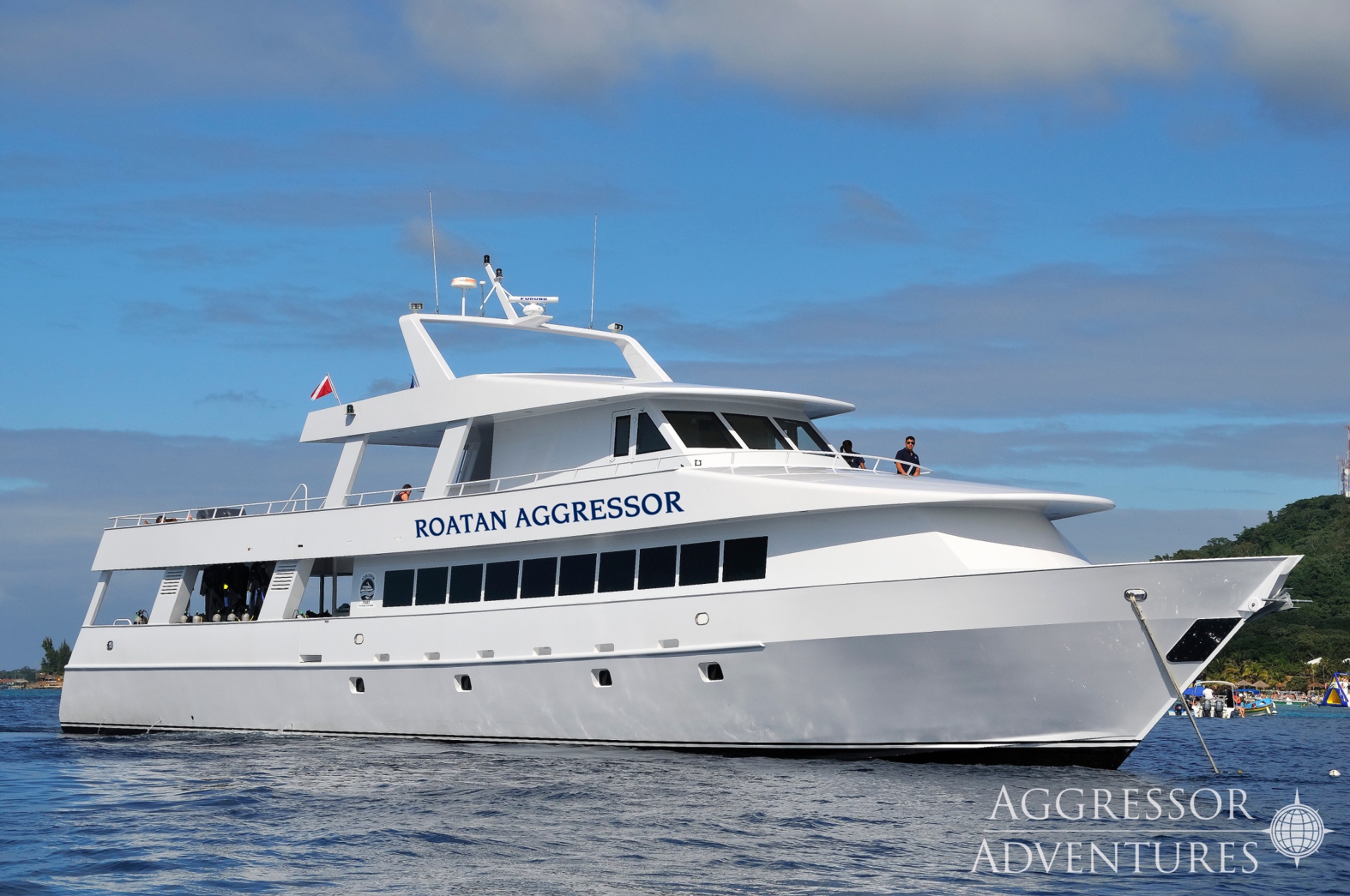 Roatan AggressorHonduras