Bluerides – Blue Rides - Tauchsafaris weltweit buchenOCEAN ADVENTURES
River CruisesRiversNature & WildlifeOur Promise
River CruisesRiversNature & WildlifeOur PromiseAnmelden

Flussreiseziele

  • Flussreiseziele
  • Amazonas
  • Donau
  • Rhein
  • Mekong
  • Nil

Schiffe & Abfahrten

  • Flusskreuzfahrt-Suche
  • Angebote

Natur & Tierwelt

  • Natur & Tierwelt

Reiseberatung

  • Unser Versprechen
  • Kontakt

Kontakt

Kontaktiere uns

Melde dich jederzeit, wir helfen dir gerne weiter, egal ob Reisewahl oder offene Frage.

E-MailSchreib uns, meist antworten wir binnen weniger Stunden.
kontakt@bluerides.com
WhatsAppSchreib uns per WhatsApp, Mo–Fr 10:00–16:00 Uhr (MEZ).
WhatsApp-Chat starten
TelefonRuf uns an, wir helfen dir gerne weiter.
Kostenlos anrufen, Mo–Fr 10–20 Uhr (MEZ).
Europa+49 800 1144 990USA+1 888 557 7735UK+44 800 707 4152Australien+61 2 8599 6113Kanada+1 888 557 7735
Which river journey is yours?Answer 8 quick questions and find the river cruise that fits you.
8 questions, 1 minute·Plus Gift
Sichere ZahlungsmethodenDeine Zahlungen sind vollständig geschützt durch AES-256-Verschlüsselung.
Unterstützt vonStripeWiseAMEXPayGoogle PaySEPABank
Impressum·AGB·Datenschutz·Über uns·Kontakt·Haftungsausschluss·Partnerprogramm·Cruise·
Besucht uns hier

© 2026 Blue Rides. Alle Rechte vorbehalten.·

Bluerides – Blue Rides - Tauchsafaris weltweit buchenOCEAN ADVENTURES
River CruisesRiversNature & WildlifeOur Promise
River CruisesRiversNature & WildlifeOur PromiseAnmelden
Agile Frog im Feuchtgebiet — Danube, Tierwelt auf Flusskreuzfahrten
Startseite›River Cruises›River Wildlife›Agile Frog

Agile FrogRana dalmatinaWo und wann du sie sehen kannst

Previous speciesAfrican SwamphenNext speciesAlpine Swift

Agile Frog at a glance

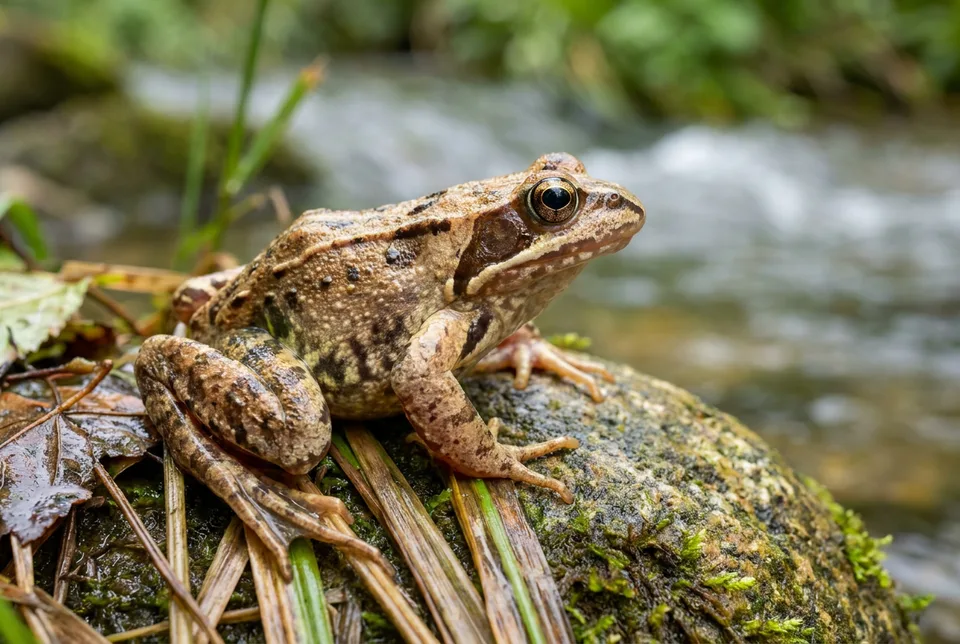
The Agile Frog is a slender brown frog associated with woodland and the standing waters used for reproduction. Its name reflects the powerful leaps that often reveal an otherwise well-camouflaged animal. Donau-Auen calls it the national park's most widespread amphibian and describes visitors noticing it just as it disappears into dense undergrowth. The registered River association is confined to the Austrian floodplains east of Vienna towards Hainburg, on the Vienna–Bratislava Danube reach. This is principally a shore-excursion species, not something to expect on open water beside a moving ship. Its life connects two environments: aquatic eggs and tadpoles develop in breeding waters, while the frog's terrestrial activity makes woodland structure important too. The clay-coloured upperparts blend with dead leaves, and a pale unspotted underside contrasts with the darker facial patch. Recognition depends on several anatomical features together, not simply on seeing a brown frog jump.

Behaviour & reproduction

Size
Species-specific body-length measurement not verified.
Weight
Species-specific weight not verified.
Lifespan
Species-specific lifespan not verified.
Status
See sourced assessment

Agile Frogs can remain unnoticed until a sudden leap carries them into vegetation. This escape behaviour explains why an observer may detect movement without obtaining enough detail for identification. Their reproductive activity is easier to interpret from a distance: Donau-Auen describes conspicuous spawn clumps in standing waters during early spring. Females attach the clumps to submerged branches or aquatic plants, and the masses may later float at the surface. The park reports that a female produces a clump containing around a thousand eggs, with many clutches sometimes present in favourable waters. Counting discrete spawn masses can therefore help researchers assess breeding populations. The account also describes algae living within the gelatinous egg capsules, close to developing embryos. These observations concern a natural breeding system, not an invitation to disturb it. Leave spawn attached, avoid entering breeding pools and allow terrestrial frogs to reach cover without pursuit.

Top wildlife locations

Flusslandschaft Danube — Lebensraum auf Flusskreuzfahrten

Danube

Austria: Donau-Auen east of Vienna towards Hainburg, on the Vienna–Bratislava reach; optional floodplain shore excursion, not evidence for other Danube ports.
Explore river cruises

Destinations describe the species' habitat, not guaranteed cruise stops. Some animals require an optional inland excursion or are found in restricted reserves.

Fun facts about the Agile Frog

  • Donau-Auen calls it the park's most widespread amphibian.
  • Its escape leaps can reveal an otherwise hidden frog.
  • The eardrum is an important identification feature.
  • The pale underside is described as unspotted.
  • Dark transverse bands occur on the hind legs.
  • Spawn clumps are attached to submerged plants or branches.
  • The park reports approximately one thousand eggs in a female's spawn clump.
  • Algae can occur within the gelatinous egg capsules.
  • Breeding-water habitat and terrestrial woodland both matter.

Best time to see the Agile Frog

Donau-Auen explicitly connects breeding and visible spawn clumps with early spring. That is useful local seasonal evidence, but it is not a numerical month range and is retained here in its original seasonal form. The registry also describes opportunities to encounter frogs from spring into autumn, usually as brief movements into cover. No retrieved original source established a complete local monthly occurrence calendar, so the location months remain empty. The best approach depends on the intended observation: breeding-water visits focus on spawn and aquatic activity, while later woodland walks may reveal terrestrial frogs. Water availability and the condition of individual pools can change what is visible between years. Ask the park guide about current breeding activity and permitted viewing points instead of using dates from another European population. A quiet walk after suitable weather can be informative, but frogs should never be flushed repeatedly simply because they are difficult to see.

Agile Frog: season matrix by destination

Highlighted months reflect the stated local evidence, not guaranteed encounters. Neutral months mean no verified monthly viewing window, not absence. Observation records and recommended viewing windows are distinct.

Danube

The national park explicitly describes early-spring spawning in standing water. It does not provide a verified numerical local observation calendar; later terrestrial encounters depend on conditions and cover.

JanFebMärAprMaiJunJulAugSepOktNovDez
Explore river cruises

Where the Agile Frog lives

In the registered Danube reach, the important habitat is the Donau-Auen floodplain mosaic rather than the main river channel alone. The park reports breeding in many kinds of standing water available during spring, including sites with submerged vegetation or branches to support spawn. Woodland and dense ground-level cover are equally relevant when looking for frogs away from the breeding water. A shaded leaf-litter margin can provide a very different environment from an exposed embankment only a short distance away. The species occurs broadly from France towards the Black Sea, according to the park account, while avoiding high Alpine areas. That distribution does not establish its presence at every cruise landing. For visitors, a permitted floodplain trail and a guide familiar with local pools are the useful combination. Protecting both the water and the surrounding terrestrial habitat matters because an amphibian's requirements cannot be met by conserving a pond in isolation.

What the Agile Frog eats

Agile Frogs are insect-eating predators during their terrestrial frog stage, taking small animals rather than grazing river plants. Their camouflage and rapid movement fit a life spent close to the ground, where suitable prey can be encountered among low vegetation and leaf litter. However, the original local account retrieved for this profile concentrates on identification and reproduction rather than providing a measured food study. A species-specific prey inventory, dietary percentages and a Donau-Auen seasonal feeding calendar were therefore not verified. It would be misleading to supply a detailed local menu from the feeding habits of other brown frogs. The distinction between life stages is important too: adult feeding ecology should not automatically be applied to aquatic tadpoles. For wildlife watching, there is no need to witness a feeding event to understand the animal's role as a small predator. Do not introduce insects, disturb litter or manipulate a frog into striking for a photograph.

Species at a glance

Common name
Agile Frog
Scientific name
Rana dalmatina
Animal group
Amphibians
Size
Species-specific body-length measurement not verified.
Weight
Species-specific weight not verified.
Lifespan
Species-specific lifespan not verified.
Status
Donau-Auen describes the species as endangered in Austria and protected through European instruments. A current formal global assessment was not verified.
Identification
Donau-Auen describes a slim, clay-coloured to medium-brown frog with relatively little dark marking across the back. Darker transverse bands on the hind legs can be conspicuous, while a dark facial patch extends from the eye towards the foreleg. The underside is whitish and lacks spots. The most useful distinguishing feature given by the park is the large eardrum: its diameter is approximately that of the eye, and the gap between eye and eardrum is less than half the eardrum's diameter. These are better criteria than colour alone, because several European frogs can look broadly brown. Long hind limbs and an energetic leap support the impression but should not replace a clear view of the head and other features. Avoid catching or stretching a frog to inspect its legs. A sharp lateral photograph, obtained without disturbance, is more appropriate for checking an identification with a local amphibian specialist.

Agile Frog: frequently asked questions

Where can I see the Agile Frog?
Danube. Walk slowly along an authorised floodplain path and watch the boundary between leaf litter and low plants. If a frog jumps, stop rather than following it into cover. Allow it to settle and use binoculars or a camera zoom from the path to look for diagnostic features. At breeding waters, observe spawn and activity from the bank without stepping into shallow margins, where eggs and small animals may be difficult to detect. Do not handle frogs or move spawn between pools; such actions can damage delicate stages and transport pathogens. Keep footwear and equipment clean when moving between wetland sites and follow any local biosecurity guidance. The registered location is Donau-Auen east of Vienna towards Hainburg, so a specialist shore visit is more relevant than scanning from a cruise deck. An uncertain brown-frog sighting should remain uncertain if the necessary identification features were not seen clearly.
When is the best time to see the Agile Frog?
Donau-Auen explicitly connects breeding and visible spawn clumps with early spring. That is useful local seasonal evidence, but it is not a numerical month range and is retained here in its original seasonal form. The registry also describes opportunities to encounter frogs from spring into autumn, usually as brief movements into cover. No retrieved original source established a complete local monthly occurrence calendar, so the location months remain empty. The best approach depends on the intended observation: breeding-water visits focus on spawn and aquatic activity, while later woodland walks may reveal terrestrial frogs. Water availability and the condition of individual pools can change what is visible between years. Ask the park guide about current breeding activity and permitted viewing points instead of using dates from another European population. A quiet walk after suitable weather can be informative, but frogs should never be flushed repeatedly simply because they are difficult to see.
How big does the Agile Frog get?
Species-specific body-length measurement not verified.. Adult weight: Species-specific weight not verified.. Size varies with age, sex and population.
How should I behave around the Agile Frog?
Walk slowly along an authorised floodplain path and watch the boundary between leaf litter and low plants. If a frog jumps, stop rather than following it into cover. Allow it to settle and use binoculars or a camera zoom from the path to look for diagnostic features. At breeding waters, observe spawn and activity from the bank without stepping into shallow margins, where eggs and small animals may be difficult to detect. Do not handle frogs or move spawn between pools; such actions can damage delicate stages and transport pathogens. Keep footwear and equipment clean when moving between wetland sites and follow any local biosecurity guidance. The registered location is Donau-Auen east of Vienna towards Hainburg, so a specialist shore visit is more relevant than scanning from a cruise deck. An uncertain brown-frog sighting should remain uncertain if the necessary identification features were not seen clearly.
What does the Agile Frog eat?
Agile Frogs are insect-eating predators during their terrestrial frog stage, taking small animals rather than grazing river plants. Their camouflage and rapid movement fit a life spent close to the ground, where suitable prey can be encountered among low vegetation and leaf litter. However, the original local account retrieved for this profile concentrates on identification and reproduction rather than providing a measured food study. A species-specific prey inventory, dietary percentages and a Donau-Auen seasonal feeding calendar were therefore not verified. It would be misleading to supply a detailed local menu from the feeding habits of other brown frogs. The distinction between life stages is important too: adult feeding ecology should not automatically be applied to aquatic tadpoles. For wildlife watching, there is no need to witness a feeding event to understand the animal's role as a small predator. Do not introduce insects, disturb litter or manipulate a frog into striking for a photograph.
Are wildlife sightings guaranteed on a river cruise?
No. Animals move freely and routes, weather, access restrictions and local conditions influence every outing. Confirm the actual itinerary and shore program before booking.

Compare wildlife in the same destinations

Explore other amphibians recorded in these destinations. Similar surroundings do not mean the animals share the same habits or viewing season.

Species comparison by animal group and destination
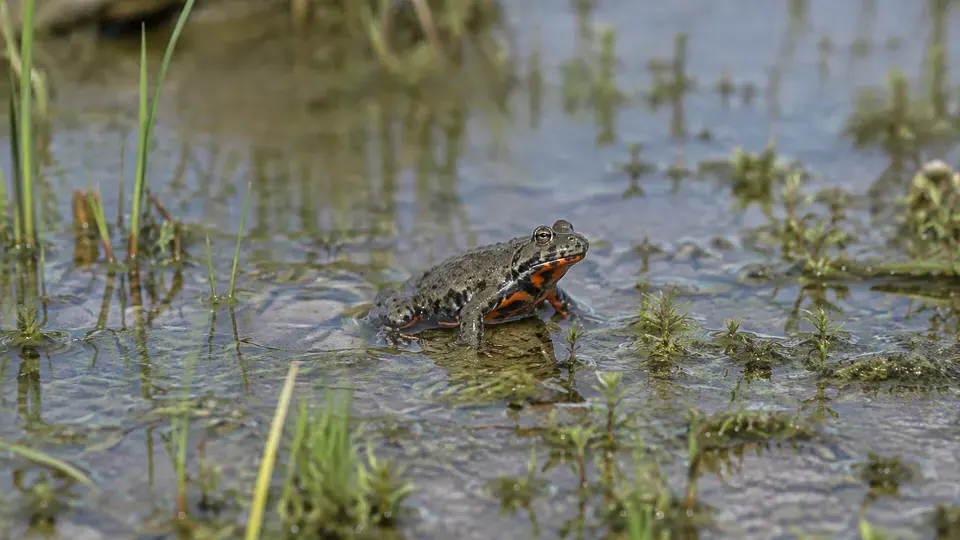
Agile Frog im Feuchtgebiet — Danube, Tierwelt auf FlusskreuzfahrtenAgile FrogEuropean fire-bellied toad im Feuchtgebiet — Danube, Tierwelt auf FlusskreuzfahrtenEuropean Fire-bellied Toad
Animal groupAmphibiansAnimal groupAmphibians
DestinationsDanubeDestinationsDanube
Scientific name
Rana dalmatina

Rana dalmatina

Scientific name
Size
Species-specific body-length measurement not verified.
Size
Weight
Species-specific weight not verified.
Weight
Lifespan
Species-specific lifespan not verified.
Lifespan
Status
See sourced assessment
Status
Identification
Donau-Auen describes a slim, clay-coloured to medium-brown frog with relatively little dark marking across the back.

Donau-Auen describes a slim, clay-coloured to medium-brown frog with relatively little dark marking across the back. Darker transverse bands on the hind legs can be conspicuous, while a dark facial patch extends from the eye towards the foreleg. The underside is whitish and lacks spots. The most useful distinguishing feature given by the park is the large eardrum: its diameter is approximately that of the eye, and the gap between eye and eardrum is less than half the eardrum's diameter. These are better criteria than colour alone, because several European frogs can look broadly brown. Long hind limbs and an energetic leap support the impression but should not replace a clear view of the head and other features. Avoid catching or stretching a frog to inspect its legs. A sharp lateral photograph, obtained without disturbance, is more appropriate for checking an identification with a local amphibian specialist.

Identification
Habitat
In the registered Danube reach, the important habitat is the Donau-Auen floodplain mosaic rather than the main river channel alone.

In the registered Danube reach, the important habitat is the Donau-Auen floodplain mosaic rather than the main river channel alone. The park reports breeding in many kinds of standing water available during spring, including sites with submerged vegetation or branches to support spawn. Woodland and dense ground-level cover are equally relevant when looking for frogs away from the breeding water. A shaded leaf-litter margin can provide a very different environment from an exposed embankment only a short distance away. The species occurs broadly from France towards the Black Sea, according to the park account, while avoiding high Alpine areas. That distribution does not establish its presence at every cruise landing. For visitors, a permitted floodplain trail and a guide familiar with local pools are the useful combination. Protecting both the water and the surrounding terrestrial habitat matters because an amphibian's requirements cannot be met by conserving a pond in isolation.

Habitat
Diet
Agile Frogs are insect-eating predators during their terrestrial frog stage, taking small animals rather than grazing river plants.

Agile Frogs are insect-eating predators during their terrestrial frog stage, taking small animals rather than grazing river plants. Their camouflage and rapid movement fit a life spent close to the ground, where suitable prey can be encountered among low vegetation and leaf litter. However, the original local account retrieved for this profile concentrates on identification and reproduction rather than providing a measured food study. A species-specific prey inventory, dietary percentages and a Donau-Auen seasonal feeding calendar were therefore not verified. It would be misleading to supply a detailed local menu from the feeding habits of other brown frogs. The distinction between life stages is important too: adult feeding ecology should not automatically be applied to aquatic tadpoles. For wildlife watching, there is no need to witness a feeding event to understand the animal's role as a small predator. Do not introduce insects, disturb litter or manipulate a frog into striking for a photograph.

Diet
Best season
Donau-Auen explicitly connects breeding and visible spawn clumps with early spring.

Donau-Auen explicitly connects breeding and visible spawn clumps with early spring. That is useful local seasonal evidence, but it is not a numerical month range and is retained here in its original seasonal form. The registry also describes opportunities to encounter frogs from spring into autumn, usually as brief movements into cover. No retrieved original source established a complete local monthly occurrence calendar, so the location months remain empty. The best approach depends on the intended observation: breeding-water visits focus on spawn and aquatic activity, while later woodland walks may reveal terrestrial frogs. Water availability and the condition of individual pools can change what is visible between years. Ask the park guide about current breeding activity and permitted viewing points instead of using dates from another European population. A quiet walk after suitable weather can be informative, but frogs should never be flushed repeatedly simply because they are difficult to see.

Best season
Season matrix by destination
DanubeNo verified monthly viewing evidence

The national park explicitly describes early-spring spawning in standing water. It does not provide a verified numerical local observation calendar; later terrestrial encounters depend on conditions and cover.

Season matrix by destination
Previous speciesAfrican SwamphenNext speciesAlpine Swift
All river wildlife
On this page
  • 01About
  • 02Behaviour & reproduction
  • 03Top wildlife locations
  • 04Fun facts
  • 05Best season
  • 06Season matrix by destination
  • 07Habitat
  • 08Diet
  • 09Species at a glance
  • 10Questions & answers
  • 11Compare

Find your river cruise

Plan deine Reise

Find your next river journey

Compare destinations, shore programs and dates with the animals and habitats you would love to see.

  • Daily shore excursions
  • Responsible wildlife watching
  • Boutique river ships
Explore river cruises