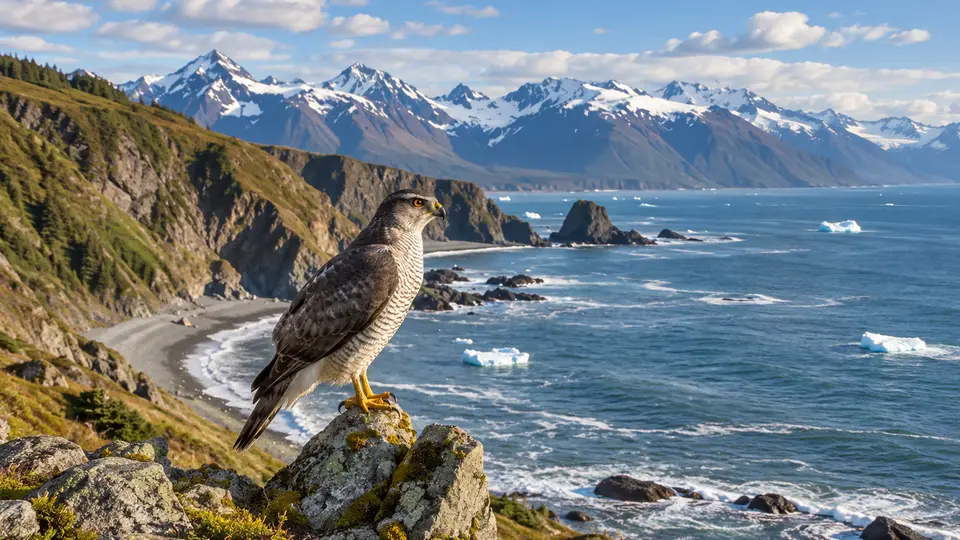
Northern Goshawk in its natural habitat, AI illustration

Northern GoshawkAstur atricapillusWhere and when to see them

Northern Goshawk at a glance

In Alaska, the bird historically catalogued as northern goshawk is now generally treated as the American goshawk, Astur atricapillus, separate from the Eurasian goshawk. This powerful forest hawk has broad wings, a long steering tail and a notably fierce expression. Females are substantially larger than males. Its presence can be difficult to detect despite its size, because much of its hunting and nesting takes place within extensive woodland rather than open coastal scenery.

Behaviour & reproduction

Size
46–61 cm long; 89–127 cm wingspan
Weight
0.6–1.4 kg
Lifespan
Not reliably established
Status
Least Concern

American goshawks typically hunt from concealed perches or make low searching flights through woodland, accelerating sharply when prey appears. They can weave between trunks and pursue quarry into more open ground. Breeding pairs defend territories, and adults may call repeatedly or swoop at intruders near an active nest. Outside the nesting period they are usually solitary and unobtrusive; northern birds sometimes move farther south when food becomes scarce. Courtship flights involving spectacular aerial displays can be observed in early spring, though rarely. They are known for their fierce defense of nests, a behavior that emphasizes the importance of respecting their space and leaving undisturbed.

Top wildlife locations

Alaska wildlife habitat

Alaska

Mature coastal forest and inland wooded valleys offer suitable habitat, but sightings are uncommon. A dedicated forest excursion is usually needed rather than beach watching; avoid approaching suspected nesting territories.
Destinations describe the species' habitat, not guaranteed cruise stops. Some animals require an optional inland excursion or are found in restricted reserves.

Fun facts about the Northern Goshawk

  • The former northern goshawk was split into American and Eurasian species by several major modern bird checklists.
  • Female American goshawks can be roughly half again as heavy as males.
  • A breeding territory may contain several alternate nest structures used in different years.
  • Their long tails act as steering surfaces during rapid turns through forest.

Best time to see the Northern Goshawk

Late spring and summer provide long daylight hours for forest excursions in Alaska, but dense foliage and secretive behaviour can limit views. Winter birds may be easier to notice in more open woodland. No season makes this scarce, wide-ranging raptor predictable. While generally elusive, spotting a goshawk during migration periods in spring and fall can offer a slightly increased chance of observation along forest corridors. Nesting season in spring can be a time of increased territorial activity, though viewing remains challenging.

Northern Goshawk: season matrix by destination

Travel and observation windows vary by region. Highlighted months are an orientation for planning, not confirmed sightings or a guarantee of access.

Alaska

This is a practical daylight and trail-access window for forest observation, not a guarantee of breeding activity or sightings; the species occurs year-round in parts of Alaska.

JanFebMarAprMayJunJulAugSepOctNovDec
Cruise ships in Alaska

Where the Northern Goshawk lives

In Alaska, goshawks occupy boreal and coastal forests, including mature spruce, hemlock, birch and mixed stands. Nesting usually requires substantial trees and suitable forest structure. Forest edges, openings and wooded valleys provide hunting opportunities, but exposed shores are not their main habitat. They show a preference for older growth forests with a mix of tree ages and densities, providing both cover and open understories. Access to water bodies like rivers or lakes can also be important for their prey base.

What the Northern Goshawk eats

Their diet includes medium-sized birds and mammals, with regional prey such as grouse, squirrels, snowshoe hares and other forest birds. Powerful feet and long talons secure prey. The balance between birds and mammals changes with habitat, season and local prey populations. In addition to snowshoe hares, grouse species like ruffed grouse and spruce grouse are common prey. They are highly agile hunters, capable of navigating dense forest with remarkable speed and precision.

Species at a glance

Common name
Northern Goshawk
Scientific name
Astur atricapillus
Animal group
Birds
Size
46–61 cm long; 89–127 cm wingspan
Weight
0.6–1.4 kg
Lifespan
Not reliably established
Status
Least Concern
Identification
The Alaskan American goshawk is larger and heavier than a Cooper's hawk, with a bold white eyebrow and finely barred gray adult underparts; Eurasian goshawks are very similar but geographically separate. Juvenile goshawks are browner overall with streaked underparts and a less distinct white eyebrow, making them distinguishable from adults. Their broad, rounded wings and relatively long tail are characteristic in flight.

Northern Goshawk: frequently asked questions

Where can I see the Northern Goshawk?
Alaska. Use public forest trails and scan woodland edges quietly. If a goshawk gives repeated alarm calls or swoops, retreat promptly along your approach route; do not search for its nest or use playback. Listen for their distinctive, sharp 'kek kek kek' call, which can sometimes alert you to their presence before you see them. Binoculars are essential for scanning forest canopies and identifying these well-camouflaged birds.
When is the best time to see the Northern Goshawk?
Late spring and summer provide long daylight hours for forest excursions in Alaska, but dense foliage and secretive behaviour can limit views. Winter birds may be easier to notice in more open woodland. No season makes this scarce, wide-ranging raptor predictable. While generally elusive, spotting a goshawk during migration periods in spring and fall can offer a slightly increased chance of observation along forest corridors. Nesting season in spring can be a time of increased territorial activity, though viewing remains challenging.
How big does the Northern Goshawk get?
46–61 cm long; 89–127 cm wingspan. Adult weight: 0.6–1.4 kg. Size varies with age, sex and population.
How should I behave around the Northern Goshawk?
Use public forest trails and scan woodland edges quietly. If a goshawk gives repeated alarm calls or swoops, retreat promptly along your approach route; do not search for its nest or use playback. Listen for their distinctive, sharp 'kek kek kek' call, which can sometimes alert you to their presence before you see them. Binoculars are essential for scanning forest canopies and identifying these well-camouflaged birds.
What does the Northern Goshawk eat?
Their diet includes medium-sized birds and mammals, with regional prey such as grouse, squirrels, snowshoe hares and other forest birds. Powerful feet and long talons secure prey. The balance between birds and mammals changes with habitat, season and local prey populations. In addition to snowshoe hares, grouse species like ruffed grouse and spruce grouse are common prey. They are highly agile hunters, capable of navigating dense forest with remarkable speed and precision.
Are wildlife sightings guaranteed on an adventure cruise?
No. Animals move freely and routes, weather, access restrictions and local conditions influence every outing. Confirm the actual itinerary and shore program before booking.

Compare wildlife in the same destinations

Explore other birds recorded in these destinations. Similar surroundings do not mean the animals share the same habits or viewing season.

Species comparison by animal group and destination
Northern GoshawkNorthern GoshawkArctic TernArctic TernBald EagleBald Eagle
Animal groupBirdsAnimal groupBirdsAnimal groupBirds
DestinationsAlaskaDestinationsAlaska, Norway, ArcticDestinationsAlaska, Florida, New England
All wildlife destinations
Plan your trip

Find your next wildlife adventure

Compare destinations, shore programs and dates with the animals and habitats you would love to see.

  • Naturalist-led shore excursions
  • Responsible wildlife watching
  • Small expedition ships

Newsletter

Take Blue Rides with you

Adventure cruise offers, last-minute deals and trip inspiration.

Free, unsubscribe anytime. Details: Privacy Policy

Partner with Blue Rides

Affiliate Program

Recommend adventure cruises and earn commission on every confirmed booking.

Share. Track. Earn.

Your footage, our stage

Send us your videos or pictures.

Captured remarkable nature or wildlife on your journey? Share it with us, we may feature it on Blue Rides.