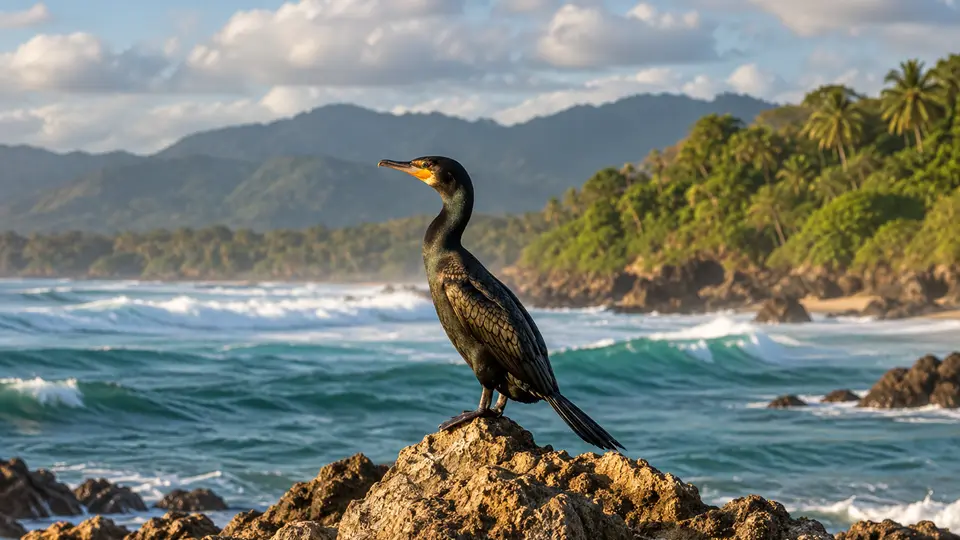
Neotropic Cormorant in its natural habitat

Neotropic CormorantNannopterum brasilianumWhere and when to see them

Neotropic Cormorant at a glance

The Neotropic cormorant is a slender, long-tailed waterbird distributed from the southern United States through much of Central and South America. In Costa Rica it occupies both freshwater and coastal wetlands, often appearing on exposed branches, posts or muddy banks. Adults look mostly black at a distance, with a small yellowish throat patch. Its ability to use rivers, reservoirs, estuaries and altered wetlands helps explain its exceptionally broad geographical range.

Behaviour & reproduction

Size
58-73 cm (23-29 in) body length
Weight
1.0-1.5 kg (2.2-3.3 lb)
Lifespan
Not reliably established
Status
Least Concern

These cormorants frequently gather at communal roosts and breed in colonies, sometimes alongside herons and other waterbirds. Individuals alternate bouts of fishing with resting on exposed perches, where they may spread their wings. They swim low in the water and propel themselves with their feet when pursuing prey. Flights between feeding and roosting areas often follow waterways, with loose lines or small groups crossing estuaries in the morning and late afternoon. These cormorants frequently gather at communal roosts and breed in colonies, sometimes alongside herons and other waterbirds. Individuals alternate bouts of fishing with resting on exposed perches, where they may spread their wings. They swim low in the water and propel themselves with their feet when pursuing prey. Flights between feeding and roosting areas often follow waterways, with loose lines or small groups crossing estuaries in the morning and late afternoon. Wing spreading helps dry their non-waterproof feathers and aids in thermoregulation. Their colonial nesting habit provides safety in numbers from potential predators.

Top wildlife locations

Costa Rica wildlife habitat

Costa Rica

Mangrove estuaries, coastal lagoons and river viewpoints offer plausible shore observation. Inland reservoirs provide additional opportunities but require an excursion; birds move among feeding sites, so no particular perch is dependable.
Destinations describe the species' habitat, not guaranteed cruise stops. Some animals require an optional inland excursion or are found in restricted reserves.

Fun facts about the Neotropic Cormorant

  • Its range extends from temperate North America to southern South America.
  • All four toes are connected by webbing.
  • Breeding adults may show fine white facial plumes.
  • It can nest in mixed colonies with herons and egrets.

Best time to see the Neotropic Cormorant

Observation is possible throughout the year in Costa Rica because the species is resident. December through April often gives visitors drier conditions on the Pacific side. Caribbean rainfall patterns differ, and local water levels may affect concentrations more than the national travel calendar. Observation is possible throughout the year in Costa Rica because the species is resident. December through April often gives visitors drier conditions on the Pacific side. Caribbean rainfall patterns differ, and local water levels may affect concentrations more than the national travel calendar. Population numbers remain relatively stable year-round, offering consistent viewing opportunities. Local movements within Costa Rica may occur in response to changing water levels or food availability.

Neotropic Cormorant: season matrix by destination

Travel and observation windows vary by region. Highlighted months are an orientation for planning, not confirmed sightings or a guarantee of access.

Costa Rica

This is a generally drier Pacific-side travel window, not a breeding season; resident birds can be observed in other months.

JanFebMarAprMayJunJulAugSepOctNovDec
Cruise ships in Costa Rica

Where the Neotropic Cormorant lives

Freshwater lakes, slow rivers, reservoirs, mangrove channels and sheltered coastal lagoons all support this adaptable species. It needs accessible fish and secure resting places rather than pristine habitat alone. Nesting usually occurs in trees or shrubs near productive water. Freshwater lakes, slow rivers, reservoirs, mangrove channels and sheltered coastal lagoons all support this adaptable species. It needs accessible fish and secure resting places rather than pristine habitat alone. Nesting usually occurs in trees or shrubs near productive water. This cormorant shows a strong preference for still or slow-moving water, avoiding areas with strong currents or heavy surf. They are often found in coastal lowlands but can also inhabit inland freshwater systems at moderate elevations.

What the Neotropic Cormorant eats

Small fish form the main diet, supplemented by crustaceans and other aquatic prey. Individuals pursue prey through the water and bring captured fish to the surface to swallow. The species can exploit shallow wetlands as well as larger rivers and lakes. Small fish form the main diet, supplemented by crustaceans and other aquatic prey. Individuals pursue prey through the water and bring captured fish to the surface to swallow. The species can exploit shallow wetlands as well as larger rivers and lakes. Their diverse diet and ability to forage in various aquatic environments contribute to their widespread distribution. Prey selection is opportunistic, based on availability in their chosen foraging grounds.

Species at a glance

Common name
Neotropic Cormorant
Scientific name
Nannopterum brasilianum
Animal group
Birds
Size
58-73 cm (23-29 in) body length
Weight
1.0-1.5 kg (2.2-3.3 lb)
Lifespan
Not reliably established
Status
Least Concern
Identification
Compared with double-crested cormorant, it is smaller and longer-tailed, with a more pointed throat patch often narrowly edged in white on breeding adults. Compared with double-crested cormorant, it is smaller and longer-tailed, with a more pointed throat patch often narrowly edged in white on breeding adults. The bill is relatively slender, and the plumage is entirely dark, exhibiting a greenish sheen in good light. Juveniles are typically browner overall, gradually acquiring the adult's darker plumage. Look for the small, distinctive yellow-orange gular patch which is often visible.

Neotropic Cormorant: frequently asked questions

Where can I see the Neotropic Cormorant?
Costa Rica. Watch from stable riverbanks, public wetland viewpoints or a deck without approaching roost trees. Keep away from crocodile habitat at the water's edge, and avoid flushing perched birds merely to photograph spread wings. Watch from stable riverbanks, public wetland viewpoints or a deck without approaching roost trees. Keep away from crocodile habitat at the water's edge, and avoid flushing perched birds merely to photograph spread wings. Binoculars are highly recommended to observe their distinctive features and behaviors without disturbance. From a boat, maintain a respectful distance, especially when birds are resting or in nesting colonies.
When is the best time to see the Neotropic Cormorant?
Observation is possible throughout the year in Costa Rica because the species is resident. December through April often gives visitors drier conditions on the Pacific side. Caribbean rainfall patterns differ, and local water levels may affect concentrations more than the national travel calendar. Observation is possible throughout the year in Costa Rica because the species is resident. December through April often gives visitors drier conditions on the Pacific side. Caribbean rainfall patterns differ, and local water levels may affect concentrations more than the national travel calendar. Population numbers remain relatively stable year-round, offering consistent viewing opportunities. Local movements within Costa Rica may occur in response to changing water levels or food availability.
How big does the Neotropic Cormorant get?
58-73 cm (23-29 in) body length. Adult weight: 1.0-1.5 kg (2.2-3.3 lb). Size varies with age, sex and population.
How should I behave around the Neotropic Cormorant?
Watch from stable riverbanks, public wetland viewpoints or a deck without approaching roost trees. Keep away from crocodile habitat at the water's edge, and avoid flushing perched birds merely to photograph spread wings. Watch from stable riverbanks, public wetland viewpoints or a deck without approaching roost trees. Keep away from crocodile habitat at the water's edge, and avoid flushing perched birds merely to photograph spread wings. Binoculars are highly recommended to observe their distinctive features and behaviors without disturbance. From a boat, maintain a respectful distance, especially when birds are resting or in nesting colonies.
What does the Neotropic Cormorant eat?
Small fish form the main diet, supplemented by crustaceans and other aquatic prey. Individuals pursue prey through the water and bring captured fish to the surface to swallow. The species can exploit shallow wetlands as well as larger rivers and lakes. Small fish form the main diet, supplemented by crustaceans and other aquatic prey. Individuals pursue prey through the water and bring captured fish to the surface to swallow. The species can exploit shallow wetlands as well as larger rivers and lakes. Their diverse diet and ability to forage in various aquatic environments contribute to their widespread distribution. Prey selection is opportunistic, based on availability in their chosen foraging grounds.
Are wildlife sightings guaranteed on an adventure cruise?
No. Animals move freely and routes, weather, access restrictions and local conditions influence every outing. Confirm the actual itinerary and shore program before booking.

Compare wildlife in the same destinations

Explore other birds recorded in these destinations. Similar surroundings do not mean the animals share the same habits or viewing season.

Species comparison by animal group and destination
Neotropic CormorantNeotropic CormorantBlack-mandibled ToucanBlack-mandibled ToucanBlue-footed BoobyBlue-footed Booby
Animal groupBirdsAnimal groupBirdsAnimal groupBirds
DestinationsCosta RicaDestinationsCosta RicaDestinationsCosta Rica, Galapagos, Mexico
Scientific nameNannopterum brasilianumScientific nameScientific name
All wildlife destinations
Plan your trip

Find your next wildlife adventure

Compare destinations, shore programs and dates with the animals and habitats you would love to see.

  • Naturalist-led shore excursions
  • Responsible wildlife watching
  • Small expedition ships