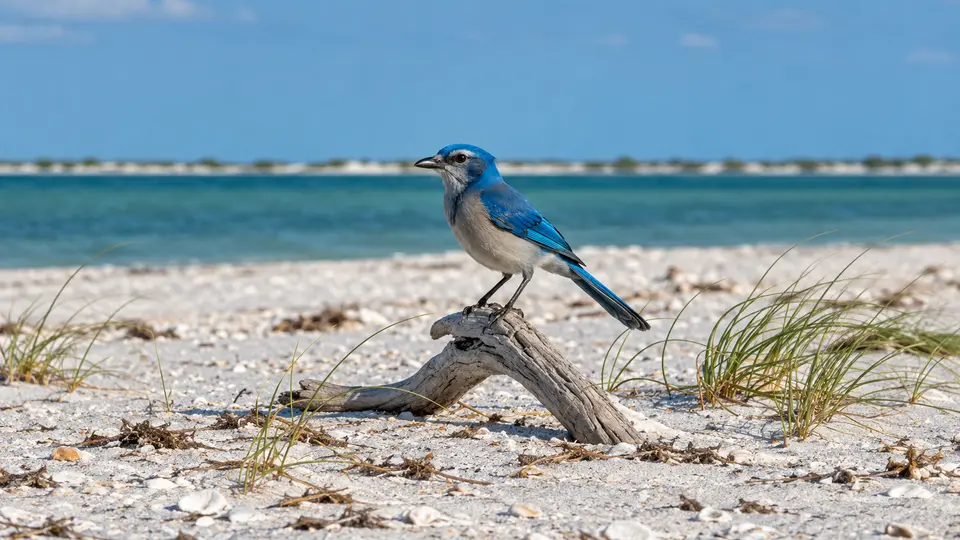
Florida Scrub Jay in its natural habitat, AI illustration

Florida Scrub JayAphelocoma coerulescensWhere and when to see them

Florida Scrub Jay at a glance

The Florida scrub jay is the only bird species found exclusively in Florida. Blue above and pale gray below, it inhabits low, open oak scrub maintained by periodic fire. Its dependence on this increasingly fragmented habitat makes it much more specialized than the familiar blue jay. Family groups often remain together for years, and the presence of nonbreeding helpers has made the species an important subject of research into cooperative breeding.

Behaviour & reproduction

Size
23–28 cm long
Weight
66–92 g
Lifespan
Not reliably established
Status
Vulnerable

A breeding pair usually occupies a year-round territory with offspring from earlier nesting seasons. These helpers watch for predators, defend boundaries and assist with feeding younger chicks. Birds move between low shrubs and open sand, frequently pausing on exposed perches to survey their surroundings. They cache acorns individually and retrieve them later. Although some individuals approach people readily, this apparent confidence does not mean feeding or close interaction is appropriate. Cooperative breeding is a defining characteristic, where up to six 'helpers' assist the breeding pair in raising young, increasing the chances of chick survival. These family groups maintain complex social structures and communication networks, using various calls to alert each other to predators or food sources. They demonstrate remarkable intelligence, including the ability to re-cache acorns when they suspect other jays have observed their original cache locations.

Top wildlife locations

Florida wildlife habitat

Florida

Public trails through managed coastal-ridge or inland oak scrub can offer viewing opportunities. Suitable habitat is localized, so a dedicated reserve visit may be necessary rather than an ordinary beach walk.
Destinations describe the species' habitat, not guaranteed cruise stops. Some animals require an optional inland excursion or are found in restricted reserves.

Fun facts about the Florida Scrub Jay

  • It is Florida's only endemic bird species.
  • Older offspring may help their parents raise subsequent broods.
  • Individuals bury thousands of acorns for later use.
  • Habitat restoration often depends on carefully managed prescribed fire.

Best time to see the Florida Scrub Jay

Resident family groups can be watched year-round where public trails cross occupied scrub. November through April usually offers more comfortable walking weather. Spring brings nesting activity and increased sensitivity to disturbance, while summer heat makes early-morning visits preferable for both people and birds. Prime viewing opportunities coincide with the cooler, drier months when the birds are most active foraging and less stressed by heat. Early mornings are consistently the most rewarding time for encounters, regardless of the season, due to higher bird activity. Fall and winter also offer a chance to witness their impressive acorn caching behavior.

Florida Scrub Jay: season matrix by destination

Travel and observation windows vary by region. Highlighted months are an orientation for planning, not confirmed sightings or a guarantee of access.

Florida

A year-round resident; cooler months improve walking comfort, while local habitat management and territory occupancy determine viewing prospects.

JanFebMarAprMayJunJulAugSepOctNovDec
Cruise ships in Florida

Where the Florida Scrub Jay lives

Suitable habitat consists of low-growing scrub oaks, sandy openings and limited tall-tree cover on well-drained soils. Both coastal and inland sand ridges can support territories. Without appropriate fire or equivalent management, scrub becomes too tall and shaded for the species. The specific scrub oak species that dominate their habitat include myrtle oak, sand live oak, and scrub oak, which are typically found on ancient dune systems. These isolated patches of habitat are often referred to as 'islands' within a sea of unsuitable vegetation or development, highlighting their fragmented nature. Florida scrub jays are endemic to Florida, meaning they are found nowhere else in the world, underscoring the importance of their unique habitat.

What the Florida Scrub Jay eats

Acorns are especially important in autumn and winter, when previously buried stores help sustain family groups. During warmer months, insects and other arthropods form a substantial part of the diet. Small vertebrates, berries and seeds are also taken opportunistically. Their strong, short bill is well-adapted for cracking acorns and probing into sandy soil for buried food. Cached acorns are critical not only for individual survival but also for contributing to the overall health and regeneration of their scrub habitat, as uneaten acorns can sprout. The jays demonstrate impressive spatial memory, often remembering the locations of hundreds of stored acorns over several months.

Species at a glance

Common name
Florida Scrub Jay
Scientific name
Aphelocoma coerulescens
Animal group
Birds
Size
23–28 cm long
Weight
66–92 g
Lifespan
Not reliably established
Status
Vulnerable
Identification
Unlike the blue jay, it lacks a crest and bold black-and-white wing markings, showing a gray back, blue head and pale forehead. Its overall plumage is a duller, more uniform blue than the vivid blue of the related blue jay, especially lacking the pronounced white wing patches. The underside is uniformly grayish-white, contrasting with the blue back and head. Juveniles have a brownish-gray head that gradually turns blue as they mature.

Florida Scrub Jay: frequently asked questions

Where can I see the Florida Scrub Jay?
Florida. Use designated scrub trails and watch perched birds without approaching nests. Never offer food or encourage birds onto hands; habituation can increase their exposure to roads, pets and unhealthy diets. Maintaining a respectful distance is crucial; utilize binoculars or a scope for close-up views to avoid disturbing their natural behaviors. Look for interpretive signs or park rangers in designated scrub areas who can often point out active territories or recent sightings. By staying on marked trails, visitors help protect the delicate scrub ecosystem and reduce disturbance to these ground-nesting birds.
When is the best time to see the Florida Scrub Jay?
Resident family groups can be watched year-round where public trails cross occupied scrub. November through April usually offers more comfortable walking weather. Spring brings nesting activity and increased sensitivity to disturbance, while summer heat makes early-morning visits preferable for both people and birds. Prime viewing opportunities coincide with the cooler, drier months when the birds are most active foraging and less stressed by heat. Early mornings are consistently the most rewarding time for encounters, regardless of the season, due to higher bird activity. Fall and winter also offer a chance to witness their impressive acorn caching behavior.
How big does the Florida Scrub Jay get?
23–28 cm long. Adult weight: 66–92 g. Size varies with age, sex and population.
How should I behave around the Florida Scrub Jay?
Use designated scrub trails and watch perched birds without approaching nests. Never offer food or encourage birds onto hands; habituation can increase their exposure to roads, pets and unhealthy diets. Maintaining a respectful distance is crucial; utilize binoculars or a scope for close-up views to avoid disturbing their natural behaviors. Look for interpretive signs or park rangers in designated scrub areas who can often point out active territories or recent sightings. By staying on marked trails, visitors help protect the delicate scrub ecosystem and reduce disturbance to these ground-nesting birds.
What does the Florida Scrub Jay eat?
Acorns are especially important in autumn and winter, when previously buried stores help sustain family groups. During warmer months, insects and other arthropods form a substantial part of the diet. Small vertebrates, berries and seeds are also taken opportunistically. Their strong, short bill is well-adapted for cracking acorns and probing into sandy soil for buried food. Cached acorns are critical not only for individual survival but also for contributing to the overall health and regeneration of their scrub habitat, as uneaten acorns can sprout. The jays demonstrate impressive spatial memory, often remembering the locations of hundreds of stored acorns over several months.
Are wildlife sightings guaranteed on an adventure cruise?
No. Animals move freely and routes, weather, access restrictions and local conditions influence every outing. Confirm the actual itinerary and shore program before booking.

Compare wildlife in the same destinations

Explore other birds recorded in these destinations. Similar surroundings do not mean the animals share the same habits or viewing season.

Species comparison by animal group and destination
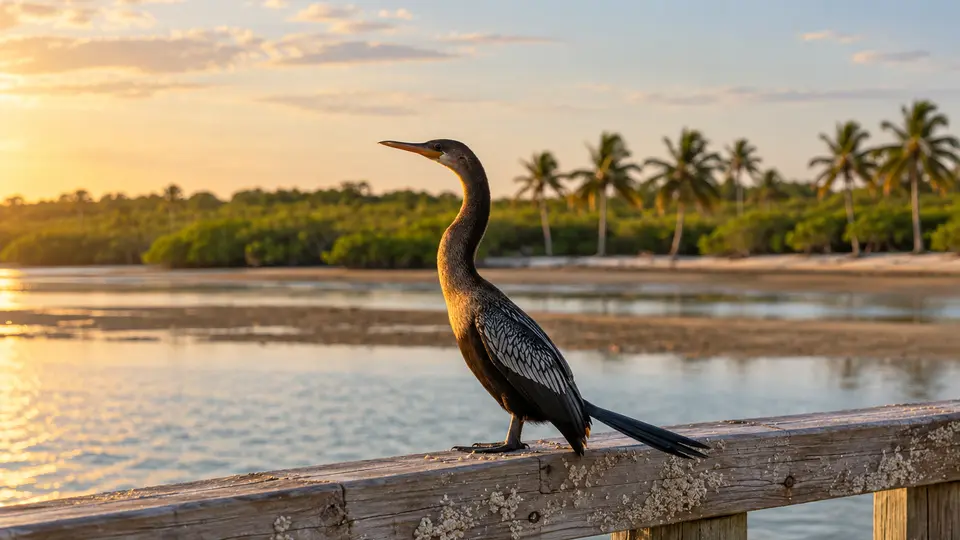
Florida Scrub JayFlorida Scrub JayAnhingaAnhingaBald EagleBald Eagle
Animal groupBirdsAnimal groupBirdsAnimal groupBirds
DestinationsFloridaDestinationsFloridaDestinationsAlaska, Florida, New England
All wildlife destinations
Plan your trip

Find your next wildlife adventure

Compare destinations, shore programs and dates with the animals and habitats you would love to see.

  • Naturalist-led shore excursions
  • Responsible wildlife watching
  • Small expedition ships

Newsletter

Take Blue Rides with you

Adventure cruise offers, last-minute deals and trip inspiration.

Free, unsubscribe anytime. Details: Privacy Policy

Partner with Blue Rides

Affiliate Program

Recommend adventure cruises and earn commission on every confirmed booking.

Share. Track. Earn.

Your footage, our stage

Send us your videos or pictures.

Captured remarkable nature or wildlife on your journey? Share it with us, we may feature it on Blue Rides.