What swimming with a manta ray is actually like
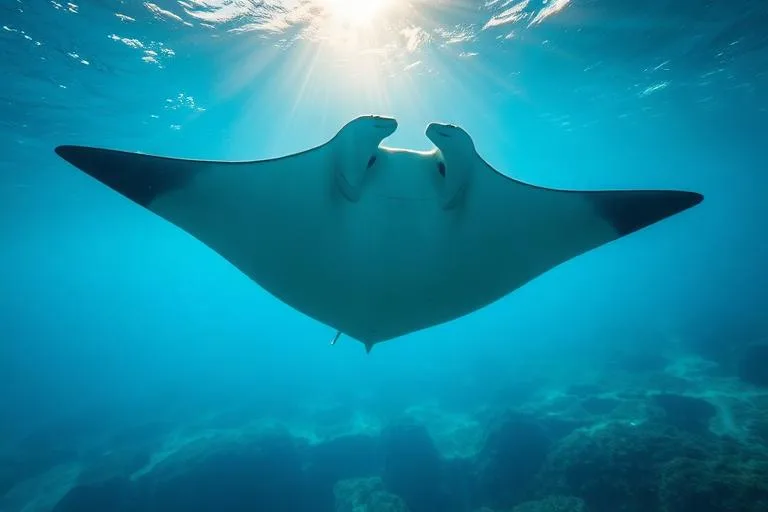
A manta encounter is nothing like a shark or whale encounter. Mantas are not fleeing you and they are not hunting anything you would recognise as prey — they are filtering plankton, or hanging above a coral outcrop while cleaner wrasse pick parasites from their gills. Both behaviours make them slow, predictable and unusually tolerant of people.The animal glides in from the blue, tilts one wing, and passes close enough that you see the individual spot pattern on its white belly — the fingerprint researchers use to identify every animal in a population. If you stay low, breathe calmly and do not swim at it, a curious reef manta will often loop back and repeat the pass a dozen times. Divers regularly log 30 to 45 minutes with the same animal at a good cleaning station.Nothing about it is dangerous. Manta rays have no barb, no sting and no teeth worth the name. The only real risk is human: a fin kick or a chasing snorkeller ends the encounter for everyone in the water.
Reef manta vs oceanic manta: how to tell them apart
There are two species, and knowing which one a destination offers tells you almost everything about the trip: how deep you dive, how long the encounter lasts, and how much it costs.Reef manta (Mobula alfredi) — 3 to 4.5 m wingspan, resident and predictable. Lives around reef systems and returns to the same cleaning stations for years. Shallow (5 to 20 m), so it works for snorkellers and beginner divers. Maldives, Nusa Penida, Komodo, Raja Ampat, Hawaii, Ningaloo, Tofo.Oceanic or giant manta (Mobula birostris) — 5 to 7 m wingspan, occasionally close to 8 m. Migratory, deeper, far rarer, and often actively interested in divers and their exhaled bubbles. Socorro, Isla de la Plata, Bahia de Banderas, occasional visitors in Raja Ampat and the Maldives.Quick ID underwater — reef mantas have shoulder markings that curve into a Y and a greyish mouth; oceanic mantas have straight, sharply cut shoulder patches forming a T and a black mouth. Oceanic mantas also carry a small vestigial nub at the tail base that reef mantas lack.Both species are listed as Vulnerable on the IUCN Red List and both are protected under CITES Appendix II, which is why every serious destination now runs a code of conduct rather than a free-for-all.
Where to swim with manta rays: the best places compared
DestinationSpeciesBest monthsSnorkel or diveTypical costMaldives — Baa Atoll / Hanifaru BayReef mantaMay–NovemberSnorkel only in Hanifaru, dive elsewhere$120–$250 per day, liveaboards from $200/nightIndonesia — Nusa PenidaReef mantaYear-round, peak April–OctoberBoth$70–$110 per two-dive day tripIndonesia — KomodoReef mantaYear-round, peak December–FebruaryBothLiveaboards from $250/nightIndonesia — Raja AmpatReef and oceanicOctober–AprilDiveLiveaboards from $350/nightMexico — SocorroOceanic mantaNovember–MayDive, liveaboard only$4,000–$6,500 per weekEcuador — Isla de la PlataOceanic manta, the largest on earthJune–OctoberDive, some snorkel$150–$220 per day tripHawaii — KonaReef mantaYear-roundNight dive or night snorkel$110–$180 per tripAustralia — NingalooReef mantaMay–NovemberSnorkel, some divesAUD 200–400 per dayMozambique — TofoReef mantaMay–SeptemberDive$60–$90 per two-tank diveIf you only ever do one manta trip, choose by species: the Maldives and Nusa Penida give you the highest chance of seeing any manta at all, while Socorro and Isla de la Plata give you the giants.
Maldives — Hanifaru Bay and the Baa Atoll manta season
Baa Atoll is the most reliable manta destination on earth. Between May and November the southwest monsoon pushes plankton-rich water into a dead-end bay called Hanifaru, and reef mantas arrive to feed in numbers found nowhere else — dozens to well over a hundred animals in a bay the size of a football pitch, sometimes chain-feeding nose to tail or barrel-rolling in dense cyclones.Hanifaru sits inside a UNESCO Biosphere Reserve. Scuba diving is banned, boat numbers are capped, and you snorkel in timed rotations with a ranger in the water. That rule is exactly why the aggregation still exists. Density is usually highest around the full and new moon of August and September, when tidal flow is strongest.Outside Hanifaru you can dive with mantas across the atolls all year — the animals simply switch sides with the monsoon: eastern atolls from May to November, western atolls from December to April. Cleaning stations at 10 to 18 m in Ari, Raa and Lhaviyani atolls mean a Maldives liveaboard almost always finds mantas somewhere in a week.
Indonesia — Nusa Penida, Komodo and Raja Ampat
Nusa Penida (Bali) is the cheapest near-certain manta dive in the world. Manta Point and Manta Bay are shallow cleaning and feeding sites at 5 to 15 m, reachable as a day trip from Sanur for well under $100. Sighting rates are high year-round, with the trade-off of cool water (20–24 °C during the August upwelling), swell and crowds.Komodo works the other way around: Karang Makassar and Manta Alley are drifts where reef mantas queue at cleaning stations over rubble fields. December to February is the peak, but mantas are resident all year. Most divers see it from a liveaboard because Komodo best sites are spread across strong-current channels.Raja Ampat adds the wildcard: Manta Sandy and Magic Mountain host reef mantas and, several times a season, genuine oceanic mantas. October to April is high season, and Magic Mountain is one of the few places on earth where both species use the same cleaning station.
Mexico — Socorro and the giant oceanic mantas
Socorro, in the Revillagigedo Archipelago some 400 km off Baja California, is the bucket-list manta trip. The mantas here are oceanic giants of 5 to 7 m and, unusually, they seek out divers. Individual animals return year after year, hover over a diver head to feel the exhaled bubbles on their belly, and stay with the group for entire dives.It is liveaboard-only: a 24 to 30 hour crossing from Cabo San Lucas, typically 8 nights, roughly $4,000 to $6,500 all-in. The season runs November to May, with January to April offering the best combination of manta activity, humpback song in the water and calmer crossings. Dives are blue-water pinnacles at 15 to 30 m, current is real, and operators expect Advanced certification with around 50 logged dives.Nowhere else combines mantas of this size with this level of voluntary interaction. If your goal is the single best manta encounter rather than the highest manta count, this is it.
Hawaii — the Kona manta night dive
The Kona manta night dive on Hawaii Big Island is the most accessible manta encounter anywhere, and it exists because of a human accident: hotel floodlights spilling onto the water drew plankton, plankton drew mantas, and a resident population of roughly 250 identified reef mantas now feeds there on most nights.Divers kneel on a sand patch at 10 to 12 m around a ring of upward-facing lights while snorkellers float above holding a lit board. The mantas barrel-roll through the plankton column, often passing centimetres from your mask. Trips run all year, cost $110 to $180, and need no more than an Open Water card — or none at all if you snorkel.The two sites are Manta Village at Keauhou and Manta Heaven at Garden Eel Cove near the airport. Do not touch, do not swim after them, and keep lights pointed up into the water column rather than at the animals.
Ecuador — Isla de la Plata, the biggest mantas on earth
Off Puerto Lopez, inside Machalilla National Park, sits the largest known aggregation of oceanic manta rays in the world — and the largest individuals ever measured, with wingspans approaching 8 m. Between June and October, when cool Humboldt water meets the warm Panama current, giant mantas gather at shallow cleaning stations at 12 to 20 m.This is a day-trip destination rather than a liveaboard one: an hour by boat from Puerto Lopez, $150 to $220 for a two-tank day, often combined with the humpback whales that breed in the same bay in exactly the same months. Visibility is moderate (8 to 20 m) and the water is 20 to 24 °C, so bring a 5 mm suit.It is the cheapest way in the world to dive with giant oceanic mantas, and still one of the least crowded.
Australia and Mozambique — Ningaloo and Tofo
Ningaloo Reef, Western Australia — reef mantas are resident year-round but peak from May to November, overlapping with whale sharks (March to July) and humpbacks (July to October). Encounters are mostly snorkel-based with spotter planes, tightly regulated, and cost AUD 200 to 400 per day out of Coral Bay or Exmouth.Tofo, Mozambique — a research hotspot rather than a resort destination. Reef mantas visit cleaning stations at Manta Reef and Giants Castle at 20 to 25 m, best in the cooler May to September window. Sightings have declined sharply from their 2000s peak because of regional gillnet fishing, so treat it as a good-value adventure rather than a guarantee. Two-tank dives cost only $60 to $90.
Cleaning stations vs feeding aggregations: how to time your encounter
Every manta site on earth is one of two things, and they behave completely differently.Cleaning stations — coral bommies where wrasse and butterflyfish service the mantas. Animals hover almost motionless for 20 to 60 minutes, usually in the morning when the queue forms. Best for divers and for photography, because you can settle on the sand nearby and simply wait. Nusa Penida, Komodo, Manta Sandy, Tofo.Feeding aggregations — plankton blooms driven by tide, current and moon. Mantas arrive in numbers, move constantly, and the window can be as short as an hour or two around the tide change. Best for snorkellers. Hanifaru Bay, the Kona night dive, Ningaloo.At feeding sites the moon matters: the strongest tidal exchange around full and new moon concentrates plankton and produces the biggest gatherings. At cleaning stations the time of day matters more than the calendar — book the first boat out.
Snorkelling or scuba: which gets you closer?
Counter-intuitively, snorkelling often wins. Mantas feeding at the surface ignore silent snorkellers, and the best feeding aggregations — Hanifaru, Ningaloo, Manta Bay — are legally or practically snorkel-only.Scuba wins at cleaning stations, where you need to stay put at 10 to 20 m for 40 minutes, and it is the only option at Socorro, Raja Ampat and Tofo. Bubbles do not scare mantas; at Socorro they attract them. What does scare them is a diver rising underneath an animal or finning towards it.Practical rule: if you want quantity and surface action, snorkel. If you want long, calm, eye-level passes and clean photographs, dive — and train to Advanced level first if you are heading anywhere with current.
Manta ray etiquette: the rules that keep encounters good
Never touch a manta. Their skin carries a protective mucus layer, and a single touch strips it and opens the animal to infection.Never swim at one or chase it. Stay still and let the manta choose the distance — this single behaviour produces the longest encounters.Stay out of the path. Approach from the side, never head-on, and never sit on top of a cleaning station.Do not dive or swim directly beneath a manta at a cleaning station. Rising bubbles push the animal off the station and the whole queue disperses.Keep at least 3 m distance, and 4 m from the tail, the figures used in the Maldives and Ningaloo codes of conduct.No flash within a few metres, and never aim night-dive lights at the eyes.Photograph the belly pattern and submit it to a citizen-science database such as Manta Trust IDtheManta or Manta Matcher. Your holiday photo becomes a data point.
What to pack for a manta trip
Exposure protection matched to the site — 3 mm shorty for the Maldives, 5 mm plus hood for the Nusa Penida August upwelling and for Ecuador, 5 mm for Socorro.Reef-safe sunscreen or a rash guard — oxybenzone-free is mandatory in Hawaii and expected everywhere else.Wide-angle camera setup — a 7 m animal will not fit in anything narrower. Ambient light beats strobes at 10 m; if you use strobes, pull them wide to avoid backscatter.Reef hook only where permitted — yes in Komodo and Raja Ampat, often no at Maldives cleaning stations.Seasickness tablets for the Socorro and Isla de la Plata crossings.A note of date, site and belly-pattern photo for citizen-science submission.
Month-by-month manta calendar
Are manta rays dangerous?
No. Manta rays have no stinging barb (unlike stingrays), no crushing teeth and no interest in anything larger than a shrimp. There is no record of a manta ray killing or seriously injuring a swimmer. A startled animal wing can knock a diver sideways, and that is the extent of it.The realistic risks on a manta trip are the ordinary ones: current at Komodo and Socorro, boat traffic at busy surface sites, sunburn and seasickness. Dive within your certification, carry a surface marker buoy and whistle on blue-water sites, and take dive insurance that covers chamber treatment for remote liveaboard destinations.
Choosing an ethical manta operator
Manta tourism is worth an estimated $140 million a year worldwide, which is why the animals are worth far more alive than in a fishery — and also why badly run tours proliferate. Ask these questions before booking:Do they brief a written code of conduct before every entry, including minimum distances and the no-touch rule?Do they cap group size (typically 8 to 12 people in the water per guide) and rotate groups instead of dumping everyone at once?Do they contribute sightings to Manta Trust, Manta Matcher or a local research project?Do they refuse to feed, bait or ride the animals, and stop guests who try?Do they use mooring lines instead of anchoring on the reef?Are they honest about sighting rates, or do they promise a guarantee no wild-animal operator can make?Blue Rides only lists liveaboards and operators that brief a manta code of conduct and work with local research programmes. Tell us the months you can travel and we will match you to the site where the mantas actually are.
在哪里遇见它们
最佳目的地推荐——行程、季节与潜点一览。
常见问题
Where is the best place to swim with manta rays?
For sheer numbers, Hanifaru Bay in the Maldives between May and November, where dozens to well over a hundred reef mantas feed at once. For the largest animals and the most interactive encounters, Socorro in Mexico from November to May. For the cheapest and most reliable, Nusa Penida in Bali or the Kona night dive in Hawaii, both of which work year-round.
Are manta rays dangerous to swim with?
No. Manta rays have no stinging barb, no dangerous teeth and no aggression towards humans, and there is no recorded case of a manta ray seriously injuring a swimmer. The only precautions are the usual diving ones: current, boat traffic and staying within your certification.
Can you swim with manta rays without scuba diving?
Yes. Some of the best manta sites in the world are snorkel-only, including Hanifaru Bay in the Maldives and most of Ningaloo Reef in Australia. Manta Bay in Nusa Penida and the Kona night snorkel in Hawaii also work perfectly without a dive certification.
What is the best month to see manta rays?
It depends on the destination: the Maldives peaks in August and September, Komodo from December to February, Socorro from January to April, Ecuador from July to September, and Hawaii is consistent all year. Feeding sites are strongest around full and new moon, when tidal flow concentrates plankton.
How much does it cost to swim with manta rays?
A day trip in Bali costs roughly $70 to $110, the Kona night dive $110 to $180, an Ecuador day trip $150 to $220, a Maldives liveaboard from about $200 per night, and a Socorro liveaboard $4,000 to $6,500 for eight nights including all diving.
How big do manta rays get?
Reef mantas reach 3 to 4.5 metres across. Oceanic or giant mantas typically reach 5 to 7 metres, and the population off Isla de la Plata in Ecuador includes individuals close to 8 metres, the largest rays on earth.
Why should you never touch a manta ray?
Their skin is coated in a protective mucus layer that blocks bacteria and parasites, and touching removes it and can cause infection. Touching also ends the encounter: mantas that are touched or chased abandon a cleaning station, often for the rest of the day.
Do you need to be a certified diver to see mantas?
Not at snorkel sites. For diving, Open Water is enough for shallow sites such as Kona and Nusa Penida, while Socorro, Komodo and Raja Ampat operators expect Advanced certification and around 50 logged dives because of depth and current.
What is the difference between a manta ray and a stingray?
Mantas are filter feeders that swim in open water, have no functional sting and reach several metres across. Stingrays are bottom-dwelling, feed on molluscs and crustaceans, and carry a venomous barb at the base of the tail. They are related but not interchangeable.
Are manta rays endangered?
Both species are listed as Vulnerable by the IUCN and protected under CITES Appendix II. The main threats are targeted fishing for gill plates and accidental capture in gillnets. Well-managed manta tourism is one of the strongest arguments for protecting them, because a living manta generates far more income over its lifetime than it ever would as a catch.
相关搜索
与本指南相关的热门搜索