Whale Shark
Rhincodon typus
About Whale Shark
Largest fish in the ocean
Quick Facts
- Habitat: The whale shark, *Rhincodon typus*, is a **pelagic species** found in all tropical and warm-temperate oceans, preferring waters between 21 and 25 degrees Celsius. These gentle giants are typically observed in surface waters, both offshore and near coasts, particularly in areas rich with plankton blooms. Key global hotspots for encounters include the **Yucatan Peninsula** off Mexico (especially around **Isla Mujeres**), the **Philippines** (notably **Donsol** and **Oslob**, though responsible tourism varies greatly between these sites), **Indonesia** (around **Cenderawasih Bay** in West Papua and **Komodo National Park**), **Australia** (specifically **Ningaloo Reef** in Western Australia), the **Galapagos Islands** of Ecuador, and the **Maldives**. While widely distributed, their specific presence in these locations is often **seasonal and migratory**, following predictable patterns tied to food availability. They frequently visit productive coastal shelves and **atoll lagoons**, demonstrating a preference for areas where upwelling or river outflows create nutrient-rich environments, which in turn support the vibrant planktonic communities upon which they feed. Acoustic tagging studies have revealed they undertake **long-distance migrations** across entire ocean basins, often converging in these well-known feeding grounds to take advantage of seasonal bounty.
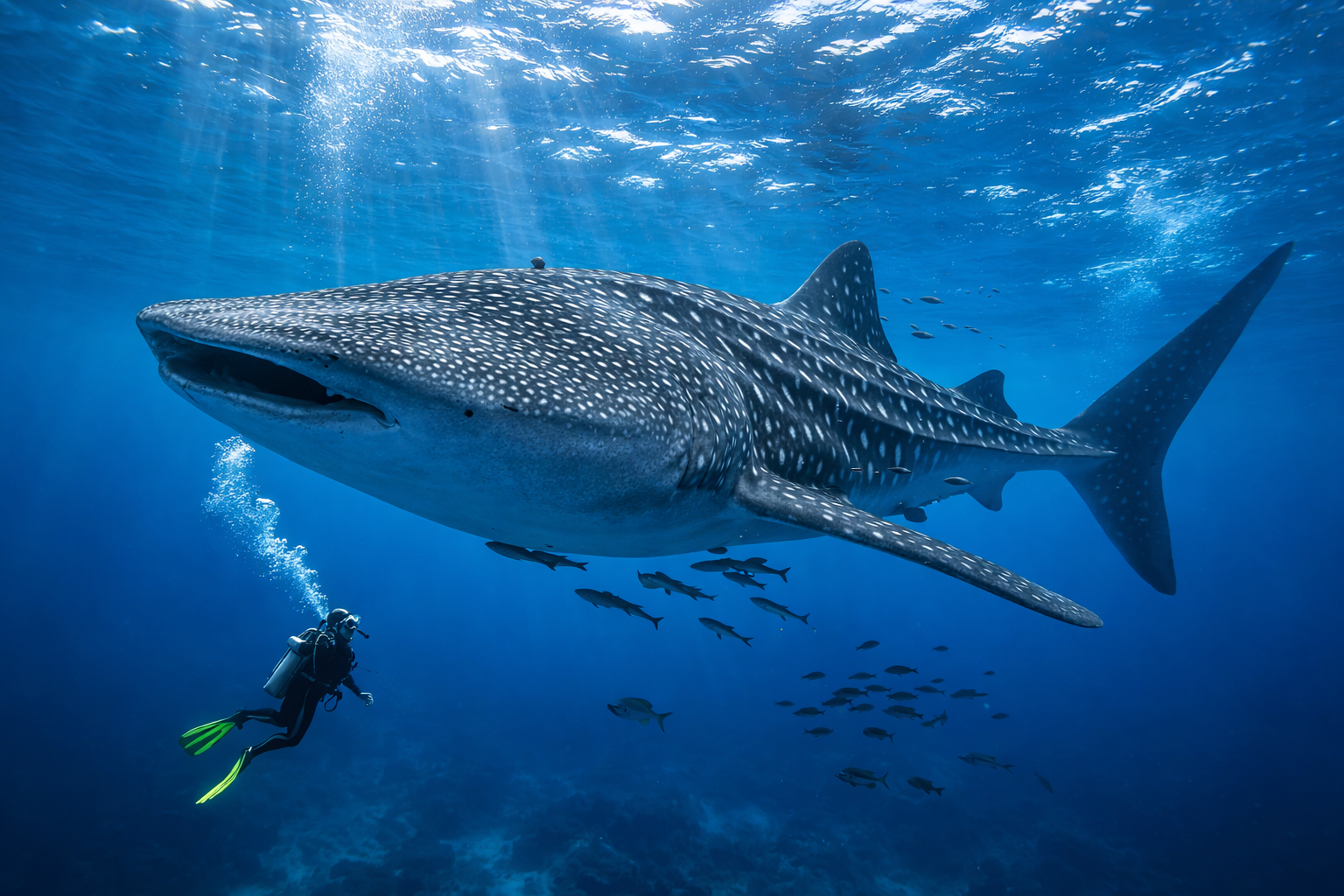
- Diet: Whale sharks are **filter feeders**, consuming a diet almost entirely composed of microscopic plankton, small crustaceans, and tiny fish. Their feeding strategy involves swimming with their **enormous mouths agape**, filtering vast quantities of water through specialized gill rakers. These **gill rakers** act like a sieve, trapping prey while allowing water to pass back out through the gills. They employ two primary methods: **ram filtration**, where they swim forward to force water into their mouths, and **active suction feeding**, where they can rapidly open and close their mouths to actively suck in water and prey, particularly useful when targeting dense patches of food. Their diet includes copepods, krill, fish eggs, and the larvae of crabs and jellyfish. Occasionally, they will also consume small schooling fish like anchovies or sardines, particularly when these are found in dense swarms. Despite their immense size, they pose no threat to humans, as their feeding mechanism is exclusively adapted for **planktonic and small nektonic organisms**. Divers can sometimes observe them feeding near the surface, an incredible and **unforgettable spectacle**.
- Best season: Encounters with whale sharks are highly seasonal and location-dependent, tracing their migrations to rich feeding grounds. In **Mexico**, particularly off **Isla Mujeres** on the Yucatan Peninsula, the peak season for sightings is generally from **May to September**, with **July and August** offering the most consistent encounters due to the massive aggregation of whale sharks feeding on fish eggs. For **Australia's Ningaloo Reef**, the prime season aligns with the coral spawning event, typically running from **March to July**. In the **Philippines**, **Donsol** sees whale sharks from **December to May**, while **Oslob** has a controversial year-round presence due to provisioning. The **Maldives** offers fairly consistent sightings in specific atolls throughout the year, but the **South Ari Atoll** often has better encounters during the **southwest monsoon** from **May to December**, and the **northwest monsoon** from **December to April** in others. The **Galapagos Islands** observe peak numbers from **June to November**, particularly large females. In **Indonesia**, **Cenderawasih Bay** provides more consistent, almost **year-round sightings**, often around local fishing platforms, whereas **Komodo** might see them more reliably from **November to April**. Always verify current local conditions and predictions, as **climatic fluctuations** can subtly shift these timings.
Fun Facts
Whale sharks have over 3,000 tiny teeth, but they're filter feeders,Each whale shark has a unique pattern of spots like a fingerprint,They can live for over 100 years,Females can carry up to 300 embryos at different stages of development
Diving Tips
Encountering a whale shark is a **privilege**, and responsible diver behavior is paramount for their protection and to ensure future sightings. Always maintain a **respectful distance** of at least **3-4 meters** from the body and **5 meters** from the tail to avoid startling them or interfering with their natural behavior. Never touch, ride, or attempt to feed a whale shark; **interaction should be passive**. Bright flash photography should be avoided, and divers should avoid blocking their path or forming a complete circle around them, allowing them **ample space to move freely**. When swimming with them, divers should move slowly and calmly, avoiding sudden movements. If a whale shark approaches you, remain still and let it pass; they are curious but usually unbothered by passive observers. Many destinations have **strict regulations** regarding whale shark interactions, often enforced by local guides and marine parks; **always adhere** to these guidelines, which may include limits on observer numbers and duration. Look for cues like surface feeding activity, identifiable by the presence of seabirds or other marine life congregating near the surface. Observe their movement patterns; they typically swim slowly near the surface, often with their mouths open. Ensure your buoyancy control is excellent to **avoid disturbing the substrate** or kicking the animal. Always choose **responsible tour operators** who prioritize the well-being of the whale sharks and adhere to established ethical codes. Non-compliance can lead to **penalties** and, more importantly, **harm to these magnificent creatures**.