Mimic Octopus
Thaumoctopus mimicus
About Mimic Octopus
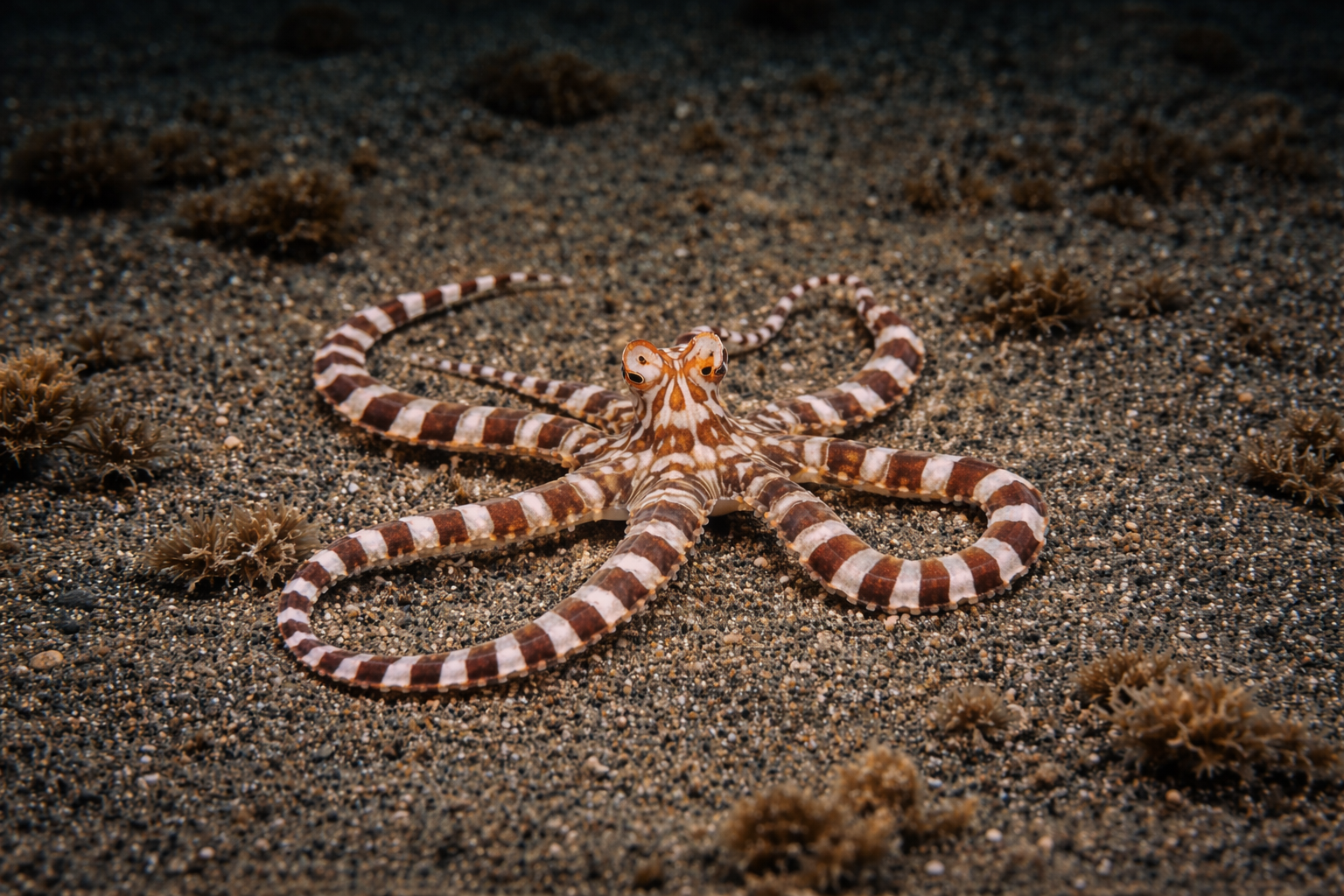
A remarkable species that can impersonate the appearance and behavior of more than 15 different marine animals including lionfish, flatfish, and sea snakes. Found on sandy and muck-diving sites in the Indo-Pacific.
Quick Facts
- Habitat: The mimic octopus, *Thaumoctopus mimicus*, thrives in the warm, shallow waters of the **Indo-Pacific**, predominantly in tropical regions with **silty or muddy seafloors**. Unlike many octopus species that prefer rocky reefs, this master of disguise is frequently found on substrate often considered 'muck' by divers, which it utilizes for camouflage and hunting. Specific dive locations where it's regularly sighted include the waters off **Indonesia**, particularly in **Lembeh Strait, Sulawesi**, and around **Anilao in the Philippines**. It also inhabits coastal areas of **Papua New Guinea**, **Malaysia (especially Sabah)**, and parts of **Australia's Great Barrier Reef** in shallower, protected bays. These octopuses favor areas with **sheltered, nutrient-rich currents** that support a diverse benthic community, providing both prey and opportunities for mimicry. They are typically found in depths ranging from a few meters down to about 30 meters, often near estuaries or river mouths where sediment runoff creates their preferred habitat. Their range is extensive across the Coral Triangle, a global center of marine biodiversity. Divers should look for them on **flat, open expanses of sand or silt**, often near seagrass beds or rubble patches, where their unique behavioral adaptations are put to the best use. These 'muck diving' environments are key to understanding their survival strategies.
- Diet: The mimic octopus is a **dexterous and opportunistic predator**, feeding primarily on **small fish, crabs, and shrimp**. Its hunting strategy is remarkably sophisticated, relying heavily on its **chameleon-like camouflage abilities** and complex mimicry. Instead of ambushing from a fixed den, the mimic octopus actively forages across the seafloor, often employing its mimicry to approach unsuspecting prey. For instance, it may pose as a venomous lionfish or a banded sea snake, deterring potential predators while simultaneously luring in curious or unwary prey. Once within striking distance, it uses its **powerful suckers and beak** to subdue and consume its catch. They are particularly effective at hunting small, bottom-dwelling fish and crustaceans that frequent their silty habitats. Their diet also includes other small invertebrates that can be found buried in the sand or moving along the substrate. The mimic octopus's intelligence allows it to adapt its hunting techniques based on the available prey and the specific conditions of its environment, making it a highly efficient and successful hunter in its niche.
- Best season: Encounters with the mimic octopus are generally good year-round in its primary habitats, but certain seasons offer **peak visibility and calmer conditions**. In **Indonesia's Lembeh Strait**, often considered a hotspot for mimic octopus sightings, the **dry season from April to October** is particularly favored by divers. During this period, the weather is typically more stable, and the underwater visibility is at its best, though the silty environment means visibility is rarely crystal clear. Similarly, in the **Philippines**, especially around **Anilao**, the months of **November to May** offer excellent diving conditions, with less rain and calmer seas enhancing the chances of spotting these elusive creatures. The **Australian wet season (December to March)** can bring lower visibility to coastal areas, making the **shoulder seasons (October-November and April-May)** potentially better for encounters, although they can be seen throughout the year. For Papua New Guinea and Malaysia, the **period from May to November** generally offers the most favorable diving conditions. While mimic octopuses don't have a strict breeding season that dictates their visibility, prolonged periods of good weather and calm waters make for more comfortable and productive muck dives, increasing the likelihood of observing their fascinating behaviors. Their cryptic nature means that regardless of the season, a keen eye and patient approach are always essential.
Fun Facts
They can mimic over 15 different species,When mimicking a lionfish, they spread their arms to resemble venomous spines,They were only scientifically described in 2005,Unlike most octopuses, the mimic actively performs dynamic impersonations
Diving Tips
Encountering a mimic octopus is a highlight for many divers, requiring **patience and a keen eye**. When diving in habitats known for them, such as **Lembeh Strait** or **Anilao**, move **slowly and deliberately** over the silty or sandy bottom. Look for subtle movements or unusual shapes on the substrate. Mimic octopuses blend in incredibly well, so pay attention to areas near **rubble, discarded debris, or seagrass patches**. When you spot one, maintain a **respectful distance** to avoid startling it. These animals are highly sensitive to disturbances and may retreat into the sand or cease their mimicry. Keep your movements minimal and non-threatening. Avoid chasing or cornering the octopus; allow it to move freely. **Never touch or harass** any marine life, especially an octopus, as this can cause undo stress, disrupt natural behaviors, and potentially lead to defensive reactions. Use a **long lens for photography** to capture their intricate details without encroaching on their space. Observe its behavior carefully; it might be mimicing a lionfish (spreading its arms) or a sea snake (hiding six arms in the sand and waving two). These behaviors are fleeting and best observed from a distance. Be mindful of your fins to avoid stirring up the fine silt, as this can reduce visibility for both you and others and disturb the octopus's hunting or camouflage strategy. Always dive with a reputable guide who is familiar with local regulations and ethical interactions. Remember, we are guests in their underwater world, and our actions should reflect **conservation and respect for marine ecosystems**.