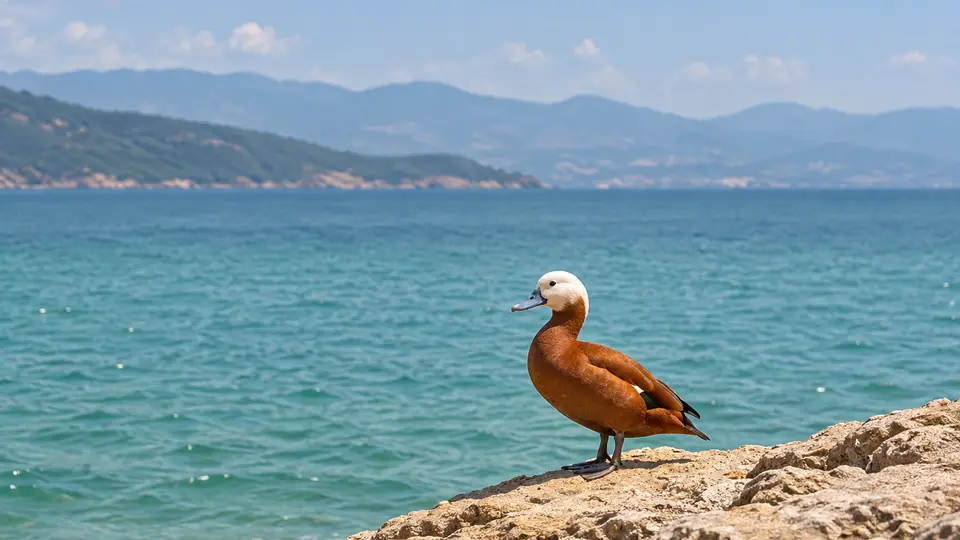
White-headed Duck in its natural habitat, AI illustration

White-headed DuckOxyura leucocephalaWhere and when to see them

White-headed Duck at a glance

The white-headed duck is a distinctive stiff-tailed waterbird of wetlands across a fragmented Eurasian and North African range. Breeding males have a white head with a dark crown and a swollen-looking blue bill. Turkey supports important populations, particularly at inland wetlands. Drainage, deteriorating water quality, hunting and hybridization with introduced ruddy ducks have contributed to conservation concern. This is primarily a lake bird, not a species to expect routinely along open marine shores.

Behaviour & reproduction

Size
43-48 cm long
Weight
500-900 g
Lifespan
Not reliably established
Status
Endangered

White-headed ducks swim low in the water, often holding their stiff tail upward. They obtain much of their food below the surface and can remain inconspicuous among wetland vegetation. Males perform elaborate postures and displays during courtship, while females conceal nests within emergent plants. Outside breeding, birds may concentrate on favored lakes in flocks. Water depth, salinity and seasonal freezing can influence movements between breeding and wintering wetlands. White-headed ducks are known for their deep diving capabilities, often remaining submerged for extended periods while foraging. During non-breeding seasons, they are relatively social, forming rafts that can include hundreds of individuals on favored lakes.

Top wildlife locations

Turkey wildlife habitat

Turkey

An inland excursion to suitable lakes is normally required; open coastal beaches are not representative habitat. Observe from legal lakeshore viewpoints, as reedbeds, protected wetlands and some access routes may be restricted.
Destinations describe the species' habitat, not guaranteed cruise stops. Some animals require an optional inland excursion or are found in restricted reserves.

Fun facts about the White-headed Duck

  • It belongs to the stiff-tailed duck group.
  • The male's bill becomes bright blue during the breeding period.
  • Hybridization with introduced ruddy ducks is a major conservation issue.
  • Wintering flocks can use saline lakes that differ markedly from vegetated breeding wetlands.

Best time to see the White-headed Duck

Autumn and winter can be useful for viewing concentrations on Turkish inland lakes, broadly November through March. Spring and summer involve more dispersed breeding birds at suitable wetlands. Lake conditions change between years, so current counts and legal access information are more useful than fixed promises. The arrival of wintering birds from more northerly breeding grounds, such as Central Asia, can augment local populations in Turkey. Optimal viewing conditions often coincide with periods of calm weather that allow for clear observation across large water bodies.

White-headed Duck: season matrix by destination

Travel and observation windows vary by region. Highlighted months are an orientation for planning, not confirmed sightings or a guarantee of access.

Turkey

This is a plausible winter wetland-viewing window, not a guarantee at any lake; water levels, weather and annual distribution can shift substantially.

JanFebMarAprMayJunJulAugSepOctNovDec
Cruise ships in Turkey

Where the White-headed Duck lives

Breeding habitat typically combines shallow open water with dense emergent vegetation, particularly in productive freshwater or mildly brackish lakes. Wintering birds may use larger, more open saline lakes. In Turkey, suitable sites are predominantly inland and can be sensitive to changing water levels. The species shows a preference for deeper sections of shallow lakes, often where dense submerged vegetation provides cover. Many significant White-headed Duck breeding and wintering sites in Turkey are protected Ramsar sites or Special Environmental Protection Areas.

What the White-headed Duck eats

Aquatic invertebrates, especially chironomid larvae, are important foods, together with seeds and other aquatic plant material. Ducks forage through soft bottom sediments to obtain concealed items. Wetland productivity and sediment conditions therefore matter as much as the visible extent of open water. Ducklings initially feed on small invertebrates and zooplankton, gradually incorporating plant material as they mature. This species can consume significant quantities of submerged aquatic plants, especially charophytes, which form extensive underwater meadows.

Species at a glance

Common name
White-headed Duck
Scientific name
Oxyura leucocephala
Animal group
Birds
Size
43-48 cm long
Weight
500-900 g
Lifespan
Not reliably established
Status
Endangered
Identification
A breeding male has a swollen blue bill and white head with a dark crown, unlike the ruddy duck's black cap, white cheek patch and less swollen bill. Females and juveniles have a duller white face with a darker line or smudgy markings across the cheek. Their bill is greyish rather than blue, and less swollen than the breeding male's.

White-headed Duck: frequently asked questions

Where can I see the White-headed Duck?
Turkey. Use a telescope from authorized lake viewpoints and remain outside reedbeds. Avoid flushing resting flocks or approaching concealed nests; this endangered duck benefits from quiet observation, especially during cold weather when disturbance wastes energy. Scanning the edges of reedbeds and areas with submerged vegetation using optics can reveal feeding or resting birds. Early morning and late afternoon are generally the most productive times for observing active birds.
When is the best time to see the White-headed Duck?
Autumn and winter can be useful for viewing concentrations on Turkish inland lakes, broadly November through March. Spring and summer involve more dispersed breeding birds at suitable wetlands. Lake conditions change between years, so current counts and legal access information are more useful than fixed promises. The arrival of wintering birds from more northerly breeding grounds, such as Central Asia, can augment local populations in Turkey. Optimal viewing conditions often coincide with periods of calm weather that allow for clear observation across large water bodies.
How big does the White-headed Duck get?
43-48 cm long. Adult weight: 500-900 g. Size varies with age, sex and population.
How should I behave around the White-headed Duck?
Use a telescope from authorized lake viewpoints and remain outside reedbeds. Avoid flushing resting flocks or approaching concealed nests; this endangered duck benefits from quiet observation, especially during cold weather when disturbance wastes energy. Scanning the edges of reedbeds and areas with submerged vegetation using optics can reveal feeding or resting birds. Early morning and late afternoon are generally the most productive times for observing active birds.
What does the White-headed Duck eat?
Aquatic invertebrates, especially chironomid larvae, are important foods, together with seeds and other aquatic plant material. Ducks forage through soft bottom sediments to obtain concealed items. Wetland productivity and sediment conditions therefore matter as much as the visible extent of open water. Ducklings initially feed on small invertebrates and zooplankton, gradually incorporating plant material as they mature. This species can consume significant quantities of submerged aquatic plants, especially charophytes, which form extensive underwater meadows.
Are wildlife sightings guaranteed on an adventure cruise?
No. Animals move freely and routes, weather, access restrictions and local conditions influence every outing. Confirm the actual itinerary and shore program before booking.

Compare wildlife in the same destinations

Explore other birds recorded in these destinations. Similar surroundings do not mean the animals share the same habits or viewing season.

Species comparison by animal group and destination
White-headed DuckWhite-headed DuckAudouin's GullAudouin's GullBlack StorkBlack Stork
Animal groupBirdsAnimal groupBirdsAnimal groupBirds
DestinationsTurkeyDestinationsCroatia, Greece, Portugal, TurkeyDestinationsPortugal, Turkey
All wildlife destinations
Plan your trip

Find your next wildlife adventure

Compare destinations, shore programs and dates with the animals and habitats you would love to see.

  • Naturalist-led shore excursions
  • Responsible wildlife watching
  • Small expedition ships

Newsletter

Take Blue Rides with you

Adventure cruise offers, last-minute deals and trip inspiration.

Free, unsubscribe anytime. Details: Privacy Policy

Partner with Blue Rides

Affiliate Program

Recommend adventure cruises and earn commission on every confirmed booking.

Share. Track. Earn.

Your footage, our stage

Send us your videos or pictures.

Captured remarkable nature or wildlife on your journey? Share it with us, we may feature it on Blue Rides.