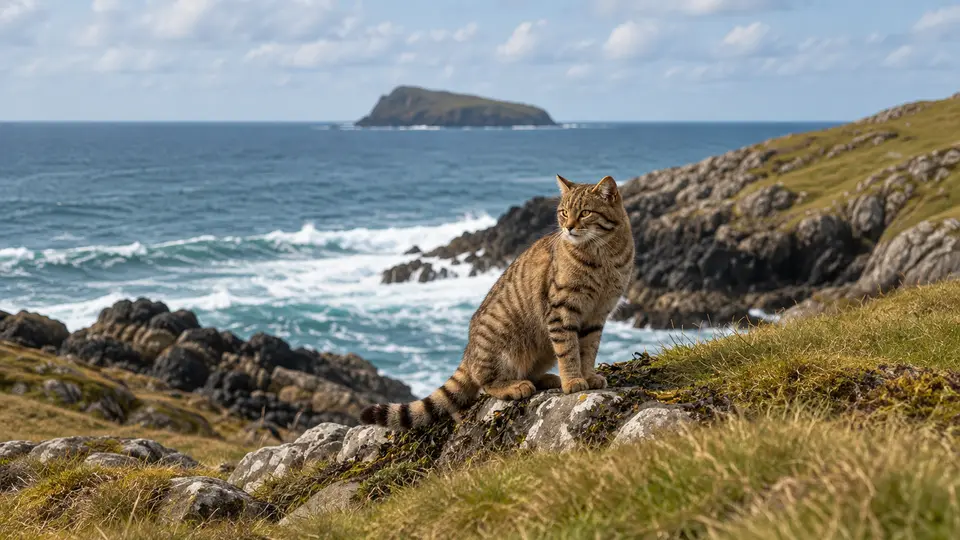
Scottish Wildcat in its natural habitat, AI illustration

Scottish WildcatFelis silvestrisWhere and when to see them

Scottish Wildcat at a glance

The Scottish wildcat is the Scottish population of the European wildcat, not a separate species with a secure independent global assessment. Although the species is globally listed as Least Concern, Scotland's population has suffered severe decline and extensive hybridization with domestic cats. Conservation now combines habitat management, domestic-cat neutering, captive breeding and carefully managed releases. A striped cat seen in the Highlands cannot automatically be assumed to be a genetically unadmixed wildcat.

Behaviour & reproduction

Size
45–65 cm head-and-body length
Weight
3–7 kg
Lifespan
Not reliably established
Status
Least Concern

Wildcats are mainly solitary and use scent marks to communicate across overlapping home ranges. Activity often peaks around dusk, night and dawn, although daytime movement occurs. They stalk prey through cover and use short rushes rather than prolonged pursuit. Females raise kittens in sheltered dens, while adults may alternate among resting places. Avoidance of people, low population density and resemblance to hybrids make reliable casual observations exceptionally difficult. They maintain relatively large home ranges, often several square kilometers, which are defended against other wildcats of the same sex. Females typically give birth to a litter of two to five kittens, which they raise alone until they become independent. Their crepuscular and nocturnal activity patterns are primarily an adaptation to hunting small mammals and avoiding human disturbance.

Top wildlife locations

Scotland wildlife habitat

Scotland

Highland woodland edges and rough grassland provide suitable habitat, but an inland excursion is required and genuine sightings are exceptionally rare. Release areas and den locations are not wildlife-viewing attractions.
Destinations describe the species' habitat, not guaranteed cruise stops. Some animals require an optional inland excursion or are found in restricted reserves.

Fun facts about the Scottish Wildcat

  • The Scottish population belongs to the same species as European wildcats on the continent.
  • Hybridization with domestic cats is a major conservation threat.
  • Wildcats communicate using scent deposited on prominent objects and travel routes.
  • Conservation breeding decisions can incorporate genetic evidence alongside coat characteristics.

Best time to see the Scottish Wildcat

There is no dependable public viewing season for Scottish wildcats. Longer spring and summer days improve access to suitable landscapes, but do not make encounters likely. Conservation restrictions and the welfare of released animals take priority over attempts to locate individuals. Public viewing opportunities are exceptionally rare due to their elusive nature and critically endangered status. Responsible ecotourism focuses on habitat preservation and supporting local conservation efforts rather than direct animal encounters. Therefore, there are no specific seasons recommended for 'viewing' them in the wild in the same way as other wildlife.

Scottish Wildcat: season matrix by destination

Travel and observation windows vary by region. Highlighted months are an orientation for planning, not confirmed sightings or a guarantee of access.

Scotland

No supported seasonal window offers dependable wild viewing; public access, conservation restrictions and individual movements outweigh general travel-season considerations.

JanFebMarAprMayJunJulAugSepOctNovDec
Cruise ships in Scotland

Where the Scottish Wildcat lives

A mosaic of woodland, scrub, rough grassland and sheltered edges provides hunting cover and resting sites. Wildcats are not simply animals of dense forest interiors. In Scotland, suitable landscapes are predominantly inland, often combining wooded valleys with more open feeding areas. They typically prefer areas with some form of cover, such as forestry plantations, gorse thickets, or rocky outcrops, which provide both hunting opportunities and refuge. Remnant ancient woodlands and native pinewoods are particularly valuable habitats for their unique structure and prey availability. Habitat fragmentation and loss pose significant threats to their already limited range in the Scottish Highlands.

What the Scottish Wildcat eats

Rabbits and small mammals are important prey, with voles, mice and other locally available animals contributing according to habitat. Birds and carrion may also be taken. As an obligate carnivore, the wildcat depends on animal food rather than seasonal fruit crops. Their hunting strategy involves stealth and patience, often ambushing prey rather than engaging in long chases. Due to their carnivorous nature, the health of wildcat populations is closely tied to the abundance of their main prey species. They are known to have powerful jaws and teeth adapted for tearing flesh, reflecting their specialist diet.

Species at a glance

Common name
Scottish Wildcat
Scientific name
Felis silvestris
Animal group
Mammals
Size
45–65 cm head-and-body length
Weight
3–7 kg
Lifespan
Not reliably established
Status
Least Concern
Identification
A thick, blunt, dark-ringed tail and distinct coat pattern suggest wildcat rather than domestic tabby, but appearance alone cannot exclude hybrid ancestry. Beyond the thick tail and pattern, a wildcat typically has a larger, more robust build than a domestic cat, with a broad head and strong jaws. Distinctive features often include clear, unbroken stripes on the flanks and legs, and a black tip to the tail that does not continue as a stripe up the back. Due to widespread hybridization, distinguishing pure wildcats from hybrids can require genetic testing or careful analysis of multiple physical characteristics by experts.

Scottish Wildcat: frequently asked questions

Where can I see the Scottish Wildcat?
Scotland. Do not bait cats, approach dens or seek confidential release locations. If a possible wildcat appears, remain distant, photograph without pursuit and report the record through an appropriate Scottish conservation recording scheme. Participating in citizen science projects that monitor wildcat populations can contribute to conservation without direct disturbance. Respecting all private property and conservation land access restrictions is crucial for their protection. Any potential sightings should be reported with detailed location information to allow for verification and data collection by conservationists.
When is the best time to see the Scottish Wildcat?
There is no dependable public viewing season for Scottish wildcats. Longer spring and summer days improve access to suitable landscapes, but do not make encounters likely. Conservation restrictions and the welfare of released animals take priority over attempts to locate individuals. Public viewing opportunities are exceptionally rare due to their elusive nature and critically endangered status. Responsible ecotourism focuses on habitat preservation and supporting local conservation efforts rather than direct animal encounters. Therefore, there are no specific seasons recommended for 'viewing' them in the wild in the same way as other wildlife.
How big does the Scottish Wildcat get?
45–65 cm head-and-body length. Adult weight: 3–7 kg. Size varies with age, sex and population.
How should I behave around the Scottish Wildcat?
Do not bait cats, approach dens or seek confidential release locations. If a possible wildcat appears, remain distant, photograph without pursuit and report the record through an appropriate Scottish conservation recording scheme. Participating in citizen science projects that monitor wildcat populations can contribute to conservation without direct disturbance. Respecting all private property and conservation land access restrictions is crucial for their protection. Any potential sightings should be reported with detailed location information to allow for verification and data collection by conservationists.
What does the Scottish Wildcat eat?
Rabbits and small mammals are important prey, with voles, mice and other locally available animals contributing according to habitat. Birds and carrion may also be taken. As an obligate carnivore, the wildcat depends on animal food rather than seasonal fruit crops. Their hunting strategy involves stealth and patience, often ambushing prey rather than engaging in long chases. Due to their carnivorous nature, the health of wildcat populations is closely tied to the abundance of their main prey species. They are known to have powerful jaws and teeth adapted for tearing flesh, reflecting their specialist diet.
Are wildlife sightings guaranteed on an adventure cruise?
No. Animals move freely and routes, weather, access restrictions and local conditions influence every outing. Confirm the actual itinerary and shore program before booking.

Compare wildlife in the same destinations

Explore other mammals recorded in these destinations. Similar surroundings do not mean the animals share the same habits or viewing season.

Species comparison by animal group and destination
Scottish WildcatScottish WildcatCommon Bottlenose DolphinCommon Bottlenose DolphinEurasian OtterEurasian Otter
Animal groupMammalsAnimal groupMammalsAnimal groupMammals
DestinationsScotlandDestinationsCosta Rica, Florida, Galapagos, Mexico, Cape Verde, Croatia, Greece, Portugal, Scotland, Seychelles, Turkey, Maldives, Australia, New ZealandDestinationsScotland, Turkey
All wildlife destinations
Plan your trip

Find your next wildlife adventure

Compare destinations, shore programs and dates with the animals and habitats you would love to see.

  • Naturalist-led shore excursions
  • Responsible wildlife watching
  • Small expedition ships

Newsletter

Take Blue Rides with you

Adventure cruise offers, last-minute deals and trip inspiration.

Free, unsubscribe anytime. Details: Privacy Policy

Partner with Blue Rides

Affiliate Program

Recommend adventure cruises and earn commission on every confirmed booking.

Share. Track. Earn.

Your footage, our stage

Send us your videos or pictures.

Captured remarkable nature or wildlife on your journey? Share it with us, we may feature it on Blue Rides.