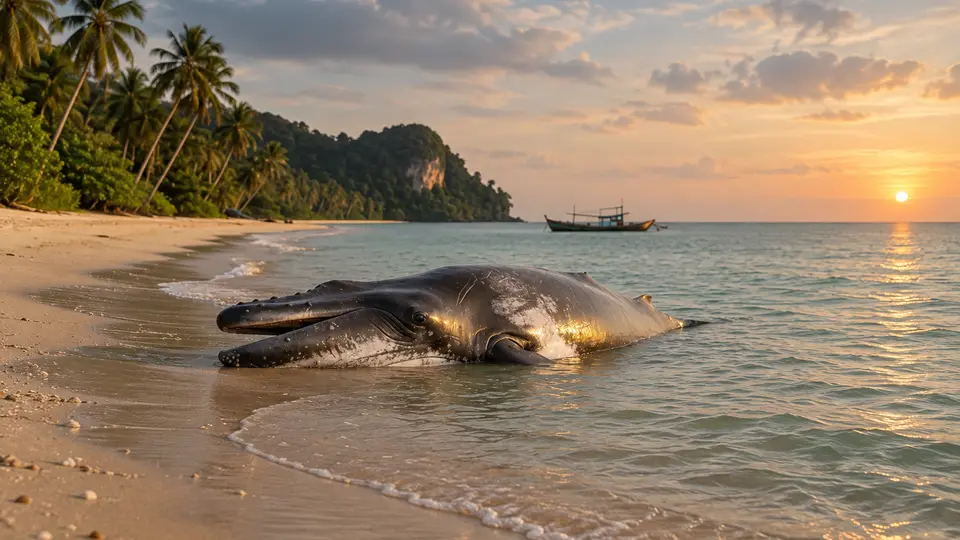
Omura's whale in its natural habitat, AI illustration

Omura's whaleBalaenoptera omuraiWhere and when to see them

Omura's whale at a glance

Omura's whale is a slender baleen whale formally described as a distinct species in 2003. Before then, many records were confused with other tropical rorquals, especially Bryde's whales. Its uneven head coloration and fine body proportions are useful clues, but identification remains difficult at sea. Records from Thailand demonstrate its presence, yet do not establish dependable viewing sites or seasons. Any visitor observation should be distant and confined to shore or a secure vessel deck.

Behaviour & reproduction

Size
9-12 m long
Weight
Not reliably established
Lifespan
Not reliably established
Status
Data Deficient

Studies of some populations show individuals feeding alone or in loosely spaced groups, sometimes remaining within relatively limited areas. These findings should not be assumed to describe every population. Like other rorquals, the whale expands its throat pleats to engulf prey-laden water and filters it through baleen. Surfacing sequences may be subtle, with a low blow and brief views of the back, making distant identification and photography challenging. Studies of some populations show individuals feeding alone or in loosely spaced groups, sometimes remaining within relatively limited areas. These findings should not be assumed to describe every population. Like other rorquals, the whale expands its throat pleats to engulf prey-laden water and filters it through baleen. Surfacing sequences may be subtle, with a low blow and brief views of the back, making distant identification and photography challenging. They are not known for dramatic aerial displays or prolonged surface activity, making encounters generally inconspicuous. Their quiet and elusive nature contributes to their historical obscurity and 'cryptic' reputation.

Top wildlife locations

Thailand wildlife habitat

Thailand

Verified records exist in Thai waters, but accessible headlands and ordinary coastal decks are not established reliable viewing sites. Shore sightings would be exceptional, and no inland excursion can improve this marine opportunity.

Destinations describe the species' habitat, not guaranteed cruise stops. Some animals require an optional inland excursion or are found in restricted reserves.

Fun facts about the Omura's whale

  • The species was formally described in 2003.
  • It is named in honor of Japanese cetologist Hideo Omura.
  • Its right and left head coloration are not symmetrical.
  • Some populations were recognized from live observations only well after the species was scientifically named.

Best time to see the Omura's whale

No well-supported seasonal window exists for routine shore or deck observation in Thailand. Calm seas can make any distant whale easier to detect, but regional travel weather is not evidence of Omura's whale presence. Current, verified local records are more useful than a calendar. No well-supported seasonal window exists for routine shore or deck observation in Thailand. Calm seas can make any distant whale easier to detect, but regional travel weather is not evidence of Omura's whale presence. Current, verified local records are more useful than a calendar. Given their apparent residency in some areas, any time of year could potentially offer sightings, although persistent observations are rare. Optimal viewing conditions are more dependent on sea state and observer effort than a specific season.

Omura's whale: season matrix by destination

Travel and observation windows vary by region. Highlighted months are an orientation for planning, not confirmed sightings or a guarantee of access.

Thailand

Available records do not support a dependable Thai shore-viewing season; calm-weather travel periods should not be presented as whale occurrence windows.

JanFebMarAprMayJunJulAugSepOctNovDec
Cruise ships in Thailand

Where the Omura's whale lives

Known records come mainly from tropical and subtropical waters of the Indian and western Pacific oceans, with additional records elsewhere. Some studied populations use coastal shelf waters. Distribution remains incompletely understood, and a coastal record does not establish a regularly occupied viewing location. Known records come mainly from tropical and subtropical waters of the Indian and western Pacific oceans, with additional records elsewhere. Some studied populations use coastal shelf waters. Distribution remains incompletely understood, and a coastal record does not establish a regularly occupied viewing location. While often found in shallow, nearshore waters, it is not strictly a coastal species and can also occur further offshore. Specific areas with observed individuals include parts of the Andaman Sea and Gulf of Thailand.

What the Omura's whale eats

Documented prey include small schooling fishes and planktonic crustaceans, with feeding ecology still poorly known across the range. Omura's whales use baleen to retain prey after engulfing water. It would be misleading to assign one universal dominant prey species to Thai waters. Documented prey include small schooling fishes and planktonic crustaceans, with feeding ecology still poorly known across the range. Omura's whales use baleen to retain prey after engulfing water. It would be misleading to assign one universal dominant prey species to Thai waters. Their diet appears to be generalized, adapting to local prey availability within their range. This flexibility allows them to exploit different schooling fish and invertebrate aggregations.

Species at a glance

Common name
Omura's whale
Scientific name
Balaenoptera omurai
Animal group
Marine life
Size
9-12 m long
Weight
Not reliably established
Lifespan
Not reliably established
Status
Data Deficient
Identification
A single central head ridge and asymmetric pale lower jaw help distinguish it from Bryde's whales with three head ridges, although distant views rarely permit certainty. A single central head ridge and asymmetric pale lower jaw help distinguish it from Bryde's whales with three head ridges, although distant views rarely permit certainty. Its relatively small size for a rorqual, typically up to 12 meters, is also a key distinguishing feature. The body is generally dark above and lighter below, with complex coloration patterns on the head that can aid in identification when visible.

Omura's whale: frequently asked questions

Where can I see the Omura's whale?
Thailand. Use binoculars from shore or an existing deck position without requesting pursuit. Do not encourage interception or feeding, and treat photographs as provisional identification evidence unless reviewed by a qualified specialist. Use binoculars from shore or an existing deck position without requesting pursuit. Do not encourage interception or feeding, and treat photographs as provisional identification evidence unless reviewed by a qualified specialist. Maintain a respectful distance to avoid disturbing individuals, especially given their generally shy nature. If a whale approaches, keep engines in neutral and avoid sudden movements.
When is the best time to see the Omura's whale?
No well-supported seasonal window exists for routine shore or deck observation in Thailand. Calm seas can make any distant whale easier to detect, but regional travel weather is not evidence of Omura's whale presence. Current, verified local records are more useful than a calendar. No well-supported seasonal window exists for routine shore or deck observation in Thailand. Calm seas can make any distant whale easier to detect, but regional travel weather is not evidence of Omura's whale presence. Current, verified local records are more useful than a calendar. Given their apparent residency in some areas, any time of year could potentially offer sightings, although persistent observations are rare. Optimal viewing conditions are more dependent on sea state and observer effort than a specific season.
How big does the Omura's whale get?
9-12 m long. Adult weight: Not reliably established. Size varies with age, sex and population.
How should I behave around the Omura's whale?
Use binoculars from shore or an existing deck position without requesting pursuit. Do not encourage interception or feeding, and treat photographs as provisional identification evidence unless reviewed by a qualified specialist. Use binoculars from shore or an existing deck position without requesting pursuit. Do not encourage interception or feeding, and treat photographs as provisional identification evidence unless reviewed by a qualified specialist. Maintain a respectful distance to avoid disturbing individuals, especially given their generally shy nature. If a whale approaches, keep engines in neutral and avoid sudden movements.
What does the Omura's whale eat?
Documented prey include small schooling fishes and planktonic crustaceans, with feeding ecology still poorly known across the range. Omura's whales use baleen to retain prey after engulfing water. It would be misleading to assign one universal dominant prey species to Thai waters. Documented prey include small schooling fishes and planktonic crustaceans, with feeding ecology still poorly known across the range. Omura's whales use baleen to retain prey after engulfing water. It would be misleading to assign one universal dominant prey species to Thai waters. Their diet appears to be generalized, adapting to local prey availability within their range. This flexibility allows them to exploit different schooling fish and invertebrate aggregations.
Are wildlife sightings guaranteed on an adventure cruise?
No. Animals move freely and routes, weather, access restrictions and local conditions influence every outing. Confirm the actual itinerary and shore program before booking.

Compare wildlife in the same destinations

Explore other marine life recorded in these destinations. Similar surroundings do not mean the animals share the same habits or viewing season.

Species comparison by animal group and destination
Omura's whaleOmura's whaleIndo-Pacific humpback dolphinIndo-Pacific humpback dolphin
Animal groupMarine lifeAnimal groupMarine life
DestinationsThailandDestinationsThailand
All wildlife destinations
Plan your trip

Find your next wildlife adventure

Compare destinations, shore programs and dates with the animals and habitats you would love to see.

  • Naturalist-led shore excursions
  • Responsible wildlife watching
  • Small expedition ships

Newsletter

Take Blue Rides with you

Adventure cruise offers, last-minute deals and trip inspiration.

Free, unsubscribe anytime. Details: Privacy Policy

Partner with Blue Rides

Affiliate Program

Recommend adventure cruises and earn commission on every confirmed booking.

Share. Track. Earn.

Your footage, our stage

Send us your videos or pictures.

Captured remarkable nature or wildlife on your journey? Share it with us, we may feature it on Blue Rides.

