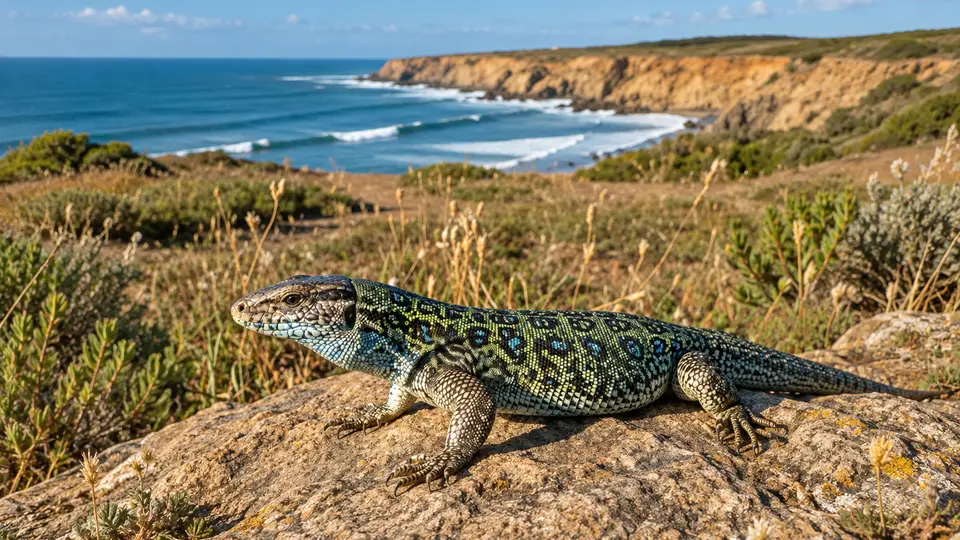
Ocellated Lizard in its natural habitat

Ocellated LizardTimon lepidusWhere and when to see them

Ocellated Lizard at a glance

The ocellated lizard is one of Europe's largest lizards, notable for the bright blue spots along its flanks. It occurs across much of the Iberian Peninsula and parts of southern France, with related species elsewhere in the western Mediterranean. In Portugal it is associated with sunny, structurally varied landscapes rather than dense closed forest. Although conspicuous when basking, it can vanish quickly into a rock pile, burrow or stone wall.

Behaviour & reproduction

Size
40-60 cm total length
Weight
Not reliably established
Lifespan
Not reliably established
Status
Near Threatened

Ocellated lizards regulate body temperature by moving between sunny basking places and sheltered retreats. They forage actively on the ground, pausing to investigate vegetation, stones and crevices. Males can be territorial, especially during the reproductive period, and may display or fight. Activity shifts with temperature: spring warmth encourages basking, whereas intense summer heat can concentrate visible activity into morning and later afternoon, with long periods spent concealed. They are diurnal and heliothermic, relying heavily on external heat sources to regulate their body temperature. During mating season, males perform head-bobbing displays and chase rivals to defend prime territories and access to females. When threatened, they may attempt to escape into dense cover or burrows, but can also stand their ground and display an open mouth, hissing as a warning.

Top wildlife locations

Portugal wildlife habitat

Portugal

Sunny coastal scrub, rocky path margins and traditional stone-walled farmland offer plausible land-based viewing. Inland excursions may improve habitat access, while urban waterfronts are unsuitable and individuals can be difficult to detect.

Destinations describe the species' habitat, not guaranteed cruise stops. Some animals require an optional inland excursion or are found in restricted reserves.

Fun facts about the Ocellated Lizard

  • The blue flank spots give the species its English name.
  • Adults can eat fruit as well as animal prey.
  • Mammal burrows may serve as ready-made shelters.
  • Like many lizards, it can shed its tail, although regrowth is not identical to the original.

Best time to see the Ocellated Lizard

April through June often offers useful basking conditions in Portugal, with another possible activity window in September and October. Local temperature and elevation matter. Midsummer remains possible, but extreme heat can reduce daytime visibility, while winter activity is much less dependable. In southern Portugal, favorable conditions can extend further into autumn due to milder climates. During peak summer, activity often becomes crepuscular, focusing on early morning and late afternoon to avoid the most intense heat. Winter months see individuals enter a period of brumation, often seeking deeper, protected refuges.

Ocellated Lizard: season matrix by destination

Travel and observation windows vary by region. Highlighted months are an orientation for planning, not confirmed sightings or a guarantee of access.

Portugal

These months often provide moderate temperatures for visible activity; weather, latitude and elevation can shift the window substantially.

JanFebMarAprMayJunJulAugSepOctNovDec
Cruise ships in Portugal

Where the Ocellated Lizard lives

They inhabit open scrub, grassland, traditional farmland, orchards and rocky slopes with abundant shelter. Dry-stone walls, mammal burrows and stone heaps can provide refuges. Some coastal landscapes are suitable, but bare beaches and heavily developed seafronts generally lack the necessary cover. They show a preference for Mediterranean evergreen and deciduous woodland edges, particularly where there is a mosaic of sun-exposed areas and dense vegetation. While adaptable, suitable habitat patches in Portugal are often fragmented by intense agriculture and urbanization. These lizards also utilize abandoned buildings and ruins as sources of shelter and basking sites.

What the Ocellated Lizard eats

Large insects, especially beetles, are important prey, supplemented by other invertebrates. Adults also take fruit and occasionally small vertebrates or eggs. This broad diet changes with local availability, but the species should not be portrayed primarily as a predator of birds or mammals. Juveniles primarily feed on smaller invertebrates, gradually expanding their diet as they grow. They are important consumers of pest insects in agricultural areas, providing a valuable ecological service. Their opportunistic feeding means they will consume almost any invertebrate they can subdue.

Species at a glance

Common name
Ocellated Lizard
Scientific name
Timon lepidus
Animal group
Reptiles
Size
40-60 cm total length
Weight
Not reliably established
Lifespan
Not reliably established
Status
Near Threatened
Identification
Its large build and rows of blue flank ocelli distinguish it from Portugal's smaller wall lizards and the more uniformly green Iberian emerald lizard. The intensity of their blue ocelli can vary between individuals and populations, but they are always a prominent feature. Younger individuals often display more pronounced ocelli than older adults. Some individuals may have a more greenish body coloration, especially in certain habitats, but the ocelli remain distinctive.

Ocellated Lizard: frequently asked questions

Where can I see the Ocellated Lizard?
Portugal. Scan sunny rocks and wall edges from paths before approaching. Do not lift stones or block burrows; a cornered lizard can bite strongly, so avoid handling and let it retreat. Their cryptic coloration can make them difficult to spot even when active; patient scanning is often required. Listen for rustling in dry leaf litter or vegetation, as this can indicate a lizard moving. Maintain a respectful distance to avoid disturbing their natural behavior.
When is the best time to see the Ocellated Lizard?
April through June often offers useful basking conditions in Portugal, with another possible activity window in September and October. Local temperature and elevation matter. Midsummer remains possible, but extreme heat can reduce daytime visibility, while winter activity is much less dependable. In southern Portugal, favorable conditions can extend further into autumn due to milder climates. During peak summer, activity often becomes crepuscular, focusing on early morning and late afternoon to avoid the most intense heat. Winter months see individuals enter a period of brumation, often seeking deeper, protected refuges.
How big does the Ocellated Lizard get?
40-60 cm total length. Adult weight: Not reliably established. Size varies with age, sex and population.
How should I behave around the Ocellated Lizard?
Scan sunny rocks and wall edges from paths before approaching. Do not lift stones or block burrows; a cornered lizard can bite strongly, so avoid handling and let it retreat. Their cryptic coloration can make them difficult to spot even when active; patient scanning is often required. Listen for rustling in dry leaf litter or vegetation, as this can indicate a lizard moving. Maintain a respectful distance to avoid disturbing their natural behavior.
What does the Ocellated Lizard eat?
Large insects, especially beetles, are important prey, supplemented by other invertebrates. Adults also take fruit and occasionally small vertebrates or eggs. This broad diet changes with local availability, but the species should not be portrayed primarily as a predator of birds or mammals. Juveniles primarily feed on smaller invertebrates, gradually expanding their diet as they grow. They are important consumers of pest insects in agricultural areas, providing a valuable ecological service. Their opportunistic feeding means they will consume almost any invertebrate they can subdue.
Are wildlife sightings guaranteed on an adventure cruise?
No. Animals move freely and routes, weather, access restrictions and local conditions influence every outing. Confirm the actual itinerary and shore program before booking.

Compare wildlife in the same destinations

Explore other reptiles recorded in these destinations. Similar surroundings do not mean the animals share the same habits or viewing season.

Species comparison by animal group and destination
Ocellated LizardOcellated LizardLeatherback Sea TurtleLeatherback Sea TurtleLoggerhead Sea TurtleLoggerhead Sea Turtle
Animal groupReptilesAnimal groupReptilesAnimal groupReptiles
DestinationsPortugalDestinationsFlorida, PortugalDestinationsFlorida, Cape Verde, Croatia, Greece, Portugal, Turkey
All wildlife destinations
Plan your trip

Find your next wildlife adventure

Compare destinations, shore programs and dates with the animals and habitats you would love to see.

  • Naturalist-led shore excursions
  • Responsible wildlife watching
  • Small expedition ships